Kingdom
UNESCO: “Moroccan Handicrafts” Celebrated in Paris as a Living Heritage “in Motion”
Presented at UNESCO headquarters in Paris, the book “Moroccan Handicrafts: A Heritage in Motion” highlights the richness, diversity, and adaptability of the Kingdom’s artisanal know-how. The result of joint work between the Secretariat of State in charge of Handicrafts and UNESCO, this book forms part of an effort to safeguard, transmit, and promote a living national heritage, deeply rooted in Moroccan cultural identity.

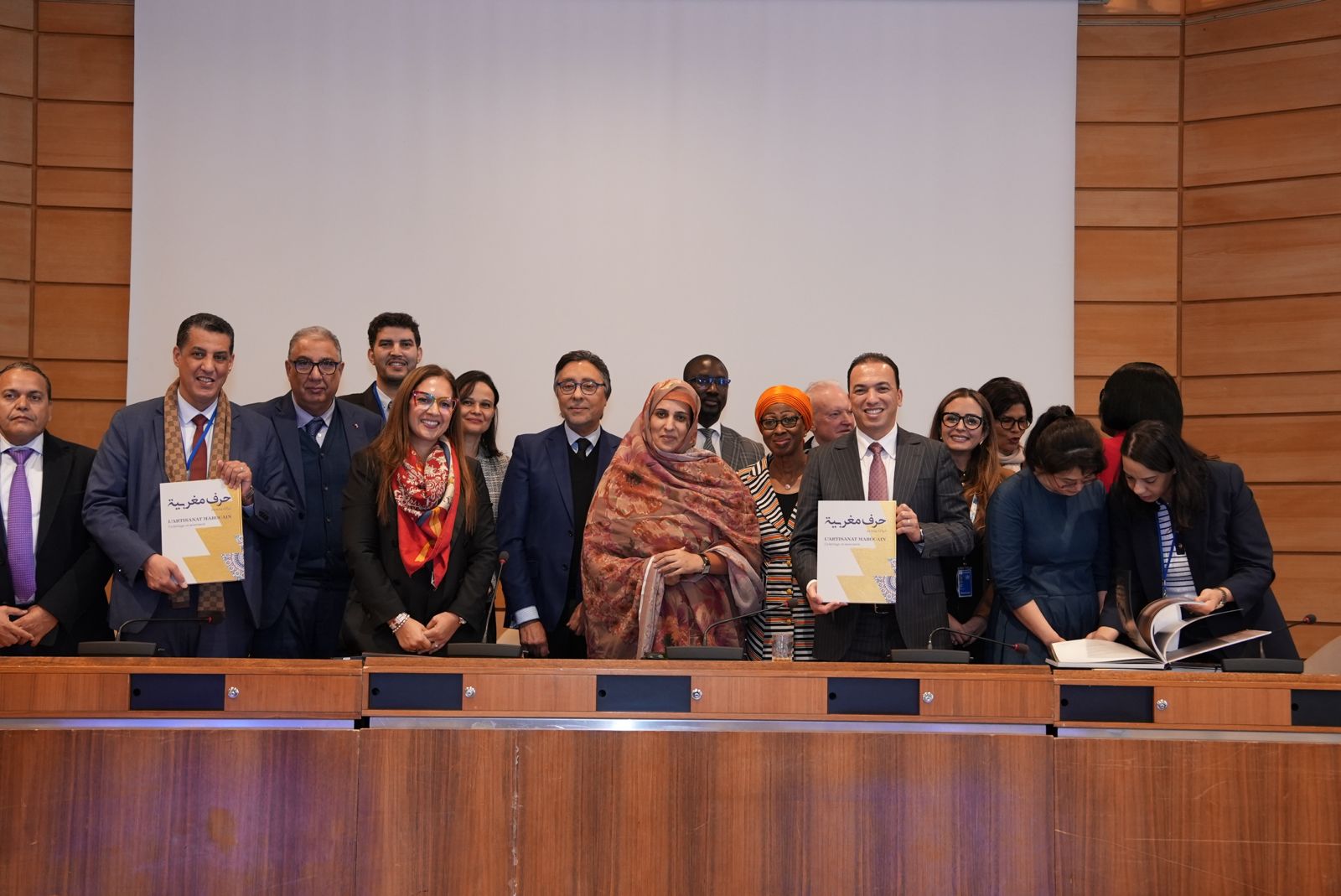
The book entitled “Moroccan Handicrafts, a Living Heritage in Motion,” dedicated to safeguarding endangered artisanal know-how, was presented on Tuesday at the headquarters of the United Nations Educational, Scientific and Cultural Organization (UNESCO) in Paris, in the presence of a host of institutional, diplomatic, and cultural figures.
Produced jointly by the Secretariat of State in charge of Handicrafts and the Social and Solidarity Economy and UNESCO, as part of the “Treasures of Moroccan Traditional Arts” program—aimed in particular at documenting authentic artisanal know-how and ensuring its continuity—this book is intended as a tool for documentation, transmission, and for showcasing the richness and diversity of Moroccan handicrafts.
It reflects a collective approach to rehabilitating several traditional trades, shaped by a balanced interaction with the four natural elements—earth, water, air, and fire—which have given Moroccan crafts their distinctive character, symbolic depth, and strong identity-bearing dimension.
The book also highlights the importance of safeguarding this artisanal heritage, anchoring documentation and historiography as pillars of transmission, and establishing handicrafts as a living and continually renewed national heritage.
In a statement to the press on this occasion, the Ambassador and Permanent Delegate of the Kingdom of Morocco to UNESCO, Samir Addahre, stressed that presenting this book at UNESCO is a moment of particular importance for the Kingdom.
He welcomed the event, which offered all 194 Member States of the UN organization the opportunity to better learn about Moroccan handicrafts, their richness, and their historical depth.
Samir Addahre also emphasized the book’s pioneering nature, as it incorporates social, economic, reintegration, and sustainable-development dimensions—an experience intended to be replicated in other countries.
For his part, the Secretary of State in charge of Handicrafts and the Social and Solidarity Economy, Lahcen Saâdi, indicated that this book represents the culmination of in-depth joint work between his department and UNESCO.
The book, he continued, constitutes a major cultural milestone in the process of safeguarding and promoting the national artisanal heritage, noting that it is not limited to documenting traditional trades threatened with disappearance, but also offers an analytical approach that makes handicrafts an object of cultural reflection, a lever for raising awareness of their civilizational value, and a solid bridge between tradition and modernity.
In this regard, he highlighted the ability of Moroccan crafts to evolve and adapt to contemporary changes without renouncing their original spirit or their deeply rooted identity.
For his part, UNESCO’s Assistant Director-General for Culture, Ernesto Ottone Ramirez, welcomed the publication of the book, stressing that it invites readers to discover the many facets of Morocco’s rich cultural heritage and its living expressions.
He further underscored the importance of supporting handicrafts, specifying that doing so promotes sustainable livelihoods, strengthens social inclusion, and contributes to communities’ resilience in the face of economic, social, and health challenges.
He also recalled that, within the framework of the 2003 Convention for the Safeguarding of the Intangible Cultural Heritage, UNESCO upholds the conviction that heritage-related know-how is not merely a remnant of the past, but a living expression of humanity’s history.
The event was also an opportunity to discover, through live demonstration workshops, several Moroccan crafts, including zellige, tapestry-making, embroidered saddlery, and tent weaving, highlighting the richness of national know-how, the finesse of its techniques, and its capacity for innovation.
The ceremony concluded with a Moroccan caftan fashion show, an emblematic symbol of national elegance and an artistic expression of the convergence between artisanal creativity and the Kingdom’s civilizational vision, in a festive atmosphere reflecting the central place handicrafts occupy in preserving national identity and enhancing Morocco’s cultural influence.