Business
Morocco-Spain: The Great Rebalancing
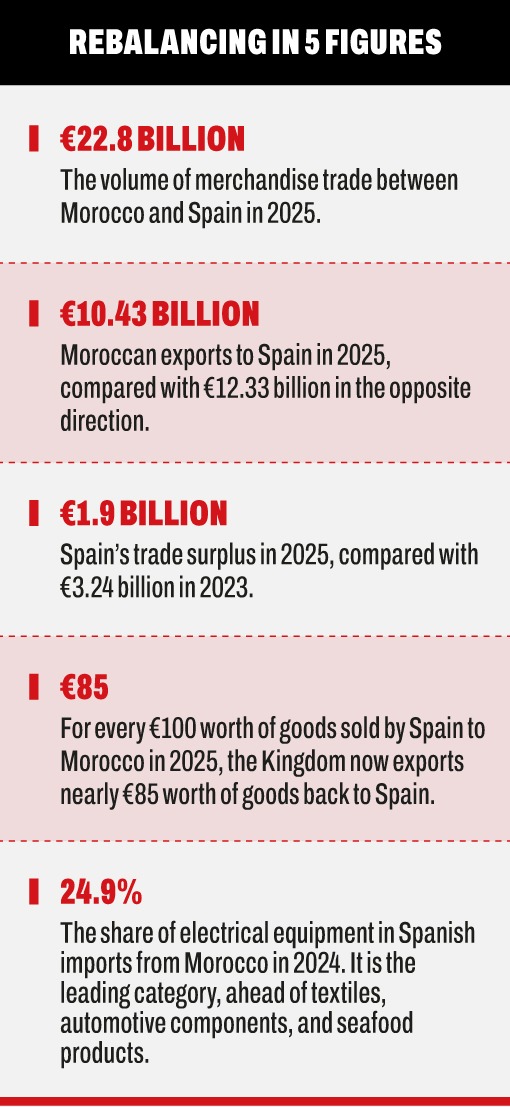
The trade between the two countries reached nearly €22.8 billion in 2025. Behind this record, the trade gap is narrowing while Moroccan exports are gaining industrial weight.

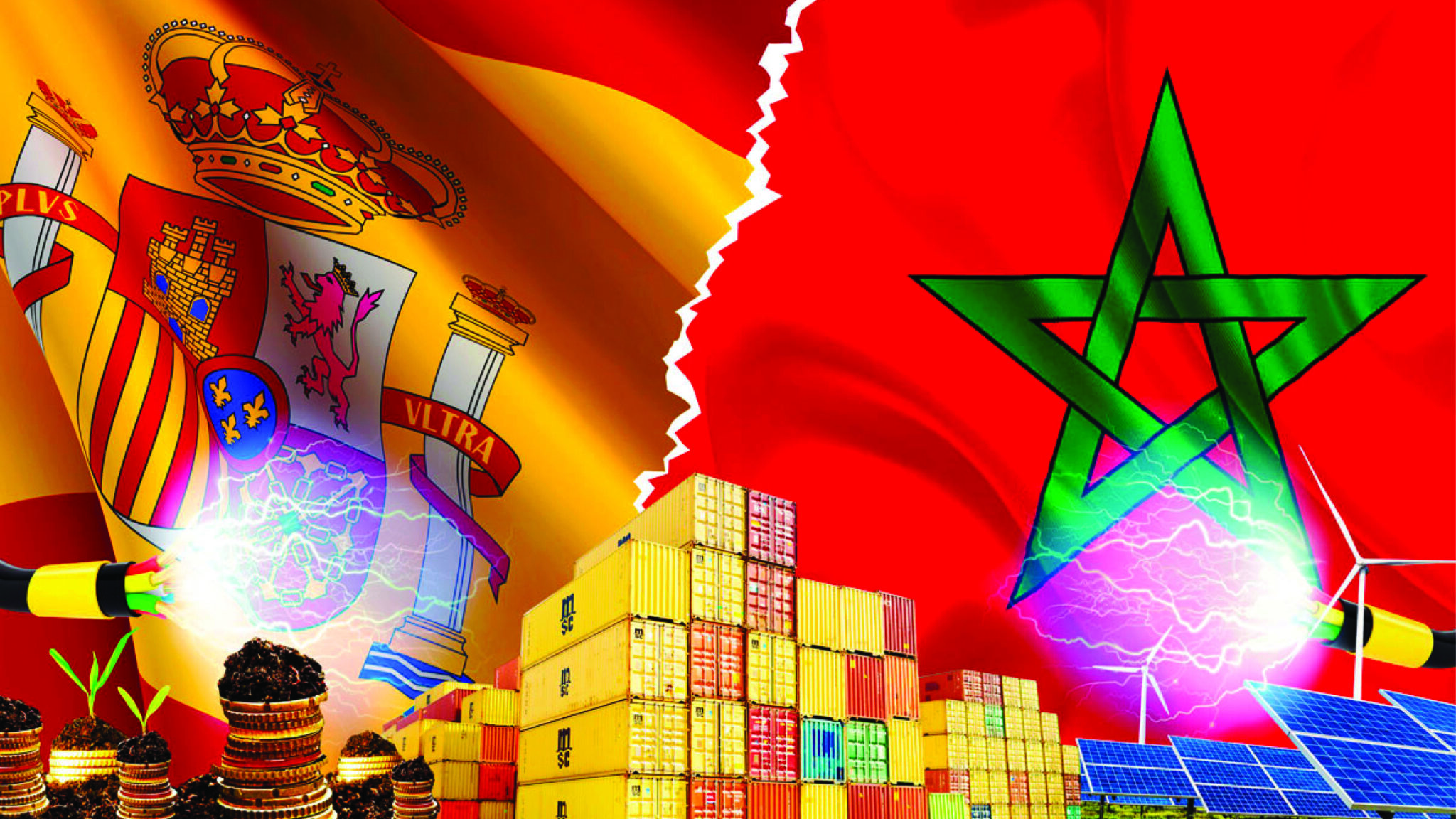
The proximity between Morocco and Spain has long been analyzed from a political, migratory or security perspective. Yet, on the other side of the Strait, a more structural transformation is underway: behind the growth in trade, its distribution and, above all, its content are evolving.
Spain retains the advantage. In 2025, it exported €12.33 billion worth of goods to Morocco, compared with €10.43 billion in the opposite direction. Its surplus thus reached approximately €1.9 billion.
But the trajectory is more revealing than the snapshot. In 2023, Spain exported €12.28 billion to Morocco and imported €9.05 billion. Two years later, its sales were virtually stable, while Moroccan exports had increased by approximately 15%.
As a result, the Spanish surplus fell from €3.24 billion in 2023 to €1.9 billion in 2025, a contraction of more than 40% in two years.
Another indicator: for every €100 worth of goods exported by Spain to Morocco, the Kingdom sold it approximately €74 worth in 2023, compared with nearly €85 in 2025. Balance has not been achieved, but the gap has narrowed considerably.
This trend is not, however, linear. Between 2011 and 2018, Spanish exports to Morocco rose from approximately €4.1 billion to €8.2 billion, while Moroccan sales to Spain increased from €3.1 billion to €6.7 billion.
After a relative decline following the pandemic, the movement has accelerated recently. The Spanish coverage ratio, around 136% in 2023, fell to 130.8% in 2024, then to 118.3% in 2025.
For economic analyst Youssef Guerraoui Filali, this evolution must be read beyond volumes: “The challenge for Morocco is not simply to increase the volume of trade, but to improve its structure and added value. We need to move from a logic of simply intensifying trade to a logic of qualitative rebalancing of trade.”
From Rebalancing to Interdependence
The most significant transformation is, in fact, found in the composition of trade. The image of a Morocco supplying Spain mainly with agricultural products, textiles or seafood corresponds less and less to reality.
In 2024, electrical equipment accounted for 24.9% of Spanish imports from Morocco, ahead of women’s clothing (12.5%), automotive equipment and components (9.5%) and seafood products (8.8%).
This specialization is not new: as early as 2020, electrical appliances already accounted for more than a quarter of Spanish imports from the Kingdom.
The current growth therefore rests on an established industrial base, particularly in wiring, electrical equipment and the automotive industry. Rebalancing is thus not solely the result of a quantitative increase in Moroccan exports. It also reflects the place the Kingdom has taken in certain European industrial value chains.
Spain sells Morocco automotive components, fabrics, electrical equipment, machinery and intermediate goods. Morocco processes or incorporates some of these inputs before re-exporting them to the European market. In textiles as well as in the automotive industry, flows now circulate in both directions.
The Strait therefore no longer simply separates a producer from a consumer: it connects different stages of the same production chain.
For Guerraoui Filali, “the real question is not how to reduce Moroccan imports, but how to transform the very structure of our economic relationship.”
The challenge is to move “from commercial interdependence toward genuine industrial interdependence,” based in particular on the integration of Moroccan suppliers, technology transfer and moving upmarket.
This evolution blurs the traditional reading of the trade balance: a Moroccan import from Spain can feed production that is subsequently exported to Spain or another European market.
This rebalancing does not therefore diminish Morocco’s importance to the Spanish economy. In 2025, 54.9% of Spanish exports destined for Africa went to the Kingdom, which became Spain’s ninth-largest customer worldwide and its third-largest market outside the EU.
The relationship extends beyond major groups: in 2024, 15,588 Spanish companies exported to Morocco, including 6,329 on a regular basis.
For Morocco too, Spain remains indispensable. Approximately 76% of Spanish exports to the Kingdom in 2024 consisted of industrial and technological products, which directly supply its productive apparatus.
Rebalancing therefore means neither decoupling nor substitution. Paradoxically, it rests on increased interdependence. In the long term, it will be measured as much by the trade balance as by Morocco’s ability to increase the value created locally and to gain greater control over strategic segments.
The relationship is therefore entering a new phase. Spain retains a surplus and remains an essential supplier, but Morocco is narrowing the gap and gradually changing the content of its exports.
The question will soon no longer be simply which of the two countries sells more to the other, but what share of their future growth they will be able to build together. Behind the rebalancing, the next stage is already taking shape: co-production.