Kingdom
The Winning Formula of Cash Plus
Following strong financial results in 2025 and its IPO, which attracted more than 81,000 subscribers (investors), the group now claims a positioning on the verge of banking. Insight.

The launch of QR code payments by Cash Plus is taking place in a context of strong momentum, marked by the implementation of the Competition Council’s decision to end the monopoly of the Interbank Electronic Banking Center (CMI) over electronic card payments (POS terminals, PEL).
Following this unprecedented decision, several payment institutions have launched merchant acquiring activities, notably through payment terminals (POS) made available to retailers.
“While many payment institutions are relying on traditional bank POS terminals, Cash Plus has made a deliberate choice, based on the belief that the future of proximity payments in Morocco will rely on less costly and easier-to-use methods, including mobile (which everyone has) and QR codes, which have become popular among Moroccans since Covid-19,” explains Nabil Amar, CEO of Cash Plus.
The head of the company listed on the Casablanca Stock Exchange is unequivocal: neighborhood grocery stores represent the country’s primary local financial infrastructure.
As a result, these popular businesses deserve a solution specifically designed for them, rather than one adapted from another model (POS, PEL). In short, Cash Plus clearly embraces the choice of offering mobile payments to neighborhood retail businesses.
Simplicity above all
When asked how the digital solution designed for merchants and their customers works, our interlocutor replies: it is extremely simple.
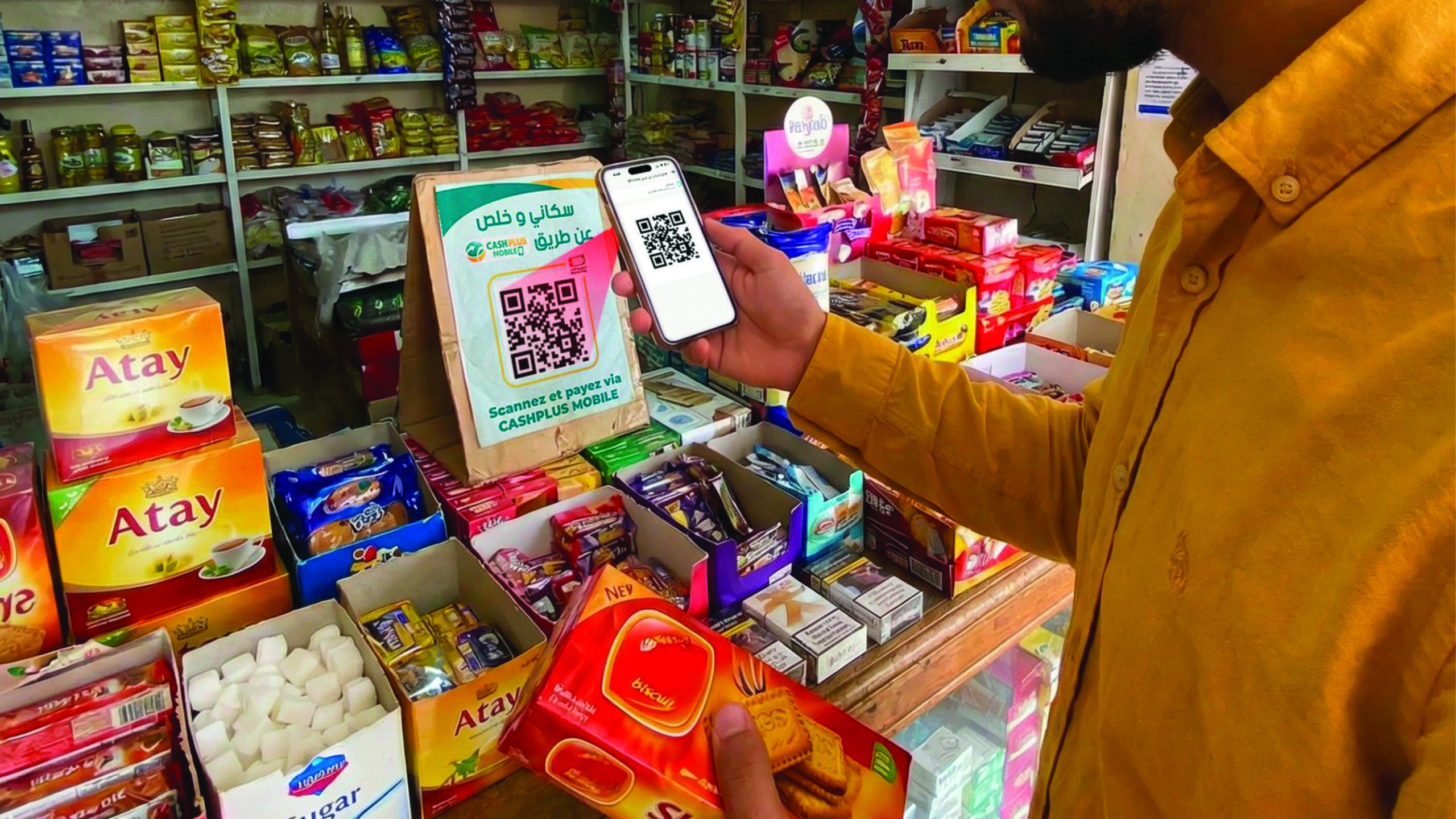
In detail, a QR code in sticker form placed at the checkout (or in a visible spot in the shop) allows the customer to scan it via the Cash Plus Mobile application, previously installed, and enter the amount communicated by the shopkeeper after the purchase.
The payment is made instantly, and the retailer immediately receives the funds in their Cash Plus wallet. It should be noted that the solution, deployed since January 2026 (and adopted by more than 12,000 merchants in Morocco), ensures interoperability with wallets from other payment institutions.
For example, a customer may have a wallet under the Maroc Pay brand, rather than Cash Plus, without this hindering payment via QR code.
No investment required
Unlike traditional solutions requiring electronic payment terminals, the QR code payment launched by Cash Plus does not require any specific equipment, apart from a smartphone.
“No investment is required from the merchant,” Amar emphasizes, also highlighting the other advantages of the new solution, which is equally suited to cafés, small businesses, and independent vendors.
To encourage adoption among merchants, the system includes free cash withdrawals at agencies for this category, which sometimes operates with tight margins. On the customer side, Cash Plus offers instant cashback.
For example, for a QR code payment of 30 dirhams, the customer receives an immediate 5% cashback in their wallet. According to our interlocutor, neighborhood businesses (acting as promoters of the solution to customers) show real interest in this digital payment method.
For now, the objective set by this promoter of financial inclusion in Morocco is to onboard nearly 60,000 merchants nationwide. This critical mass should accelerate the use of QR code payments, developed by Cash Plus’s internal teams.
The tech bet
The group, which relies on a large network of 5,200 agencies, has clearly chosen to invest in its own talent in order to build and fully control its entire technological infrastructure in-house (mobile application, wallet, real-time payment systems, etc.).
This technological approach has enabled the Casablanca-listed company to quickly implement the QR code payment solution, adopted by more than 12,000 merchants in just two months. Beyond this new solution, Amar also shed light on Cash Plus’s ambitions and next steps in fintech.
“Our immediate priority remains mobile payment. The goal is not limited to equipment; ultimately, we want QR code payment to become a daily reflex for neighborhood businesses,” our source explains.
In the same vein, Cash Plus’s medium-term ambition is to establish itself as a leader in payments in Morocco, particularly for local businesses, with value-creating services for customers and partners.
2 million account holders
More than just a money transfer and reception service, Cash Plus is now strengthening its position as a leading fintech through its technological infrastructure, combined with extensive territorial coverage (a dense network of physical agencies). This clearly represents a strength in terms of business diversification (proximity services).
Amar proudly states that the Moroccan listed fintech now has more than 2 million account holders.
In addition, more than 1.5 million Moroccans receive monthly state social aid via the fintech’s infrastructure, which recorded a 14% increase in net banking income (NBI), reaching 863 million dirhams in 2025, along with double-digit growth in net income attributable to the group (RNPG), reaching 242 million dirhams.
In short, the company—which also participated in the national livestock reconstitution program in 2025 by distributing aid to breeders (payment accounts)—is now a key partner of the State.
On the verge of becoming a bank
After strong financial results in 2025 and its IPO, which attracted more than 81,000 subscribers (investors), Cash Plus in 2026 claims a position on the verge of banking (account opening, payment methods, cash withdrawals by card, etc.), even though it does not yet offer loans.
Still within the banking sphere, it should be noted that the group collaborates with all banks in the market and does not rule out positioning itself in the future in the bank credit distribution market in Morocco. That said, last year’s performance undeniably confirms the acceleration of Cash Plus’s transformation.
As a reminder, although money transfers remained the main revenue driver in 2025, with 940 million dirhams in commissions (+11%), the payment accounts segment is the most dynamic, with commission growth of 32% (reaching 275 million dirhams in 2025).