Kingdom
Morocco-Senegal: Revitalized Cooperation
Rabat and Dakar want to breathe new momentum into their bilateral cooperation. The numerous agreements signed during the latest Joint Commission should stimulate their exchanges and strengthen a partnership held up as a model on the continent.

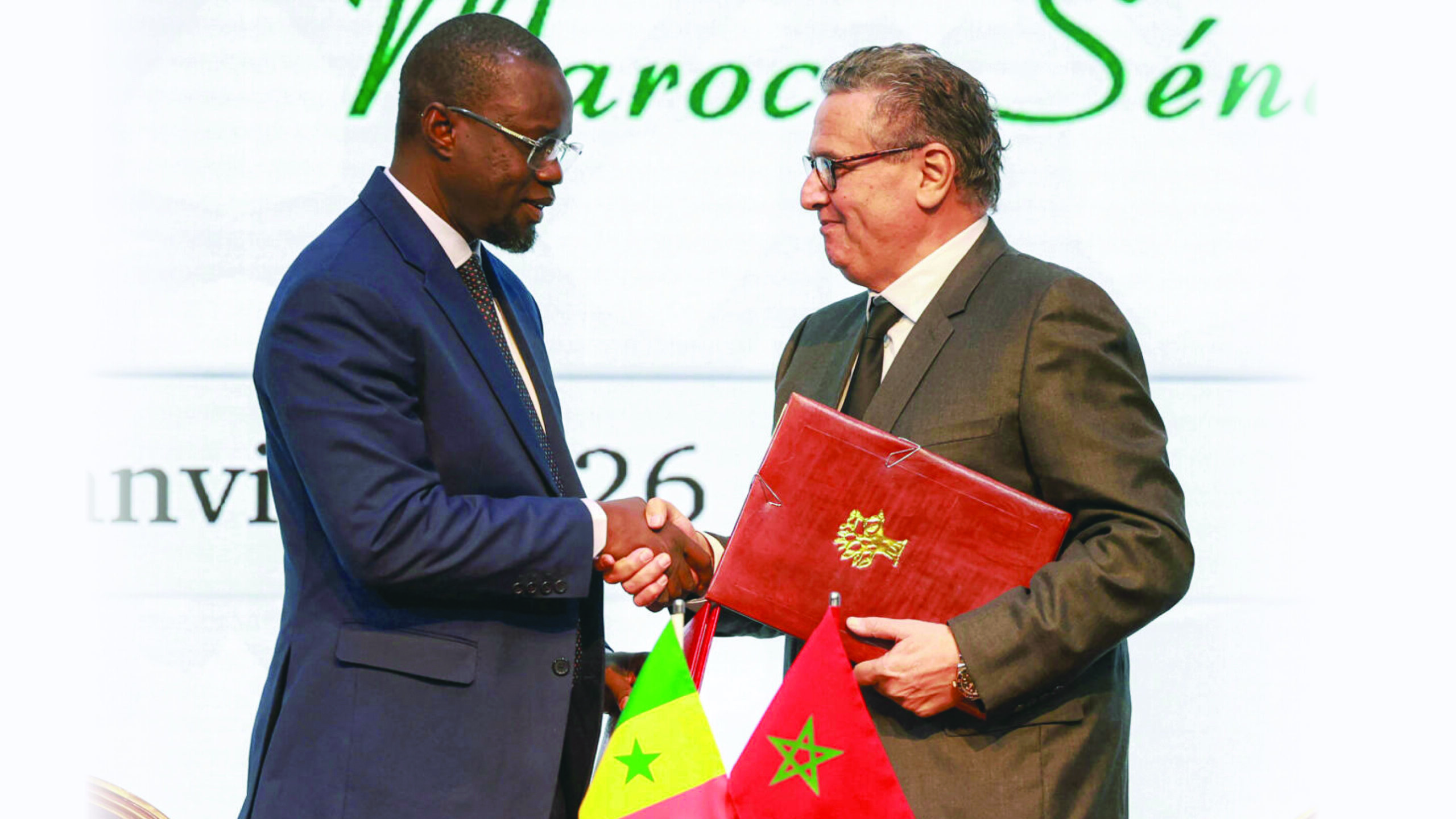
A flurry of agreements, shared challenges, and investment pledges marked the 15th Major Joint Cooperation Commission between Morocco and Senegal, held on January 26 and 27.
This event was rich in outcomes and helped consolidate longstanding and diversified relations, solidly anchored over time and circumstances. The last meeting of this kind dated back to 2013, making this reunion particularly symbolic for Rabat and Dakar.
The tone for this bilateral meeting was set by the two heads of government, who highlighted the depth and durability of bilateral relations.
“Morocco and Senegal are linked by a durable and diversified investment relationship,” stated Aziz Akhannouch. For his Senegalese counterpart, Ousmane Sonko, the economic and commercial cooperation, already very dynamic, can be raised to a higher level.
“Senegal reaffirms its constant commitment to work tirelessly to strengthen and broaden cooperation with Morocco, in the spirit of the cultural, spiritual, and historical ties uniting the two peoples and in the supreme interest of both countries,” he affirmed.
17 agreements in strategic sectors
He also specified that Senegal could count on Morocco as a reliable partner to achieve its development goals, including the national transformation agenda “Senegal 2050.” Beyond declarations, the meeting was concrete: 17 cooperation agreements and partnerships along with memoranda of understanding were signed.
In the diplomatic field, Ministers Nasser Bourita and Cheikh Niang signed several conventions, including a memorandum of understanding concerning the establishment of a mechanism for consular consultations, a draft memorandum of understanding in the field of youth, and an implementation protocol for the agreement on international road transport of passengers and goods.
Industrial and commercial cooperation was also strengthened. The memorandum of understanding on the development of small and medium-sized enterprises (SMEs), the cooperation agreement in industrial infrastructure, and the memorandum of agreement on standardization illustrate the two countries’ desire to stimulate their economic exchanges.
These agreements come at a time when Senegal is entering a new phase of development, particularly in oil, gas, and special economic zones.
Developing agriculture and the maritime economy
Agriculture, a pillar of the national transformation agenda “Senegal 2050,” was at the center of discussions. Senegal wishes to benefit from Moroccan expertise, through the agreement concerning the development of animal sectors, animal health, and food safety.
Minister of Agriculture Ahmed El Bouari and Senegalese Minister of Economy, Planning, and Cooperation Abdourahmane Sarr signed a cooperation agreement for the sanitary control of fisheries and aquaculture products. Maritime cooperation between the two countries should also accelerate.
Senegal plans to draw inspiration from Moroccan successes in this area to develop major port infrastructure, such as the future deep-water port of Ndayane, located 50 km from Dakar. The partnership and cooperation agreement between the National Ports Agency (ANP) and the Dakar Autonomous Port (PAD) fully aligns with this ambition.
In the higher education sector, an implementation program for the period 2026-2028 was signed, confirming the two nations’ desire to strengthen scientific and academic exchanges.
Strengthening economic exchanges
On the sidelines of the Joint Commission, an economic forum was organized on January 27 in Casablanca, bringing together the business communities of the two countries and chaired by the two heads of government. “Senegal is for Moroccan companies a natural gateway to West Africa. But it is above all a major partner on the continent: in the first ten months of 2025, trade between our two countries nears 300 million dollars,” Akhannouch emphasized.
For Ousmane Sonko, the commercial relationship must go further: “We want to move from an economic relationship still largely centered on trade flows to one based on productive complementarity, co-production, local transformation, and the integration of our respective value chains.”
Chakib Alj, President of the CGEM, recalled that “Moroccan exports to Senegal exceeded 4 billion dirhams in 2024, while Moroccan imports more than doubled to reach nearly 600 million dirhams.” According to him, Moroccan operators are ready to invest more, in partnership with local companies, in a win-win spirit. “The Morocco-Senegal Economic Impulse Group has a key role to play in this regard. It must be a tool for acceleration, to move more quickly from intention to action, identify concrete projects, remove obstacles, and accelerate the deployment of investments,” he recommended.
For Pierre Goudiaby Atepa, President of the Senegal Investors Club, the business environment is very attractive: “Senegal shows a sustained growth dynamic with a growth rate of 7.8% in 2025, reflecting a rapid expansion of the economy over the last decade. This trajectory is accompanied by contained inflation, projected at about 1.2% in 2025.”
He added: “Moroccan companies investing in Senegal are an integral part of our economic ecosystem and they operate as if at home, in a spirit of partnership, mutual respect, and reciprocal trust.”
Investments: 36 Moroccan projects approved in Senegal
Over the years, Moroccan companies have significantly contributed to Senegal’s development.
According to Bakary Sega Bathily, Director General of the Agency for Investment Promotion and Major Projects (Apix), “36 Moroccan projects have been approved in Senegal between 2010 and 2025, for a cumulative amount of approximately 320 million dollars, leading to the creation of nearly 1,900 jobs. These investments mainly concern port infrastructure, agro-industry, poultry farming, and construction materials.” A dynamic that will be reinforced by the new agreements focused on a win-win partnership.