International
Morocco–Egypt: Toward a Strategic Partnership
The holding of the first session of the Morocco–Egypt Coordination and Monitoring Committee serves as a prelude to a new era of bilateral cooperation. Aziz Akhannouch outlined its framework and the avenues for its implementation.

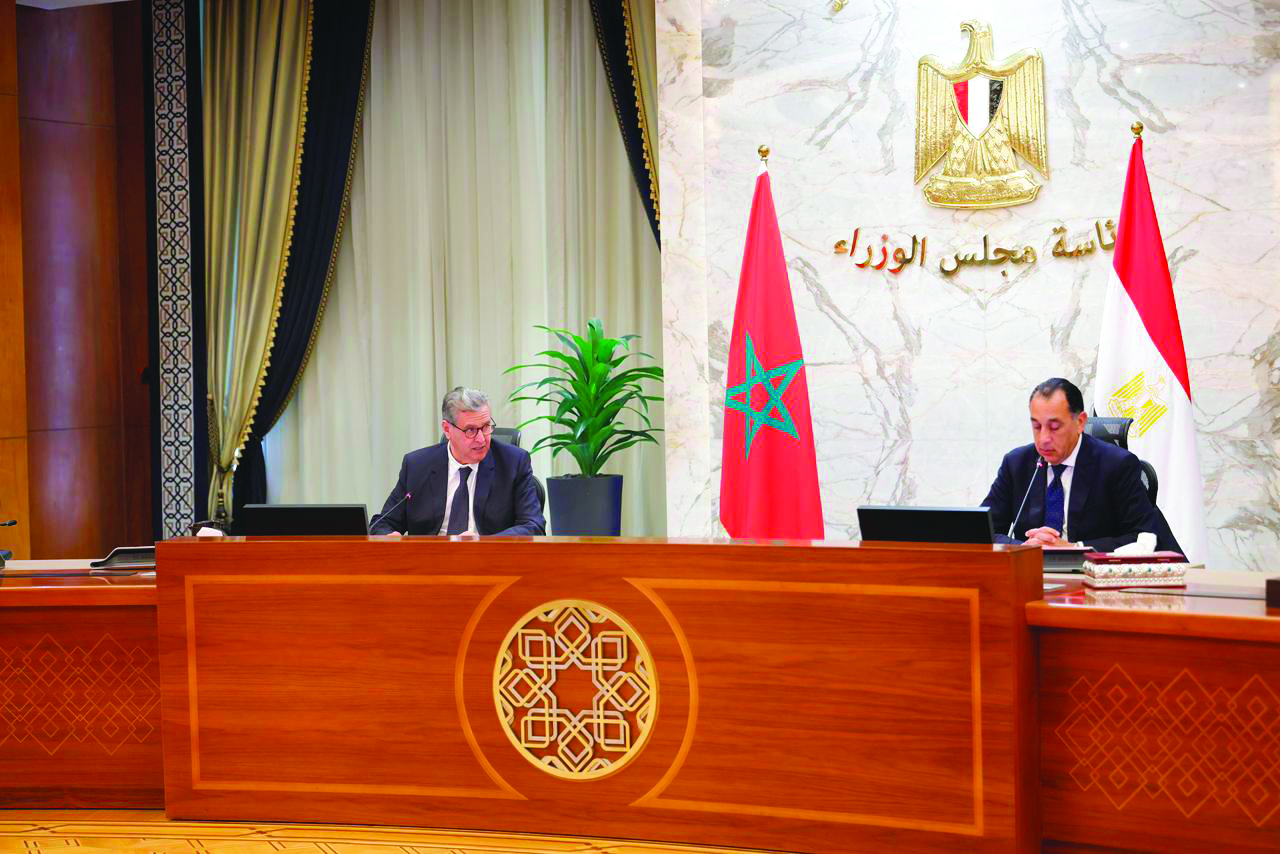
Morocco and Egypt are in the process of writing a new chapter in their multidimensional partnership. The holding, on Monday, April 6 in Cairo, of the first session of the Morocco–Egypt Coordination and Monitoring Committee, co-chaired by Head of Government Aziz Akhannouch and Egyptian Prime Minister Mostafa Madbouly, has outlined its contours. The minutes of the meeting summarize both the stakes and the objective: the two countries express “their willingness to develop their bilateral relations, as well as their commitment to strengthening economic cooperation within the framework of a comprehensive partnership.”
In his opening address at this first session, the Head of Government summed up the stakes by emphasizing an ambition to “elevate” bilateral relations to the level of a “comprehensive and exemplary strategic partnership.” This partnership, he stressed, must be “based on effective solidarity, comprehensive economic integration, and political coordination on regional and international issues.” For Akhannouch, this meeting constitutes “a political declaration and a new charter laying the foundations of our strategic partnership, with pragmatic orientations ensuring real and solid integration across various fields between the Kingdom of Morocco and the Arab Republic of Egypt, thereby strengthening their position as key regional hubs.”
Promising avenues
However, the Head of Government stressed that achieving this desired model partnership requires a prerequisite: the need to increase, in a balanced manner, the volume and value of bilateral trade. He added that this also requires optimal implementation of the provisions of free trade agreements at both regional and continental levels, as well as “the removal of all administrative constraints and obstacles to ensure the smooth flow of goods between the two countries.”
But that is not all. It is also a matter of “encouraging investment flows in both directions,” he noted, with the aim of “leveraging the expertise and economic potential available in both countries.” Strengthening economic integration, based on a win-win principle, also depends on expanding cooperation into several areas, the Head of Government specified. While this defines the overall framework, Akhannouch also outlined specific sectors where this new partnership could be deployed. He notably mentioned the development of direct logistics and maritime connectivity between the strategic ports of both countries, particularly between the Tanger Med port and Port Said East, as well as the Suez Canal. Such connectivity, he explained, would enable both countries to become an integrated platform and a shared gateway to access African, European, and Asian markets—creating a natural complementarity that would serve the interests of operators on both sides.
Continuing with the promising sectors where this partnership could materialize, the Head of Government highlighted industrial integration, by promoting complementary industries in order to capitalize on the respective competitive advantages of both countries.
In the same vein, he advocated encouraging both parties to organize bilateral business meetings, economic forums, and participation in trade fairs. The objective, clearly, is to boost trade exchanges and investments between the economic operators of both countries. This partnership could also take shape through the development of solar and wind energy projects, as well as by strengthening cooperation in renewable energy, particularly green hydrogen. He also emphasized the importance of establishing bilateral cooperation in the mining sector, notably through mutual capacity building and the exchange of expertise and data in mineral exploration. The Head of Government also stressed the importance of updating the legal framework governing relations between the two countries. A signal in this regard was already given on that same Monday, April 6, with the signing of several agreements aimed at strengthening bilateral cooperation. This reflects the shared will, he said, to elevate bilateral relations to a higher level. These legal mechanisms cover several areas, including tourism, housing and urban planning, health and pharmaceuticals, electricity and renewable energies, industry, as well as investment and customs.
The path is thus set, its roadmap defined, and the ambition solemnly declared. What remains is the involvement of private sector operators to give concrete form to the commitments made.
A continental approach
Beyond bilateral relations, which are entering a new era, Head of Government Aziz Akhannouch noted that Morocco–Egypt cooperation also includes strengthening coordination at the continental level, particularly within the framework of the African Continental Free Trade Area (AfCFTA). The idea, he explained, is to ensure “a shared positioning on the African continent as an integrated economic bloc.” Both countries, with their African experience, could thus leverage this as a major driver for a shared continental ambition.