Business
Renewable energies: Soon at full capacity
Industrial decarbonization, electricity self-production, the energy transition strategy… all factors that are putting the green energy industry into orbit. For both wind power and PV, a dedicated ecosystem is accelerating its emergence.

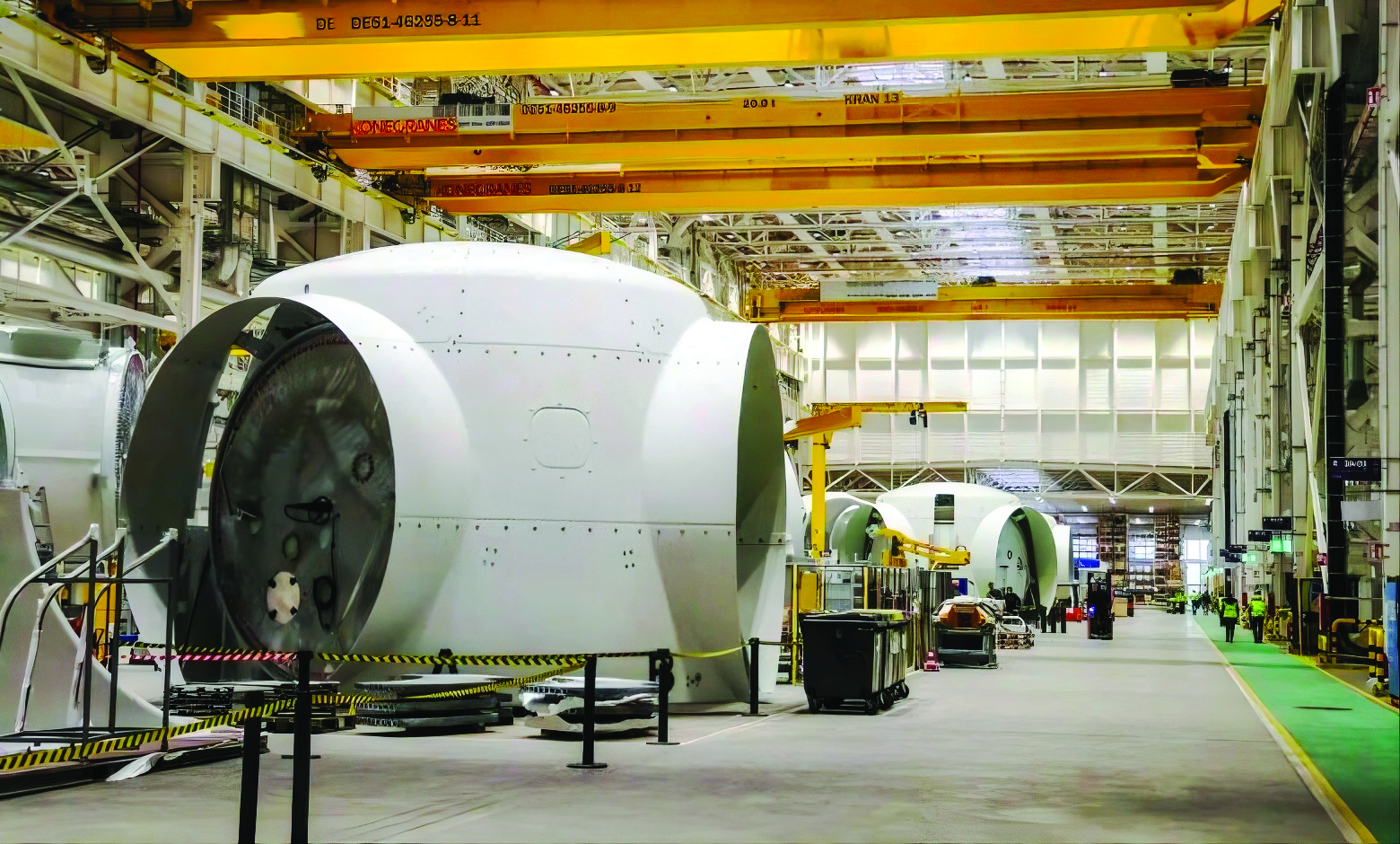
Producing, transporting and storing. This is the triptych on which the entire renewable energy value chain rests.
It is also the foundation on which our country’s energy future rests. Our energy sovereignty. Although the Kingdom has already taken a major step forward as a producer of clean energy, with the objective of 52% renewables in the energy mix initially set for 2030 now much closer, the fact remains that there is an entire upstream sector still to be built.
The will is there and dates back several years. The installation in Tangier in 2017 of a wind turbine blade manufacturing plant by Siemens Gamesa, the first plant of its kind in Africa and the Middle East, is proof of this. The manufacturer has since withdrawn from our country, but the activity was relaunched by a Chinese manufacturer in Nador. For nearly a year, Aeolon has been producing new-generation blades intended both for export and for the domestic market. Alongside it, another Chinese company, Dao Shengtian, produces materials for the wind industry, such as epoxy resins. Not far away, in Tangier, the Indian company Indore supplies “WinSpar” (pultruded profile), a structural element used in wind turbine blades to give them rigidity and strength. For nearly a decade, Delattre Levivier Maroc (DLM) has been producing metal towers in Casablanca. Among them, other local companies supply auxiliary equipment and services, such as logistics and bolting solutions for the assembly and maintenance of wind turbines.
The remainder, particularly inverters, is currently imported. Nevertheless, the value chain is gradually being established. In solar energy, the industrial fabric is somewhat more developed. In Skhirat, PV Industry, a subsidiary of Jet Contractors, produces photovoltaic panels and cells, with an announced capacity of 30 MW/year.
Alongside it, Cleanergy Rabat is developing a capacity of nearly 200 MW per year for the assembly of CE-certified modules.
Solaris (GPM Holding) claims a production capacity of 750 MW/year of solar panels at its Tangier plant, opened in 2024. This capacity is added to the 250 MW/year of the Al Hoceima plant commissioned in 2018. Meier Energy (Casablanca) produces measurement sensors and data loggers for large-scale PV power plants. For the time being, the Kingdom still has no cell manufacturers (wafers, silicon). All cells are imported from China. What Morocco manufactures to date is the final link. In other words, Morocco currently manufactures the mechanical and electrical “last mile” of the solar chain (structures, cables, transformers, module assembly, instrumentation), but none of the high-value-added technological links (PV cells, inverters, integrated storage systems). However, the situation may change with the future Tan-Tan polysilicon plant. This is a structuring project that will eventually provide Morocco with polysilicon manufacturing capacity (the basic input for PV cells). The Sondiale plant in Tan-Tan, a subsidiary of GPM Holding, which required an investment of 8 billion dirhams and is scheduled to become operational by the end of 2029, will produce 30,000 tonnes of materials per year.
OCP: A business builder
In the meantime, Morocco genuinely intends to encourage the development of this ecosystem. The 2026 Finance Law provides for an increase in customs duties to protect this industry. The rate for photovoltaic cells assembled into modules or panels rises from 2.5% to 10%. At the same time, the local content rate is gradually increasing. For example, in certain projects, particularly those developed by OCP, the target is up to 90% local content for panels from the beginning of 2026. Morocco remains a pioneer in Africa in the field of solar energy. The famous Noor solar complex in Ouarzazate, using CSP technology (concentrated solar thermal power), has established its reputation in the field. This same power plant is on its way to becoming a pioneer in the world as well, no longer because of its size, but because of its thermal storage technology, currently in the R&D phase.
In UM6P’s laboratories, researchers have developed, from phosphate residues (phosphogypsum), materials capable of storing thermal energy across temperature ranges from 300 to 900°C. These materials are expected to replace molten salt. UM6P’s subsidiary, InnovX, is also a key player in the development of renewable energy technologies in Morocco.
As is known, it operates in several fields as a “business builder,” whose role is to design, launch and develop innovative industrial and technological companies. Its intervention in the renewable energy sector is multidimensional and focuses on creating complete and competitive industrial sectors rather than isolated projects. In partnership with the OCP Group, InnovX is also considering the construction of a solar panel plant using HJT technology (Heterojunction), which offers better yields (26–27%).
In batteries, Moroccan R&D led by UM6P has given rise to the NGB Materials project. A pilot line targeting 1,000 tonnes/year of LFP cathodes, with an increase in production to 30,000 tonnes/year planned from 2028. Seven patents have been filed as part of this project on phosphoric-acid-based processes. It should be emphasized that upstream, OCP is acting as a genuine lever for the development of renewable energies. The group is indeed targeting 100% clean energy for its facilities by 2027. Its subsidiary OCP Green Energy is managing this transition with solar and wind farms, in order to achieve total carbon neutrality by 2040, relying on significant and continuous investments, particularly in renewable energies.
Whether in production, in the green hydrogen sector through HydroJeel, or in storage and the development of dedicated industrial parks, the ambition is to build complete and sovereign industrial sectors, positioning Morocco as a competitive player in African and European markets.
The adoption of a new law on electricity self-production, government programs such as PERG 2.0, floating stations, or partnerships such as Solar Rooftop 500, as well as the imperative of decarbonizing national industry, are all factors that will accelerate the deployment of the renewable energy industry ecosystem.
Obviously, one of the links in the renewable energy value chain on which Morocco has built its strategy in this area is storage using batteries (BESS). The range of projects initiated in recent years is no longer presentable. The battery value chain is almost complete. The Kenitra gigafactory will very soon enter production, the Cobco one in Jorf Lasfar is already operational, and upstream, an entire network of suppliers has already entered the scene. The Kingdom is rapidly moving from the materials stage to the production of cells and complete systems. This shows that Morocco is undergoing a strong acceleration. The foundations (materials) have been laid, the first giant gigafactory is at an advanced stage of construction, and the first significant cell production runs are imminent before the end of 2026. The country is moving from an “emerging” status to that of a credible African hub for batteries.
The legal boost
The adoption of Law 82-21 on the self-production of electrical energy will certainly change the situation. By authorizing industrial companies, SMEs, farms and tertiary-sector businesses to produce their own electricity, with the possibility of feeding the surplus into the grid, the law creates predictable, regular and distributed demand. This will have a knock-on effect on local manufacturing. Until now, the absence of regular local outlets had slowed heavy investment in upstream industrial tooling and components. With the pressure of export decarbonization, self-production is becoming an imperative for exporters.
This guarantees PV equipment manufacturers a sustained order book.
Furthermore, Law 82-21 formally incorporates the right of access to energy storage services. This encourages the emergence of a local sector for the integration of storage