Kingdom
Morocco–Egypt Cooperation: Akhannouch Aims to Inject New Momentum
At the opening of the first session of the Morocco–Egypt Coordination and Monitoring Committee, the Head of Government აღნიშნა that achieving a model partnership requires increasing, in a balanced way, both the volume and value of bilateral trade, while making the most of the opportunities offered by a robust legal framework.

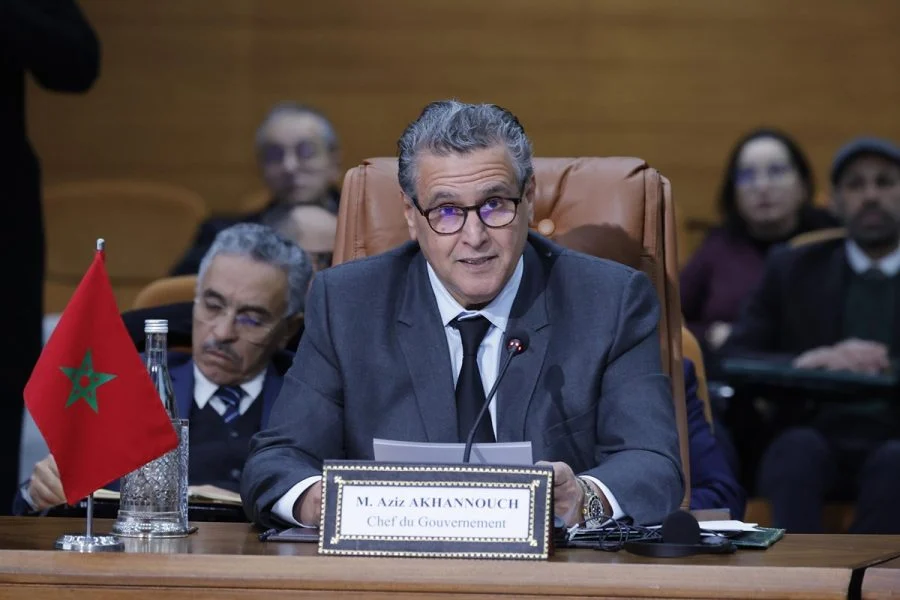
Head of Government Aziz Akhannouch stressed on Monday in Cairo the shared determination of Morocco and Egypt to give new momentum to their bilateral cooperation and relations between the two brotherly countries.
In a speech at the opening of the first session of the Morocco–Egypt Coordination and Monitoring Committee, Akhannouch stated that holding this meeting “reflects the ambition of the leaders of the two countries, His Majesty King Mohammed VI and his brother His Excellency President Abdel Fattah El-Sisi, to inject new momentum into bilateral relations and elevate them to the level of a comprehensive and exemplary strategic partnership, based on effective solidarity, broad economic integration, and political coordination on regional and international issues.”
This meeting, he added, constitutes “a political declaration and a new charter laying the foundations of our strategic partnership, with pragmatic orientations ensuring real and solid integration across various fields between the Kingdom of Morocco and the Arab Republic of Egypt, thereby strengthening their position as key regional hubs.”
“The strength of our bilateral relations also rests on the clarity of our positions regarding the strategic issues of our two countries,” Akhannouch continued, noting that achieving this desired model partnership requires increasing, in a balanced manner, both the volume and value of bilateral trade, while taking advantage of the opportunities offered by a rich legal framework.
This requires, he stressed, optimal implementation of the provisions of free trade agreements at both regional and continental levels, as well as the removal of all administrative constraints and obstacles to ensure the smooth flow of goods between the two countries and to promote investment flows in both directions.
This will make it possible to leverage the expertise and economic potential of both countries to support efforts toward the development and prosperity of the two brotherly peoples, the Head of Government said, concluding that the key to the desired economic integration between the two countries—based on a “win-win” principle—lies in expanding cooperation into multiple areas.
He noted that these areas include, in particular, the development of direct logistical and maritime connectivity between strategic ports, especially between the port of Tanger Med and Port Said East, as well as the Suez Canal corridor, which would enable both countries to become an integrated platform and a shared gateway to African, European, and Asian markets.
This also involves, he continued, industrial integration by promoting complementary industries in both countries to capitalize on their respective competitive advantages, as well as encouraging the organization of bilateral business meetings, economic forums, and participation in sectoral trade fairs to boost trade and investment between economic operators in both countries.
He added that this also includes the creation of a Morocco–Egypt investment platform bringing together institutions responsible for investment, with the aim of facilitating information exchange, coordinating promotion efforts, exploring project opportunities, improving understanding of business environments in both countries, and exchanging expertise and experience in developing large-scale solar and wind energy projects, as well as strengthening regional cooperation in renewable energy, particularly green hydrogen.
He further noted that this cooperation also encompasses strengthening coordination within the framework of the African Continental Free Trade Area, with a view to achieving a common positioning on the African continent as an integrated economic bloc, as well as establishing bilateral cooperation in the mining sector through mutual capacity building and the exchange of expertise and data in mineral exploration.
Aziz Akhannouch also emphasized the importance of updating the legal framework governing relations between the two countries to meet their ambitions and keep pace with rapid global changes, noting that the signing of several legal instruments on this day represents an important step in this direction and a strong signal of the shared determination to elevate bilateral relations to a higher level.
The Head of Government also considered culture to remain a fundamental pillar of Morocco–Egypt relations, as it provides them with deep roots and lasting resonance in the consciousness of both peoples. He called for continued cooperation and exchange of experience in the fields of culture, arts, and heritage, particularly in preserving and promoting both tangible and intangible heritage, developing cultural and creative industries, and expanding opportunities for participation in cultural and artistic events and festivals.
On another note, Akhannouch stated that the current military escalation in the Middle East “must not overshadow the centrality of the Palestinian issue, which remains the key to security and stability in the region.”
He concluded that, within the framework of the Kingdom of Morocco’s support for the brotherly Palestinian people, His Majesty King Mohammed VI, Chairman of the Al-Quds Committee, continues to give special importance to the Holy City and to pursue sustained efforts to preserve its legal status, civilizational vocation, and historical symbolism as a land of coexistence among the three monotheistic religions.
The first session of the Morocco–Egypt Coordination and Monitoring Committee was held on Monday, co-chaired by Head of Government Aziz Akhannouch and Egyptian Prime Minister Mostafa Madbouly.
This session took place with the participation of a high-level Moroccan delegation, including the Minister of Foreign Affairs, African Cooperation and Moroccan Expatriates, Nasser Bourita; the Minister of Economy and Finance, Nadia Fettah; the Minister of Equipment and Water, Nizar Baraka; and the Minister of Agriculture, Maritime Fisheries, Rural Development, Water and Forests, Ahmed Bouari.
The Moroccan delegation also included the Minister of Industry and Trade, Ryad Mezzour; the Minister of Youth, Culture and Communication, Mohamed Mehdi Bensaid; the Delegate Minister in charge of Investment, Convergence and Evaluation of Public Policies, Karim Zaidan; as well as the Kingdom’s Ambassador to Egypt, Mohamed Aït Ouali.