Kingdom
Foundations of the Welfare State: Consolidation in Progress
The government has placed social issues at the forefront of its priorities. Formalizing its commitments, its policy encompasses all aspects through a unified approach, covering all sectors. Growing evidence confirms this success.

The consolidation of the foundations of the welfare state, a quintessentially cross-cutting project, has been made one of the government’s top priorities in its agenda—indeed, its major priority. Confronting existing gaps, the Executive has vigorously tackled this project across all dimensions. Translating commitments into action, the Executive charted the course and swiftly moved to implementation.
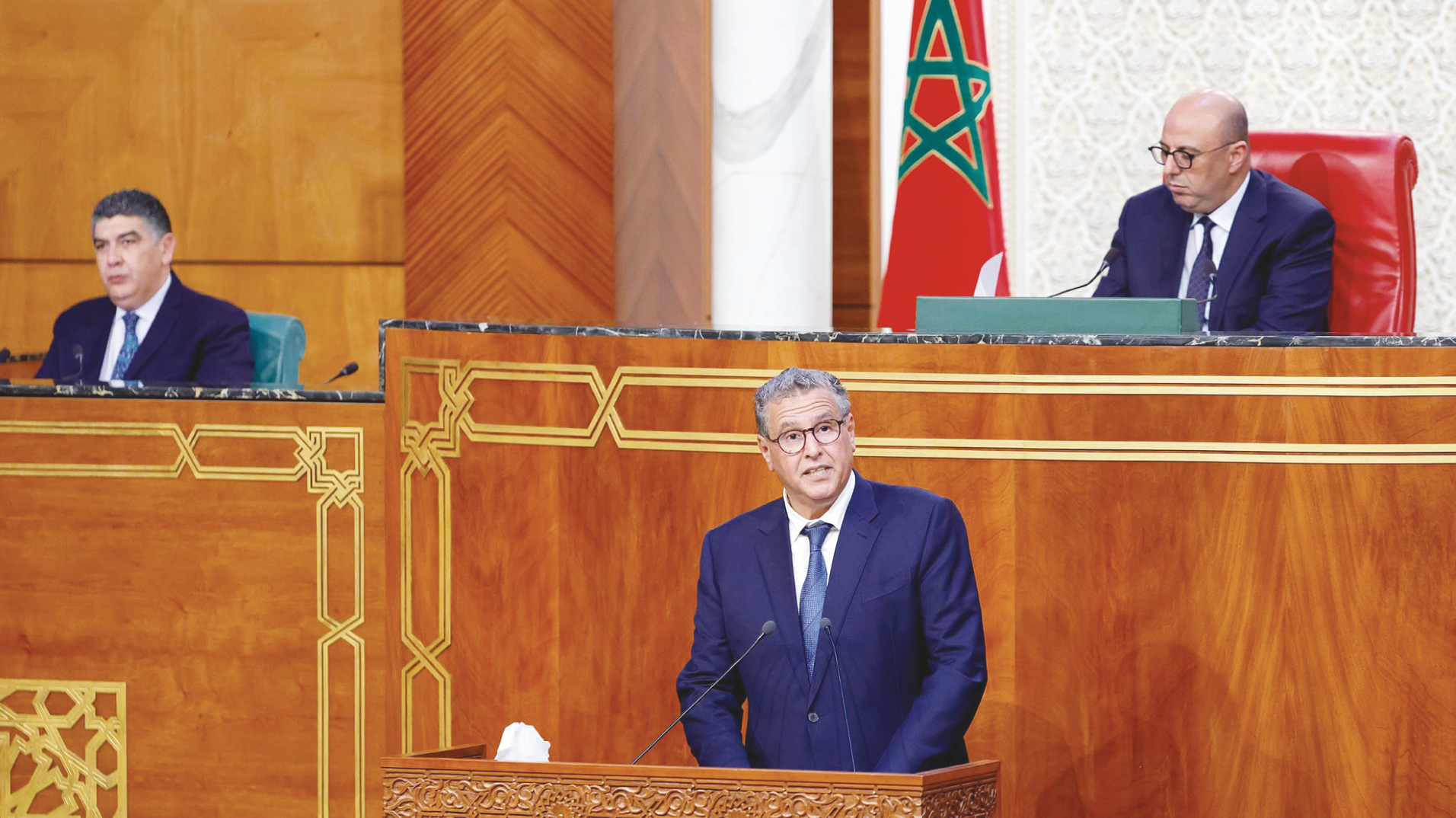
Starting with prioritizing the expansion of social protection—one of the major pillars, if not the cornerstone, of this initiative. The results have not been long in coming. Yet, it was with conviction and confidence, backed by data, that the Head of Government addressed the House of Councillors on Tuesday, May 27.
Clear, direct, and unequivocal, Aziz Akhannouch cut to the chase during the monthly session on ‘the general policy for consolidating the foundations of equity and social protection,’ emphasizing that ‘the government has succeeded in realizing the objectives of the royal project to expand social protection.’
He clarified that these objectives include strengthening social cohesion and ensuring equitable access for all citizens to their fundamental rights.
No One Left Behind
In this vein, the Head of Government stressed, ‘the adopted approach has enabled the inclusion of all vulnerable categories. This is part of building a resilient society where merit and equal opportunity prevail.’ To achieve this, the Executive activated all institutional levers to create the conditions for the success of this large-scale project.
This includes the expansion of compulsory health insurance, which now covers all Moroccan families under a renewed social contract that reinforces solidarity and cohesion while reducing professional and territorial disparities across societal groups.
Indeed, beyond public servants and private/public sector employees, ‘the government has taken bold measures’ to accelerate the extension of medical coverage to the most vulnerable social categories, notably by integrating 4 million families into the AMO-Tadamon program.
This has increased the number of beneficiaries and their dependents to approximately 11 million people. To ensure the sustainability of this system, the state covers these families’ contributions to the tune of 9.5 billion dirhams.
Here, too, the numbers speak volumes. From the launch of AMO-Tadamon through March of this year, over 14 million cases were submitted to the National Social Security Fund (CNSS), including 300,000 related to chronic and costly illnesses. Of these, more than 12 million cases were processed, with total funding exceeding 17 billion dirhams.
In this momentum, the government did not stop halfway, extending coverage to non-salaried workers (TNS). This category now benefits approximately 3.5 million people. By the end of April, over 4 million cases had been submitted—a daily average of 9,255—with 3.6 million processed and an allocated budget of 4 billion dirhams.
Simultaneously, to ensure no one is excluded from medical coverage, the government laid the groundwork for the AMO-Achamil program, opening access to new categories who can now benefit from the same medical services and hospital care as others. Currently, this program covers 313,000 individuals and their dependents.
Furthermore…
In his remarks, Aziz Akhannouch also addressed the direct social support program. This initiative, targeting 4 million families, provides monthly direct assistance ranging from at least 500 dirhams to up to 1,200 dirhams.
Backed by financial efforts totaling 25 billion dirhams in 2024—revised upward to 26.5 billion dirhams in 2025—the program will continue next year with a budget of 29 billion dirhams.
In total, this support mechanism accounts for no less than 2% of GDP. A socially impactful measure, it has benefited 4 million families (approximately 12 million individuals), including 3.2 million families also covered by compulsory health insurance.
As part of this comprehensive and inclusive social policy, support for children’s education has not been overlooked. To alleviate household burdens, the Executive launched an ‘exceptional supplementary aid’ this year targeting 1.8 million families (3.1 million children), 61% of whom are from rural areas, as emphasized by the Head of Government.
Moreover, to improve maternal and neonatal health, the government continues to disburse lump-sum allowances for newborns. By the end of January, 42,800 families received 2,000 dirhams for the first child and 1,000 dirhams for the second, with a total budget of 65 million dirhams.
Widows are not left behind. Addressing the limited social coverage for this group, the government has increased the number of beneficiaries sixfold since 2021, now exceeding 420,000 widows—including 330,000 without children who previously lacked access. Additionally, 87,000 widows caring for approximately 97,000 orphaned children are supported.
This is achieved through progressive social support, set to reach 400 dirhams per enrolled child by 2026. These indicators underscore a government approach that is fundamentally social, proactive, targeted, and impactful on the daily lives of diverse social groups—particularly the most vulnerable.
Human-Centered Priorities
The consolidation of the welfare state’s foundations, spearheaded by the government, is closely tied to reforming the healthcare system—a reform rooted in elevating human capital.
While co-chairing a high-level side event during the 78th World Health Assembly (WHA78) in Geneva, the Minister of Health highlighted Morocco’s experience in this area. For Amine Tahraoui, strengthening and valuing human resources (HR) in healthcare is part of a profound systemic overhaul.
One where the human element serves as the cornerstone. Tahraoui emphasized that Morocco is striving to increase its healthcare workforce density to 4.5 professionals per 10,000 inhabitants by 2030, up from 1.89 today. This, the Minister stated, is an ‘ambitious yet indispensable goal’.
Achieving it, he added, ‘requires training, recruiting, retaining, and supporting’ personnel. In essence, this is not only a structural challenge but, above all, a societal choice to build a more humane, accessible, and equitable public service, Tahraoui explained.
To this end, the Executive’s measures aim to enhance the value of healthcare workers, incentivize retention, and attract talent. The new HR management model for the sector is at the forefront of this effort.