Influences
Casablanca vibrates, celebrates, and reinvents its musical tempo
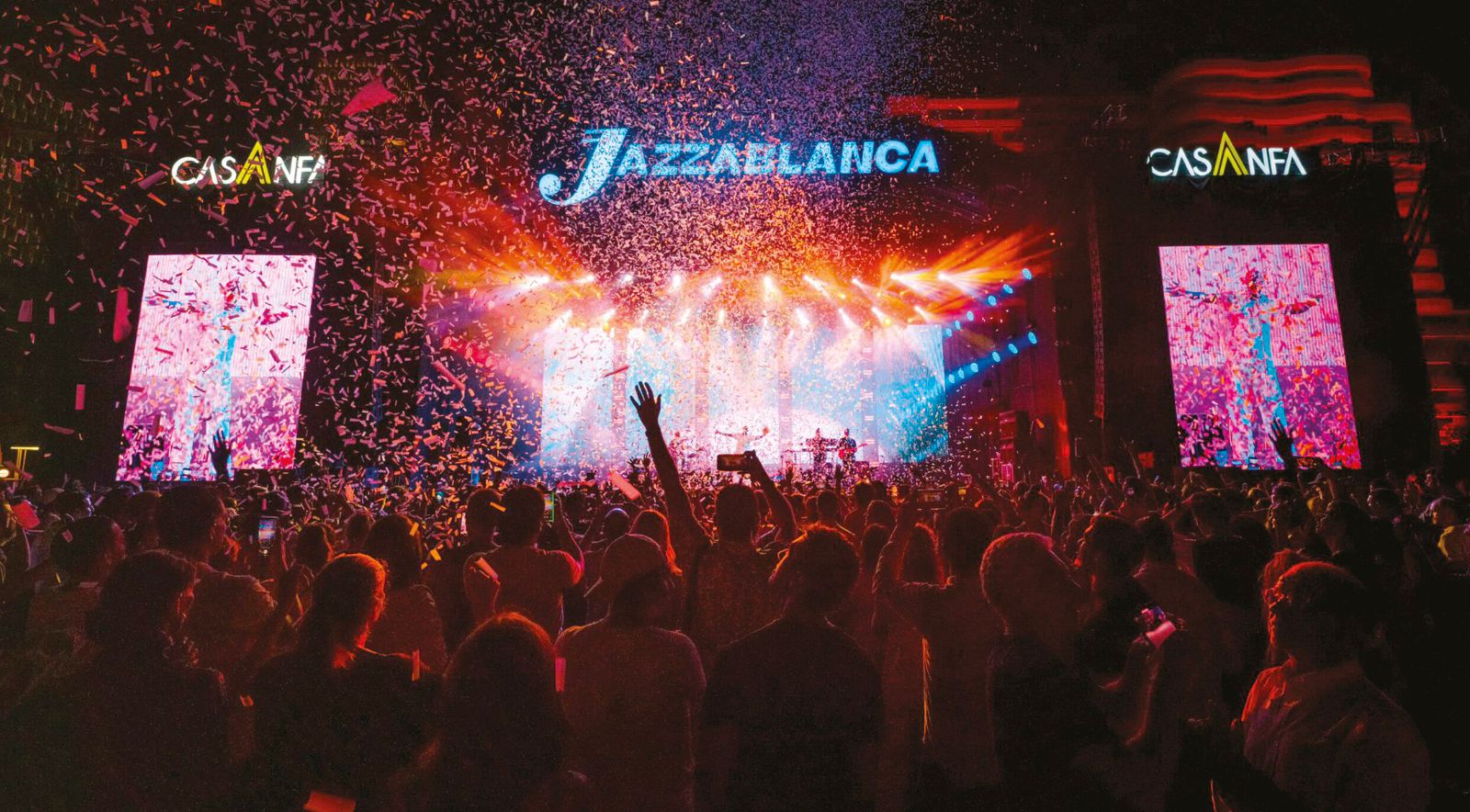
The metropolis, long dimmed, seems to be regaining its former flamboyance. Proof can be seen in the blossoming of festivals that punctuate its seasons. Latest celebrations: the 18th Jazzablanca, the 2nd Nostalgia Lovers, and the 1st Casablanca Music Week.

Casablanca keeps connecting past and present. The latter is savored like an old liqueur, recounted with relish, described with superlatives. A magical city. Casablanca has always fascinated intellectuals and artists who would come for a week and end up staying for life.
Then, a sudden torpor fell upon the dream city. Casablanca settled down. Nothing remained of its creative exaltation, its cultural ferment, its generous fever.
Concrete prevailed. Dreariness, basically. But the city’s passionate lovers couldn’t stand for it to be swallowed by History. So they made it a point of honor to bring it back to life musically. So much so that Casablanca today abounds with events.
Indeed, the city that never sleeps has decided to make some noise. Long confined to a handful of niche festivals or feverish nights in clubs and cabarets, the metropolis awoke in 2025 like a giant conductor, orchestrating a symphony of festivals that are reshaping its DNA: Casa Vintage Festival, Timeless Festival, Casablanca Music Week, Nostalgia Lovers, Jazzablanca.
This year, these gatherings have transformed the economic capital into a festive crossroads where music lovers, nostalgics, and the curious meet in a whirl of sounds, lights, and emotions. But beyond the stages, the whole city—and its unsung heroes—pulses to the rhythm of this renaissance.
Buzz
Faced with the musical desert that once afflicted the metropolis, where only a few events brightened the city—like the legendary Festival de Casablanca (not to be confused with the one organized by WeCasablanca) or the International Noujoum Gnaoua Festival, whose 12th edition bewitched United Nations Square last year—Casablanca is reborn. And in this landscape, one event has stood strong against all odds: L’Boulevard, created in 1999. This event, the beating heart of Morocco’s urban music scene, has revealed talents like Hoba Hoba Spirit and Don Bigg, while welcoming international stars like Alborosie, Mad Professor and the Robotics, or Keziah Jones.
Thanks to its Tremplin competition, L’Boulevard has given a platform to young artists, becoming an institution that has preserved Casa’s rebellious and creative spirit in the face of cultural lethargy.
Today, the excitement is palpable. Jazzablanca, in its 18th edition, took over Anfa Park—where it’s been since 2022—from July 3 to 12, stretching the festivities over ten days, a first! Forget the usual four days—make way for an XXL lineup spotlighting jazz, but also funk, soul, and world music.
Seal, Black Eyed Peas, Macklemore, Kool & The Gang, plus Moroccan stars like Hindi Zahra or Daraa Tribes: the Casa Anfa and Stage 21 venues vibrate with cosmopolitan energy.
And so no one is left out, the free “Nouveau Souffle” stage in the Arab League Park highlights emerging local talents, while Glen David Andrews’s band from New Orleans sets the streets on fire, from Rick’s Café to the Central Market.
“We want to make Casablanca a global musical crossroads, while staying rooted in our identity,” says Moulay Ahmed Alami, festival director. “Seeing Hindi Zahra on stage was like coming back to our roots, but with a universal touch,” marvels Sofia, a 27-year-old festivalgoer.
A week earlier, from June 20 to 29, Casablanca Music Week (CMW) shook La Casablancaise stadium with a bold proposition. Organized by NRJ Maroc, this newcomer didn’t settle for concerts: it mixes music (Mary J. Blige, Gims, Jason Derulo), open-air cinema, gaming, fitness, and food court.
“We wanted to create a festival that speaks to everyone, from music lovers to gamers, foodies to athletes,” explains Hakim Chagraoui, CEO of NRJ Maroc and CMW’s artistic director.
“Thanks to the public’s enthusiasm, we’ve achieved 65% of our ticketing goal twenty days ahead of CMW, which is great. We’re already working on the next edition, which, ideally, gets prepared a year in advance,” he adds. The result? 60,000 festivalgoers for a first edition that repositioned Casablanca as a multifaceted cultural destination.
“I loved the mix: a Mary J. Blige concert, then a gaming tournament right next door. Casa has never been so lively!” says Mehdi, a 19-year-old from Casablanca.
And there’s Nostalgia Lovers, from July 3 to 5 at Go Velodrome, which got 25,000 people dancing to tunes from the ’80s, ’90s, and 2000s.
Thomas Anders (Modern Talking), Lou Bega, Las Ketchup, Montell Jordan: the lineup, curated by Public Events, is a shot of retro dopamine. With arcade terminals, a recreated MTV studio, and the “Olé Nostalgia” brunch with Latino flavors, the festival isn’t just playing the revival card—it reinvents it.
“It’s like my youth took over the city,” enthuses Amina, a 42-year-old Casablancan, there with her kids to relive the era of walkmans and VHS music videos. “Hearing ‘Mambo No. 5’ live was a trip back in time!” adds her son Adam, 15.
Impact
These festivals are more than just about decibels. They are an economic and tourist engine that’s giving new life to Casablanca. According to estimates relayed by WeCasablanca, the summer 2025 festivals attracted tens of thousands of visitors, including a growing share of foreign tourists, generating about a 15% increase in hotel nights in June and July 2025. “These events are changing Casablanca’s image,” says Saïd, manager of a restaurant near Anfa Park. “Before, tourists would breeze through for the Hassan II Mosque. Now, they stay for the festivals, spend, visit.”
Food courts, like CMW’s with its twenty hand-picked restaurateurs, also boosted the local economy while offering accessible prices, as highlighted by Hakim Chagraoui: “We made sure each stand was unique, with pricing adapted to local purchasing power.”
“Festivals are a godsend for us. We doubled our turnover in June,” says Fatima, owner of a food truck.
Behind the Scenes
But behind the lights and the stages, there are those: the “men in black,” technicians, stagehands, security guards. These unsung heroes, often in the shadows, are the artisans of this cultural revolution. “Before, I had to go to Marrakech or Rabat to work on festivals.
Now, Casablanca offers me work at home,” boasts Youssef, 29, a security guard employed by a local agency for Jazzablanca and CMW.
With the explosion of events, security agencies like Securitas Maroc and G4S report a 20% increase in contracts in Casablanca in 2025, reducing precariousness for hundreds of workers. “I can finally stay close to my family while working,” adds Youssef, smiling.
Same story from the stagehands. Driss, 35, a technician for Public Events, helped set up the 40 meters of the main stage at Nostalgia Lovers. “It’s intense work, but rewarding. Seeing 25,000 people vibing on a stage I put up makes me feel useful,” he says.
These teams, often Casablancans, work for weeks or months ahead to turn places like Go Velodrome or Anfa Park into festive arenas. “We sleep barely at all, but the vibe is so electric you forget the tiredness,” adds Driss. “Building a stage for Black Eyed Peas, that’s something!” exclaims his coworker Rachid, 30, proud of his work.
A Knockout Line-up
On the programming front, Casablanca does nothing by halves. Jazzablanca boasts the elegance of a festival marrying jazz’s demands with global pop’s energy. Having stars like Ibrahim Maalouf or the unprecedented collaboration bringing together Hamid El Kasri and Mehdi Nassouli with international musicians shows one intent: making cultures converse without compromise. CMW, with stars like Mary J. Blige or Shaggy, bets on eclecticism, going from R&B to reggae in a single night.
Nostalgia Lovers, for its part, plays the raw emotion card: “Seeing Thomas Anders sing ‘Cheri, Cheri Lady’ is like opening a box of memories,” says Karim, a 38-year-old festival goer.
Casablancans themselves savor this transformation. “They used to say Casa was a nightlife city, but that was mostly clubbing. Now, we’re celebrating during the day, in the streets, with everyone,” says Laila, a 22-year-old student who came to dance at the Jazzablanca parade.
“The free stages are awesome. It lets everyone enjoy, not just the rich,” adds her friend Nada, 23. This accessibility—strengthened by the free stages and urban activities—makes these festivals true moments of collective togetherness.
In 2025, Casablanca is no longer just a business city. It has become a destination to come and feel, dance, remember. The festivals, led by visionary organizers like Moulay Ahmed Alami or Othmane Benabdeljalil, have captured the soul of a metropolis seeking renewal.
But this success also rests on those unseen: the security agents who keep watch, the techs who build the stages, the cooks who feed the crowds.
Together, they make Casablanca a city that no longer only lives by night, but shines under the blazing sun of a cultural summer. So, ready to book your ticket for the next edition? Because Casa, for sure, hasn’t stopped making noise.