Influences
Expo: A Real Fiction, Aïda Muluneh’s powerful flash
The female figures whose bodies are covered with vivid paints, whose direct and imperious gazes pierce the viewer, by Aïda Muluneh are at the heart of a beautiful exhibition at Galerie 38 in Casablanca. It is an opportunity to discover a magnetic body of work where Ethiopian memory, alchemical colours, and symbolic reinvention combine with rare intensity.

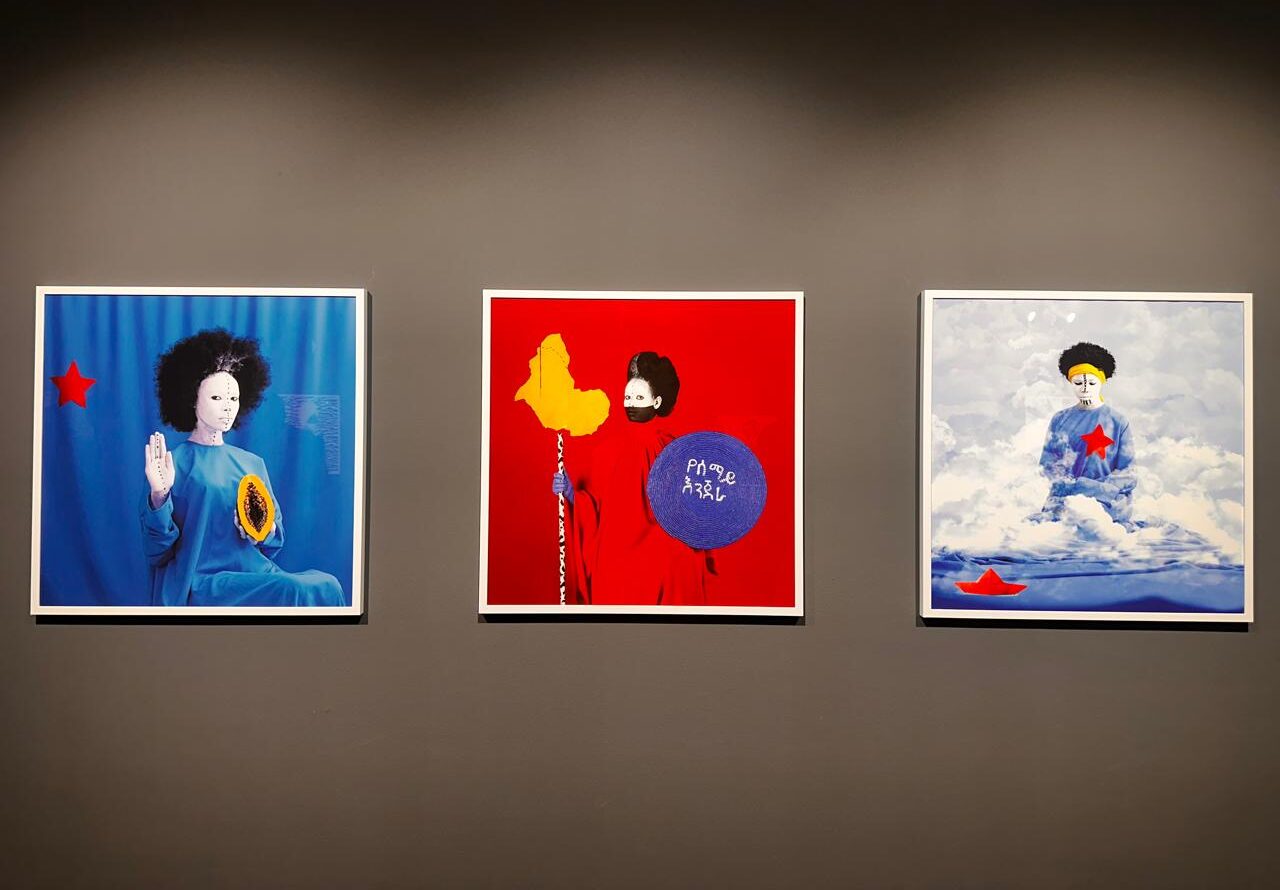
Until June 27, Galerie 38 is hosting A Real Fiction (or a real fiction), Aïda Muluneh’s solo show. You enter out of curiosity, without really knowing what you will find. Painted and draped female figures stare at you, as if they occupy the entire space, imposing themselves with an immediate visual force and a presence that disorients. The Ethiopian, born in 1974 in Addis Ababa, does not exhibit photographs. She summons living paintings where the documentary has given way to a commanding staging.
The visual experience is immediate, almost physical. Muluneh has abandoned the austere black-and-white of her early journalistic work for a restricted palette of primary colours (blood reds, deep blues, solar yellows) that act like alchemical materials. At the heart of this visual grammar reigns body painting, one of the most powerful markers of her language.
Inspired by the traditional tattoos of women from northern Ethiopia, notably the symbolic elongation of the neck, and by the mural frescoes of Orthodox churches, Aïda transforms the body into a pictorial surface, a living palimpsest and an archive of resistance. The motifs (dots, bands, fields of colour) partially cover the skin, producing both a distancing and an intensification. The graphic flatness achieved brings the image closer to a painting or a postage stamp, cancels natural shadows and reinforces the frontal, almost iconic character of the figures.
The sober, immersive scenography reinforces this spiritual chiaroscuro. The prints, with textures worked in post-production, retain an organic roughness, “perfection in imperfections”, as the artist says. Each image is a film set frozen at the magical moment when the model, chosen for her energy, becomes a character.
Trained in cinema at Howard University and having worked at the Washington Post, Muluneh explains that “(her) basic premise is to work at being both”. Simon Njami, via The Divine Comedy, was the trigger for this transformation toward the plastic arts. Her “photo-paintings” reinvent African historical and cultural narratives outside ideological constraints, mixing memory, spirituality and futuristic projection.
The setup is brilliant when it reaches the claimed universality. “I want to show the universal aspect of our humanity”, she asserts. The direct gazes of the models, set on painted skin, unsettle the viewer who is observed in return. Feminine strength asserts itself without eroticization. Body painting then becomes a political and decolonial act; it reactivates sophisticated traditional practices as a living, modern force, rejecting both exoticization and erasure. The visual car-crash she aims for works. One cannot look away.
Yet one can question a certain formal redundancy. The almost mathematical rigor of the compositions, while guaranteeing readability, sometimes borders on repetitive stylization. The symbolism, powerful, risks becoming too legible, almost didactic, where a more opaque shadow would have increased the mystery. Body painting itself, when it becomes too much of a signature, can smooth out its initial charge and tend toward the decorative.
So be it! A Real Fiction presents a major proposition. Muluneh, founder of the Addis Foto Fest and an agent of change on the continent, constructs a language that rebalances shadow and light. A body of work that, far from exotic or militant easiness, questions our relationship to image, identity and history with a poetic urgency and a troubling depth. A must-see.