Kingdom
Casablanca-Settat: Catalyst for Projects, with a Continental Ambition
The region is changing its physiognomy visibly. Construction sites are open everywhere, and particularly in the metropolis and its surroundings. The 2030 deadline is both a culmination and a new beginning.

At the beginning, the quest for the well-being of citizens, then comes an ambition for a continental-level urban and economic hub. The Casablanca-Settat region, whose role exceeds the scale of its budget—approximately 1.5 billion dirhams—functions as an investment lever, in synergy with other local actors, namely the municipalities and local authorities.
This is how large-scale projects, carried out jointly, have been able to contribute to the metamorphosis of the economic metropolis, without forgetting the other urban hubs of the region. Particular attention has been paid to urban and interurban mobility, with roadways including several newly constructed axes, engineering structures, underpasses, interchanges, viaducts… and a collective transport system whose rail component forms the backbone.
By 2029, the city of Casablanca and the entire region will have a modern transport network at the heart of which is the RER (Regional Express Rail), and whose nodal point is the new Casa-Sud station.
The climate emergency obliging, the region has also set about addressing the risks of water stress, mobilizing the necessary means to secure the supply of drinking water for all inhabitants, as well as for industrial use and for watering public spaces.
For this latter type of need, especially in Casablanca, enormous work has been deployed for the reuse of wastewater, the capture of rainwater and natural springs.
The economic and financial vocation of the region also implies major infrastructure projects with the development of industrial activity zones as well as related logistical infrastructures. At the same time, the economic metropolis aims to move upmarket in terms of new technology, particularly fintech, with the strengthening of the financial center via a world-class training center.
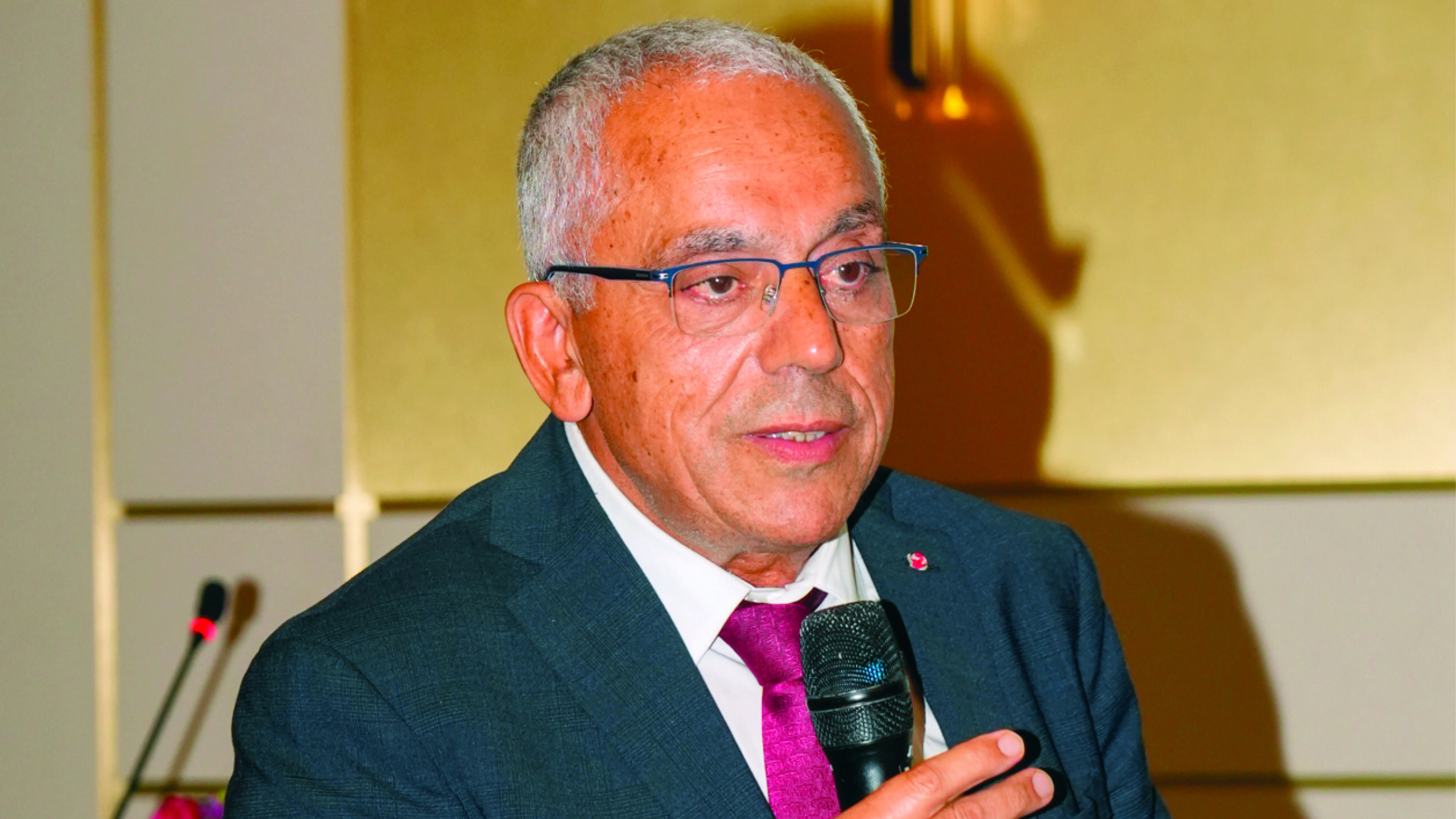
To this are added premier tourism projects, starting with the resizing of Mohammed V Airport and the construction, in the coming years, of two convention palaces and an exhibition center. It must be said, as highlighted by the President of the region, Abdellatif Maâzouz, during a meeting organized by “La Vie éco” on November 13, that the 2030 deadline represents a major milestone for the sustainable development of the region.
“It embodies a long-term commitment to present and future generations, fostering innovation and prosperity,” he stated. In broad terms, he observes, the intervention axes of the institution he presides over are three in number.
First, the improvement of the living environment in the short, medium and long term. Next, economic development and leadership. And, finally, territorial and human development outside Greater Casablanca. Excerpts from the intervention of the President of the Casablanca-Settat region:
The well-being of citizens as the underlying theme
“Starting from a royal vision launched particularly since 2014, we have worked with all stakeholders at the regional level, but especially, in Casablanca, on a vision that takes as its main concern the well-being of citizens. We have therefore set up projects and mobilized the necessary means to realize them. In this sense, three clarifications are to be made.
The first is that everything is done as a team. If everything is working much better today than in the past, and here better than elsewhere, it is thanks to good teamwork and cohesion among all stakeholders.
The second, we have had an accelerating factor, if not accelerating factors, but at least it is the 2030 World Cup, with an intermediate stage which is 2025, with the Africa Cup. We had to be ready.
The third, we work together, so we optimize our efforts and our means by launching projects jointly. That is to say that for example, on one side, the region finances a project and, on the other, the City Council mobilizes its own means to realize it. This is what we call positive synergy, with the main concern being the well-being of citizens.
And one of the axes we are working on is the improvement in the short, medium and long term of the inhabitants’ living environment. All while keeping in our sights leadership, not only at the local level, but also on the scale of the entire continent. We are already, at all levels, the first region of the Kingdom. Our ambitions are continental.”
Water: A challenge and a strategy
“When we decided to take up the challenge of improving the citizens’ living environment, we had to start with ‘life’ itself, that is to say, water. Considerable efforts have therefore been deployed to ensure the availability of this vital resource. The projects realized in this regard are known to all: water transfer, desalination, large plants and monoblocks…
This has allowed many citizens to have drinking water. And the efforts continue, notably through the large project of the Casablanca seawater desalination plant, which will be operational in early 2027. In addition to all these visible projects, there is also work being done literally underground.
It involves the construction of a pipeline network to evacuate wastewater and reuse it, but also to channel stormwater and reduce the risk of floods linked to climate change. The city has created, these last three years, a large number of green spaces, which, despite water scarcity, have been able to be maintained. This would not have been possible if we had not innovated in terms of water resources.
So, there is enormous work being done in Greater Casablanca. It is moreover the domain that has mobilized the largest budget, amounting to 5.6 billion dirhams.”
Waste: An end to landfilling, making way for transformation
“Still within the framework of improving the living environment, we all know the negative impact of a public landfill: odors, pollution, environmental risks…
We therefore decided, with the President of the City Council and the whole team, to work on a very avant-garde project, that of rehabilitating the former Médiouna landfill and investing in a large waste treatment and recovery plant.
We no longer speak of a landfill station, we speak of a resource that will serve tomorrow as a source of electrical energy for the city, and also compost, with an enormous investment. We are talking about an envelope approaching 18 billion dirhams.”
Mobility: Reinventing urban and interurban travel
“Remaining in this idea of improving the living environment, mobility is decisive. A great deal of work has been done in this regard thanks to the efforts of all. We had buses and today we also have the tramway and the BHNS, which have allowed Casablancans to move around more easily.
By 2029, the situation will be even better. A large bus acquisition plan is scheduled by 2028. One year later, two RER lines will be put into service. This corresponds to enormous budgets.
Work on road axes has also been done, with the objective of smoothing traffic, reducing congestion and strengthening traffic flow. Everyone has noticed, especially those coming from outside the city, that circulation has become much smoother since the interchanges, that of Sidi Maârouf and that of Aïn Harrouda, were opened to traffic.
Here too, we are talking about a budget of 1.1 billion dirhams that is deployed. Of course, without forgetting the underpasses that have brought Dar Bouazza back into fashion, because, at one point, inhabitants began leaving this area due to traffic problems. One could mention many other projects that have clearly improved circulation between the city and its surroundings, notably the airport.”
RER: A Revolution in Urban Transport
“Since 2021, we have carried out numerous road and highway projects. We tackled arteries inside the city, access roads, as well as routes connecting Casablanca to other cities in the region and to Rabat. We are still working on this.
However, if we continue each driving our own car, we can build as many roads as we want, it will never be enough. So, public transport is crucial for improving the quality of life, not only to facilitate mobility but also to reduce pollution.
Significant efforts have therefore been made on this point, but more was needed. The idea of the RER (Regional Express Rail) is not new, but the announcement of the 2030 deadline acted as a catalyst.
To understand the impact of the 2030 World Cup, it is important to know that FIFA imposes a maximum of 20 minutes travel time from a hotel to a training stadium, and 30 minutes to the competition stadium.
FIFA does not talk about kilometers, but about minutes. Moreover, the institution does not accept that more than 25% of spectators arrive at the stadium in their personal vehicles. In other words, 75% of spectators must use collective transport. Hence the importance of the RER, BHNS (Bus Rapid Transit), buses, and all the rest.
The project was therefore launched and the process accelerated. The RER will be operational in 2029. And as you know, there will be a metropolitan RER line and an intercity one. The network will be deployed around the new Casa-Sud station, which will be the largest.
Casa-Sud will be a multimodal hub, with the tramway, high-speed rail (LGV), metropolitan RER, and regional train. For the first time, we will have true regular regional trains connecting Casablanca to Settat and El Jadida, with departures every 30 minutes or even less for each of the two lines. The RER network will include 18 stations, 8 of which are inside the city of Casablanca.
The idea is that when a Casablancan leaves home, between the RER, tramway, bus, and regional train, they wait a maximum of twelve minutes, eight minutes on average, to find a means of public transport.
Our goal is to make rail the backbone of mobility in the region and the city; it will be the RER and tramway, supported by buses and coaches with a network of grand taxis. All of this will be managed by a digital mobility platform.”
Air Quality: An Indicator of Quality of Life
“This is undoubtedly one of the best, if not the best, news to announce to the inhabitants of Casablanca. For years, we have talked about sustainability, green spaces, water, and advances in this area. There is a way to measure its impact: through the quality of the air that Casablancans breathe.
We invested in air quality monitoring stations at the regional level, and this allowed us to observe that the result of all this work is remarkable. It is visible in the air quality observation bulletins for the same period over the last three years: May 2023, May 2024, and May 2025.
On the document, the red dots in 2020, which corresponded to points of high pollution, have been reduced. In 2024 and 2025, they completely disappeared, turning green. This means there is significantly less or almost no pollution left. The reasons for this change: mobility has become smoother.
It is the buses, whose fleet has been renewed and now meets the strictest standards in this regard. It is the two new tramway lines, lines 3 and 4. It is the green spaces, the roads that have been widened. It is, of course, the entire vehicle fleet, including the grand taxis whose fleet has also been modernized.
It is also greater strictness from the authorities, who no longer permit polluting industrial activities in Casablanca. All of this will continue, with even greater amplitude.”
Other Projects, Other Challenges
“After the inauguration by the Sovereign of the Casablanca port complex, the region is building a maritime corridor between Miami and the metropolis. Miami will represent Casablanca in America, and Casablanca will represent Miami in Africa.
Following this, a major cruise company was approached to make Casablanca not only a stopover but also a departure point, because Casablancans also travel and would like to go on cruises.
The region, which is the main shareholder of the Casablanca Finance City (CFC), additionally invested around 144 million dirhams to enable this hub to flourish further, become better known, and train resources in fintech.
In this sense, an innovation and technological leadership center will be created within the Hassania School of Public Works, in partnership with the Ministry of Equipment, for an investment of 800 million dirhams. This center will be the Mecca of technology in Morocco.
All of fintech and new technology will be there. Nanotechnology as well. Agreements have been signed with American, British, and Chinese universities, which will precisely allow training the elite of technology in the region.
And by 2030, a convention palace and an exhibition park will see the light of day in the region. Very interesting projects are underway. It is not just one convention palace, but two that are under study.
In short, there are two projects that are beginning to mature and a third perhaps that will emerge with different dimensions. We are talking about two convention palaces, urban skills, and an exhibition park, a bit outside, not far from the airport. An envelope of 1.5 billion dirhams is planned for this purpose.”