Influences
Hamza Qabil: The Young Entrepreneur Shaking Up the Natural Beverage Market…
A former handball player in Montpellier, a trained jurist, and now based in Monaco, the young businessman slipped into the French market in 2020 with the agility and confidence of an athlete. His juice brand, Maya Drink, ranks among the top 5 in sales. Today, he is positioning himself, skillfully, on the Moroccan market and preparing his return to establish his production unit there…

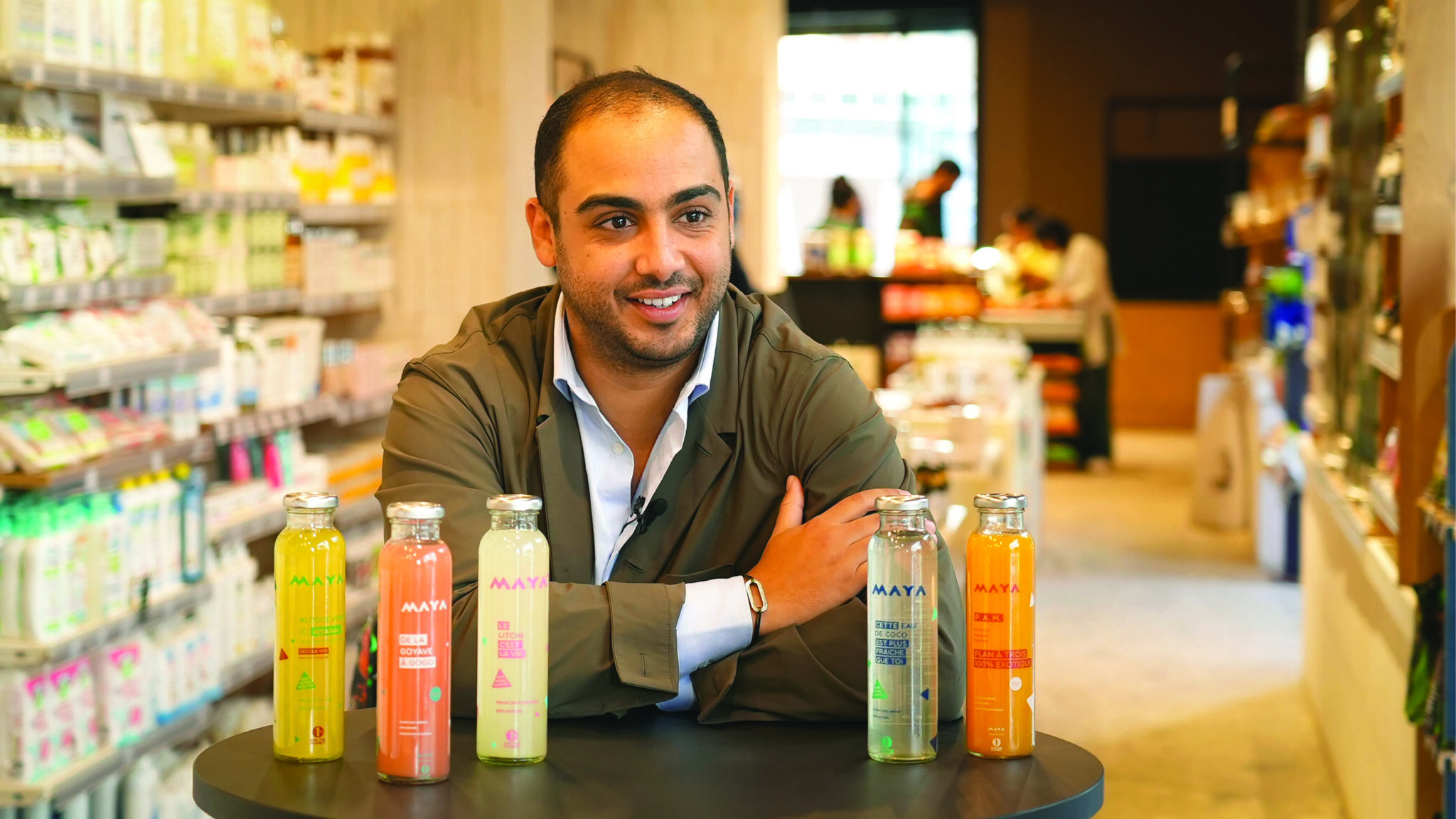
Hamza Qabil is part of this generation of Moroccan entrepreneurs who move forward quietly, discreetly, but with consistency and strong intuition. A law graduate in private law from the Faculty of Law in Nice, he was born in Fez and grew up in France during his studies. An only child deeply attached to his family, he discovered early on that his future would not be in law firms.
His professional shift occurred during an internship at the Montpellier Cancer Institute, where he took part, as a former handball player, in a “Sport and Health” prevention program against the harmful effects of industrial beverages.
There, he observed—supported by data—the impact of sugar and additives on health. The idea emerged: Offer natural beverages, transparent in their composition, capable of providing a credible alternative in a market saturated with industrial products. “The objective was to meet a clear need for natural beverages in the French and European market”, explains Hamza Qabil.
His project began to take shape. In December 2019, he launched his alternative beverage brand, Maya Drink, in Montpellier. The headquarters of his group, which he named Dima Malik— a nod to his home country—were set up three years later in Monaco following an invitation from the Principality to rejuvenate its circle of entrepreneurs.
The factory, however, is located in Vietnam. A strategic choice: being close to fresh exotic fruits because, as he notes, “today the best orchards are in Vietnam”. At first, production (10 million bottles) was entrusted to a Vietnamese subcontractor… whom he eventually bought out in 2024, becoming the sole shareholder of a group in which he has invested 30.6 million dirhams. The founder and only shareholder.
The adventure began under unexpected conditions. In March 2020, in the midst of lockdown, Hamza received his first container: 50,000 bottles to sell, with no visibility and in a paralyzed market. Distribution was carried out through wholesalers specializing in beverages for bakeries, pharmacies, and parapharmacies.
He also tackled distribution himself in CHRs (cafés, hotels, restaurants) that were open, approaching professionals one by one—often alone, sometimes discouraged, but determined. “We had to sell in order to survive”, he sums up today with a modesty that hides the magnitude of the challenge.
A projected turnover of 7.5 million MAD in Morocco in 2026…
Four years later, his production exceeds 10 million bottles per year. His five flavors—coconut water, lychee, pineapple-mango-passion, guava, and aloe vera-pineapple—are exported to France, the Benelux, Switzerland, Norway, Denmark, the French overseas territories (notably Guadeloupe, Réunion, and Martinique), and even Georgia. And will soon be available on the Moroccan market.
Hamza Qabil has just signed a partnership with the Moroccan group DistriBio, specialized in organic products, for the exclusive representation of the brand in Morocco. “A contract has just been signed with the Label’Vie Carrefour group and Green Village, a brand belonging to our partner DistriBio, which has already placed a first order.
Overall, we expect to exceed, in our first year, 500,000 bottles imported into Morocco. We expect a turnover of 7.5 million dirhams for 2026″, the young entrepreneur tells us, acknowledging that it is always difficult to enter an export market.
However, he believes that now is the best time to position himself in the Moroccan market: many MREs are returning to the country and already know the brand, and major events such as the AFCON and the World Cup are ideal opportunities to reach consumers and make the brand known.
For the same purpose, a billboard campaign will be launched in the first quarter of 2026. In the French market, he achieves 70% of Maya Drink’s sales, which has climbed into the top 5 alternative beverages. His bestseller is the passion-mango-pineapple trio.
Also called Plan à Trois. In fact, on each glass bottle—with a sleek design created by Hamza himself—a short phrase is printed. For example, on the coconut water bottle, you will read “cooler than you”, or “lychee is life” on the lychee juice. A way to attract the consumer and create a connection…
Maya Drink production will be relocated to Dakhla…
The young business owner—tall, dark-haired, and with an athletic presence inherited from his handball years in Montpellier—exudes a calm, almost reserved energy. His close circle remains his compass.
Before every important decision, he consults his family, his friends… and always his mother first. “When she approves a flavor first, I do a tasting with other close members, because you can’t afford to miss: once the juice is validated, the machine starts up. So you have to be sure…”, says the creator of Maya Drink, who announces the launch next year of a new flavor: matcha with coconut water.
He points out that the five flavors are identical for all markets: “we do not make adaptations to appeal to the consumer. It is the consumer who must discover, adapt to, and adopt the brand”.
However, he explains that there is an adaptation of the commercial approach for the market of his home country. Thus, the Moroccan strategy is not a copy of the one used in France: in Morocco, he will begin with mass distribution and then CHRs, “because to sell outside your natural market, you must first establish yourself on supermarket shelves”.
A simple, thoughtful logic that perfectly reflects his approach. The Moroccan market is now ready for this new mode of consumption, particularly among CSP+ and young working adults who prefer healthy eating for better health and well-being. This is the right time to develop this niche of alternative beverages that responds to a real and tangible demand.
For this, one must be present in mass distribution and at an accessible price. According to the CEO of Dima Malik, the goal is to “democratize eating better and drinking better across all social categories.”
The 310 ml bottle is sold at 30 dirhams—30% cheaper than in the French market. Regarding his target audience, Hamza says he is “not narrowing his focus to a specific type of consumer. It is broad and includes children from the age of five, as well as athletic and health-conscious consumers”.
Having come to Morocco for three weeks to finalize partnership contracts with his clients, Hamza is also preparing his return to his home country. Two projects are bringing him back: starting a family and relocating his factory to Dakhla, where market studies and discussions with the CRI have already begun. Fresh exotic fruit supplies will come from African countries.
Once again, Hamza will venture solo in this journey because, he says, “it is better to be alone than poorly accompanied, and it always makes decisions easier to take”.
Behind this fast-paced journey stands a young man with a discreet temperament, driven by a will to build. An entrepreneur who speaks of his success as a succession of lucky coincidences, even though it is above all the result of discipline, close monitoring of the agri-food market—particularly the beverage segment—and constant hard work.