Business
Public Finances: The Path is Marked Out
Controlled debt, contained inflation, sustained growth, advanced or even completed social projects… Two months before the elections, the economic and social situation is much better than it was five years ago. With the three-year programming laid out, the way is traced.

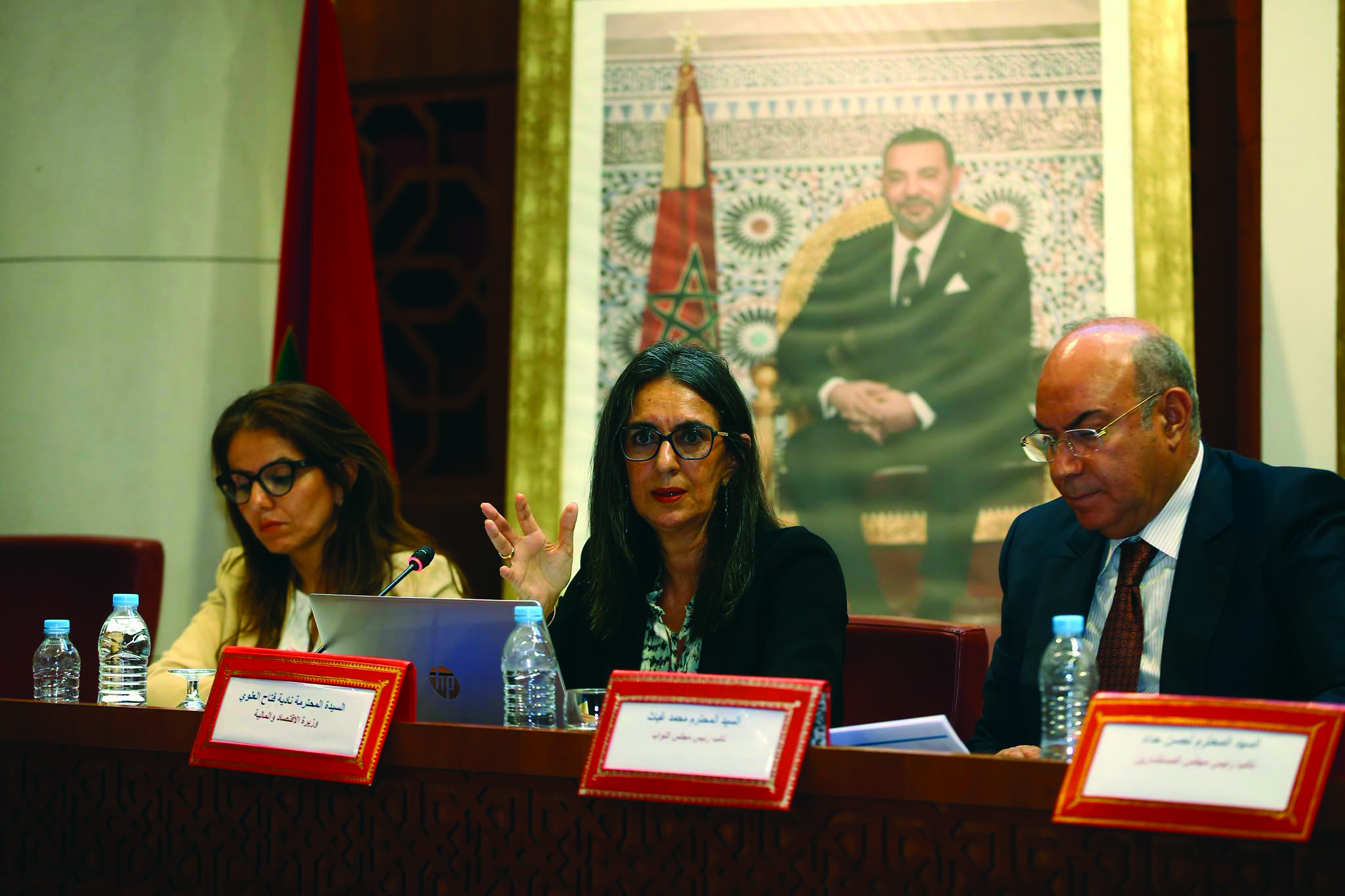
One week after the closure of the last parliamentary session and thus of the legislative term, Nadia Fettah Alaoui, Minister of Economy and Finance, returned to Parliament for the last “oral” of her mandate. Before the joint finance committees, the minister presented the state of execution of the 2026 Finance Law, but above all the performance of the outgoing government, incomparable achievements given the context in which it took over the management of public affairs.
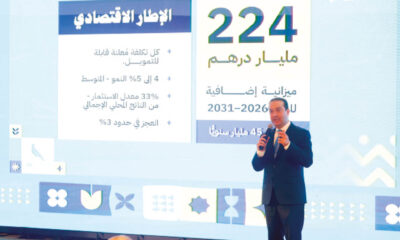
Concretely, as the law now requires, the minister presented the execution of the 2026 Finance Law, the general framework for the elaboration of the draft 2027 Finance Law, and the three-year budgetary programming 2027-2029. In substance, the minister painted a picture of the national economy and traced the broad lines of public finances for the incoming team. Not only are all indicators green, with an economic growth rate of 5.3% by the end of this year, but also the Akhannouch team—this is new—in addition to elaborating the draft Finance Law that will be presented to Parliament a few weeks after the elections, has already designed a kind of “roadmap” for the first three years of the future Executive.
Need we recall that when the head of government presented his program in 2021, he promised a growth rate of 5% towards the end of his mandate. Several political, and even economic, actors doubted his ability to keep this promise. For them, it was unachievable. But he ended up achieving it.
If the Akhannouch government was called upon to manage both a difficult exit from the health crisis, the fallout from the Russo-Ukrainian crisis, and a period of drought already set to last, for the team emerging from the legislative elections of September 23, the path is already traced. Certainly, with the return of rains and above all the large-scale deployment of the national water program, with its main components—the reinforcement of storage, desalination, interconnection of basins, and reuse of wastewater—the question of water stress is no longer posed with the same acuity as five years ago.
However, the geopolitical factor, with the risk of imported inflation, has practically not changed. It is now integrated into the government’s assumptions.
Nevertheless, as the minister emphasized, “the three-year budgetary programming 2027-2029 is based on the continuation of the implementation of major projects and the consolidation of the social state”. The government, she specified, “is counting on a growth rate of 4.1% in 2027, then 4.2% in 2028 and 2029”.
Growth called upon to transform into points of human development, better regional distribution of wealth, and above all job creation.
Growth that Creates Employment
According to the minister, within the framework of the principle of state continuity, the future government should pursue the completion of strategic projects and the acceleration of major reforms. And this, in such a way as to consolidate achievements, ensure their sustainability, and open new perspectives for the continuation of the economic and social dynamic during the next phase.
This, “while ensuring the reinforcement of the effectiveness of public policies and the preservation of economic and financial balances”.
Which will undoubtedly have a positive impact on employment and the deployment of social policies. In terms of employment precisely, the effects of successive years of drought continue to weigh on the labor market, particularly in rural areas.
“Since 2019, the agricultural sector has lost nearly 905,000 jobs, the majority of which were unpaid”, emphasized the minister.
The labor market, she lets it be understood, “has however initiated a favorable evolution from the second half of 2024, which consolidated in 2025 with the net creation of 193,000 jobs. This is the best annual result since 2006, excluding the year 2021, marked by an exceptional recovery of jobs lost during the Covid-19 pandemic”.
This dynamic contributed to bringing the unemployment rate down to 13% in 2025, with an improvement of 0.5 points in urban areas, where it stood at 16.4%. Unemployment nevertheless remains high, particularly among young people, women, and graduates.
In the first quarter of 2026, the first results of the new labor force survey show a workforce of 10.364 million people holding paid employment, while the unemployment rate, measured according to the strict concept, stood at 10.8%. “As retrospective data are still being elaborated, they do not allow, at this stage, precise temporal comparisons”, indicates the minister. However, these indicators “confirm the gradual improvement of the labor market, while highlighting the persistence of challenges related to employment in rural areas and the professional integration of young people, women, and graduates”.
The roadmap handed down to the next government insists above all on the consolidation of the foundations of the social state, but also on territorial equity with the implementation of the new generation of territorial development programs. The objective being, of course, the reinforcement of complementarity between the economic, social, and territorial dimensions. An approach where one no longer goes without the other and where the logic of results prevails. It is thus that the implementation of major projects and sectoral strategies will be pursued, which goes hand in hand with the generalization of the social protection project, through the widening of the field of beneficiaries and the reinforcement of the sustainability of financing the various social protection schemes.
The Social State Definitely Established
The next stage will above all be inscribed, emphasizes the minister, under the theme of the valorization of human capital and the reinforcement of economic and social inclusion.
This through the continuation of the reform of education and teaching systems and the effective implementation of the employment roadmap. The imminent deployment of the new generation of integrated territorial development programs will undoubtedly make it possible to improve access to basic public services, reduce territorial disparities, support vulnerable categories, and improve living conditions of the population in all regions of the Kingdom. The outgoing government also leaves as an inheritance to its successor a cleaned-up business climate, supported by instruments of incentive for productive investment. This through the continuation of the implementation of the Investment Charter, the simplification of administrative procedures, a last decree relating to the CRI and CRUI, having been adopted no later than July 22 last, and the acceleration of the realization of investment projects with economic and social impact.
The outgoing government has thus contributed, even worked extensively, to the creation of an environment conducive to productive investment for employment and added value, through an equitable distribution of investment support mechanisms in all regions of the Kingdom and the reinforcement of their regional governance.
In parallel, the consolidation of industrial sovereignty, through the continuation of infrastructure development, support for national industry, encouragement of innovation, and valorization of the “Made in Morocco” label constitute a lever for industrial and territorial development. To this are added the reinforcement and development, currently underway, of road, rail, port, and airport infrastructure.
This without forgetting the major project that will also change the daily life of citizens: the digital transformation currently in an acceleration phase with the development, at the same time, of solid infrastructure capable of reinforcing network connectivity, cloud computing capacities, as well as data security and transparency.
Finally, the minister also mentioned a project, and not the least, that will completely transform the face of Morocco: energy. Fettah Alaoui highlighted the consolidation of energy independence and transition towards clean energies, through the development of green hydrogen and the implementation of the natural gas roadmap. A project—recent events show it—that is already largely advanced and that will make the Kingdom, today strongly independent of hydrocarbons, a net energy exporting country in a few years to come.