Kingdom
Women’s Access to Justice: Ouahbi Brings Together Institutional Actors and Civil Society
The seminar organized in Rabat served as a space for dialogue and consultation among various institutional stakeholders and civil society actors on ways to strengthen women’s access to justice and to develop legal and institutional safeguards aimed at protecting their rights.

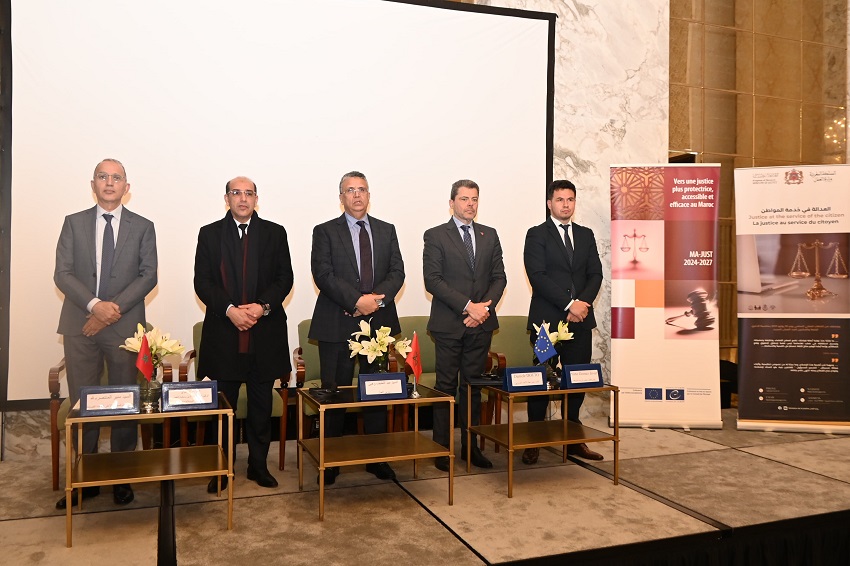
As part of the celebration of International Women’s Rights Day, the Ministry of Justice organized a national seminar on Tuesday, March 10 in Rabat under the theme “Women’s Access to Justice: Achievements, Challenges, and Prospects,” in partnership with the Council of Europe, within the framework of the MA-JUST program: Toward a more protective, accessible, and efficient justice system in Morocco.
The seminar was chaired by the Minister of Justice, Abdellatif Ouahbi, in the presence of several government and judicial officials, representatives of constitutional and national institutions, as well as experts, academics, and members of legal professions.
The event also saw broad participation from around one hundred representatives of civil society organizations working in the fields of justice, human rights, and women’s rights.
The seminar served as a space for dialogue and consultation among institutional stakeholders and civil society on ways to strengthen women’s access to justice and to develop legal and institutional guarantees aimed at protecting their rights.
It also provided an opportunity to assess the progress Morocco has made in this field and to examine the prospects of ongoing legislative reforms, both in civil and criminal law.
In his address on the occasion, the Minister of Justice emphasized that the celebration of International Women’s Rights Day is a privileged moment to reflect on the progress made by the Kingdom in promoting women’s rights and to measure the achievements accomplished, while also offering an opportunity to renew discussion on future actions needed to consolidate effective equality between women and men and to strengthen the protection of women’s rights within society.
The minister added:
“The defense of women’s rights is not a slogan raised during commemorations, but a daily struggle for dignity, justice, and equality. There can be no true justice or modern democratic society if women cannot access justice freely and effectively, and if they do not have a strong legal framework protecting them against all forms of violence and discrimination.”
He recalled that Morocco has made significant progress over the past decades in promoting women’s rights at the constitutional, legislative, and institutional levels. In this regard, he referred to the reform of the Family Code in 2004, which represented a major step in strengthening women’s rights and their position within the family and society, as well as the progressive provisions enshrined in the 2011 Constitution, which affirmed the principles of equality and non-discrimination and reinforced the Kingdom’s commitment to international human rights conventions.
The minister also noted that the legislative reforms currently underway are part of a comprehensive reform vision led by His Majesty King Mohammed VI, aimed at modernizing the legal framework in order to strengthen the protection of rights and freedoms and to accompany the social changes taking place within Moroccan society.
In this context, he emphasized that the reform of the Family Code constitutes one of the major legislative projects currently under study. It is being carried out through a broad participatory approach involving various constitutional institutions, human rights bodies, and civil society actors, with the aim of strengthening the protection of the rights of women and children and reinforcing justice within the Moroccan family.
The minister also highlighted the importance of the new measures introduced in draft procedural laws, particularly the Code of Criminal Procedure and the Code of Civil Procedure, which help reinforce the principles of a fair trial and improve mechanisms for the protection of victims, especially women victims of violence. These reforms aim in particular to develop support and protection mechanisms within courts, strengthen the role of units responsible for assisting women and children, and reinforce measures to combat violence, sexual assault, and human trafficking.
He also stressed that the Ministry of Justice is working to institutionalize a gender-based approach within the justice system through the establishment of dedicated institutional mechanisms, notably the Gender-Sensitive Justice Observatory. This body is responsible for monitoring and evaluating public policies in this area and promoting access to justice for women, children, and vulnerable groups, while supporting the work of support units for women victims of violence within courts.
At the conclusion of the seminar, the launch of a HELP program training session dedicated to the theme “Gender Approach and Women’s Access to Justice” was announced. This human rights training program, intended for legal professionals, aims to strengthen their capacities and promote the integration of a gender perspective into daily legal and judicial practice, thereby contributing to the promotion of a more equitable and inclusive justice system.
Finally, participants emphasized the importance of strengthening partnerships with civil society, considered an essential actor in defending women’s rights and in supporting public policies aimed at promoting equality and ensuring women’s fair and effective access to justice.