Kingdom
When the Hammam Comes Home
Long associated with neighborhood bathhouses, the hammam ritual is now taking on a new form. Since the Covid-19 pandemic, at-home hammam services have been on the rise. Exfoliation with black soap, massages, and traditional treatments—professionals recreate the atmosphere of the Moroccan bath in their clients’ homes.

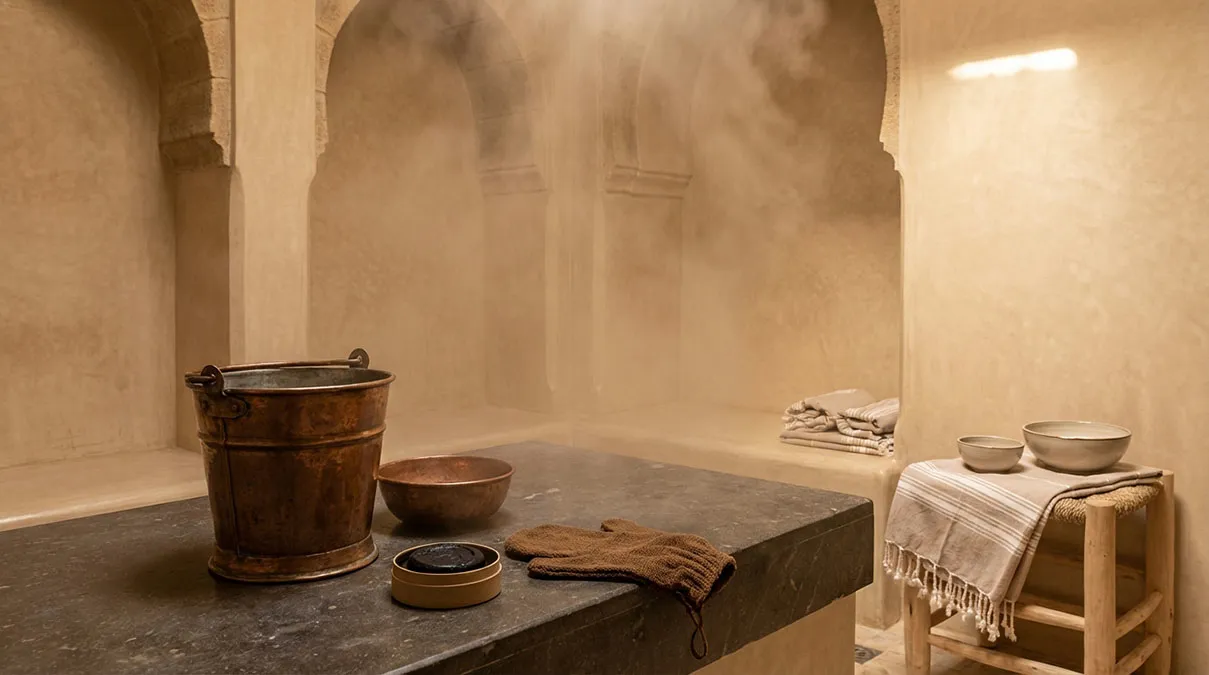
The hammam ritual has always been experienced in public bathhouses—places of social interaction deeply rooted in Moroccan culture. But in recent years, another practice has been gaining ground: the at-home hammam.
This trend, which accelerated after the pandemic, is gradually transforming how this moment of well-being is experienced. More and more women—those who can afford it—are bringing the hammam into their homes, turning their bathrooms (when they don’t already have a traditional “beldi” bath) into spaces for relaxation and care.
Fatima, a former “tayaba” (bath attendant) in a public hammam, took on a series of small jobs after 2020—street vendor, cleaner, waitress—before deciding to embark on this new venture.
“The idea didn’t come out of nowhere. A client who had Covid several times called me one day and asked me to come to her home for an exfoliation. At first I was surprised, but it turned out to be a promising experience: I was paid 200 dirhams instead of 100, and she gave my number to several acquaintances. I remember that in one week, I earned 2,300 dirhams. I didn’t think long before switching to being a home-based ‘tayaba’,” she says.
She adds, “This service has nothing to do with my work at the neighborhood bath, which didn’t bring in much. I used to go home in the evening with 100 or 150 dirhams after sharing the day’s earnings with my two colleagues. Now, I can earn between 1,000 and 1,500 dirhams!”
At first, Fatima’s business wasn’t as profitable because she initially offered her services to regular clients of the hammam where she worked. “They paid me 70 to 100 dirhams depending on their means, and I used their products. I did two to three hammams per week. But later, when my daughter talked about it on social media, my business grew and I was able to get clients who could pay more,” she explains.
600 dirhams for exfoliation and soaping at home
Her clientele now mainly consists of women living in neighborhoods such as California, Bouskoura, and Anfa. Many of them have a hammam in their villas or large bathrooms.
To provide the best service and ensure quality, Fatima invested in equipment: work clothes, buckets, stools, exfoliating gloves, black soap in different scents, henna, tabrima, nila, orange blossom water, rose water, lavender floral water, and powdered clove.
“I automatically offer my products, and the clients also have their own bath product ranges,” says Fatima, who, concerned with service quality, bought a used car “to transport my equipment and, above all, to be on time for clients—some of whom even used to send their driver for me,” she explains.
She adds, “I offer the traditional beldi ritual, which is in high demand for brides or young mothers after childbirth.” She notes that “for brides and young mothers, the service costs 800 dirhams. But often, clients are generous and give me a bit more.”
Like Fatima, many women have entered this line of work. Former hammam employees or young beauticians, they have opted for freelance work, which is more profitable and offers flexible hours. Their only concern is its informal nature. To address this, Fatima and her peers believe that creating a small business could be an option.
In terms of pricing, at-home hammams are now in a range similar to mid-range spas—sometimes even on par.
According to Fatima, this is due to the logistics involved: travel, transporting equipment, and purchasing products. But in return, she says, “the client enjoys a moment of well-being in the privacy of her home without having to travel.”
In a mid-range spa, a 60-minute hammam costs between 300 and 500 dirhams for exfoliation and soaping. For specific rituals that include massage and body and hair treatments, the price can reach up to 2,000 dirhams.
If clients pay a bit more for an at-home hammam, it’s because this wellness option combines the comfort of home, privacy, time-saving, and personalized service.
This home-based “tayaba” also offers hair and body treatments, using either the client’s products or her own recipes, while adapting them to each client’s needs.
And each service comes at a price: hair and body treatments cost an additional 100 to 150 dirhams. The at-home hammam may not replace traditional bathhouses, but it reflects a new way of experiencing tradition—regardless of cost—while adapting to the constraints and desires of a busy urban clientele.