Kingdom
Water: A Two-Pronged Strategy
The program to build large dams is continuing. At the same time, new high-capacity desalination units are taking shape. The Kingdom has prepared for both contradictory scenarios.

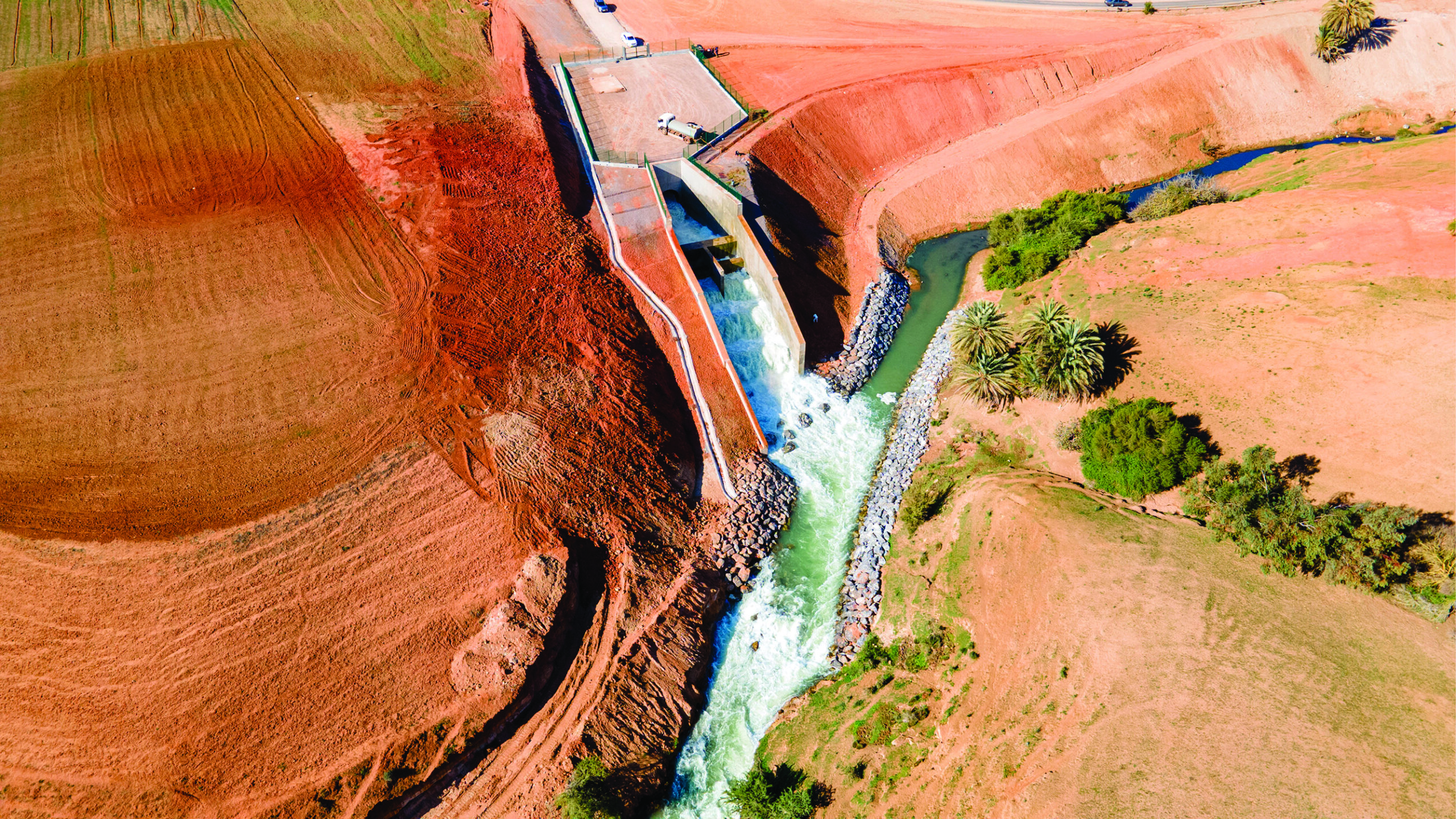
For several days now, the dam fill rate has exceeded the 70% threshold. Nearly 12 billion cubic meters are stored in the large and medium-sized dams listed on the Ministry of Equipment’s day-by-day updated register. As of February 23, 35 dams exceeded an 80% fill rate.
That should be enough to cover two years of drinking-water needs for Morocco’s entire population. Various meteorological forecasting models are still predicting rain in early March, while the temperature increases of recent days should speed up the melting of snow that, only a few days ago, still covered an area of more than 10,000 km², compared with an unprecedented peak of 55,500 km².
The Oum Er-Rbia and Tensift basins should benefit in particular. Faced with such a situation, the government is nonetheless continuing its water mobilization program, especially for non-conventional water. The Casablanca desalination plant will be commissioned on schedule.
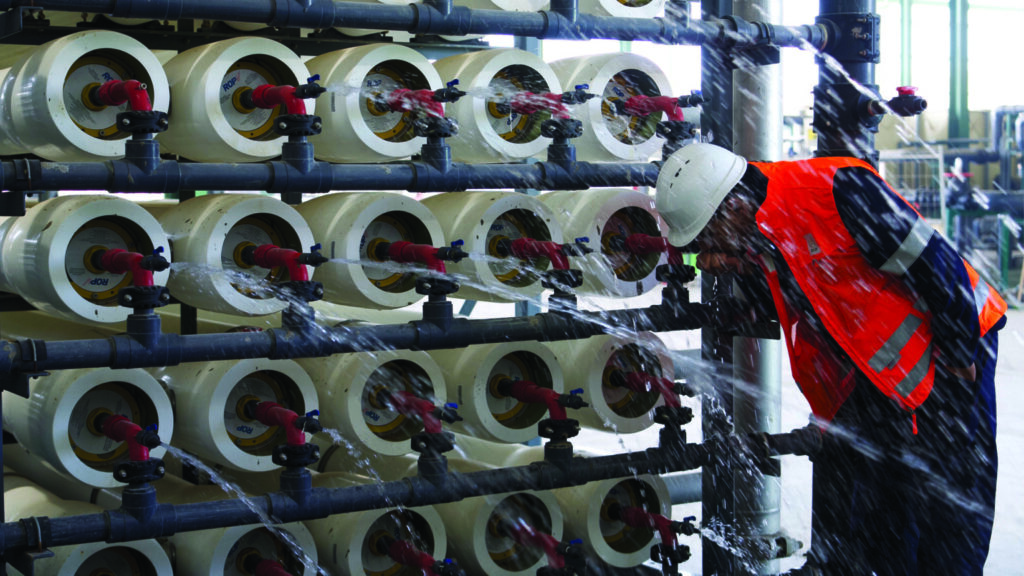
Construction work on the Tiznit plant—the largest in Africa—will start toward the end of the year. The same applies to the Rabat plant (300 million m³), as well as the Nador and Tangier plants. In parallel, OCP is continuing its program to mobilize non-conventional water (desalination and wastewater treatment), with a target of more than 1 billion cubic meters by 2030.
The Group is moreover about to complete its project to convey desalinated water to Marrakech. Work is continuing to supply the city and neighboring communes with drinking water via 185 km of pipelines linking the city to the Safi seawater desalination plant.
Progress on this major project has reached 90%, and its effective commissioning is scheduled for next April. It will guarantee water inflows estimated at 80 million cubic meters per year for Greater Marrakech.
Water–energy–food
Meanwhile, another large-scale project is moving forward. The interconnection of water basins should ultimately link Oued Laou in the North to the El-Massira dam in the South, passing through Loukkos, Sebou, and Bouregreg.
The interconnection between the Oued El-Makhazine and Dar Khrofa dams is now operational with a flow rate of 3.5 m³ per second, i.e., an annual transfer volume of 109 million m³.
Work on the water highway between Bouregreg (Sidi Mohammed Ben Abdellah dam) and Oum Er-Rbia (El-Massira dam) will be launched toward the end of the year (with a transfer capacity of 800 million m³ per year), alongside a vast agricultural irrigation program covering nearly 250,000 hectares.
This water highway will be operational three years later. The interconnection of hydraulic basins is not a new strategy. It was adopted in 2009 under the El Fassi government, but was never activated until the advent of the current government.
What must be understood is that the water highway is not just pipelines and pumping stations. It is an entire network of dams interconnected with one another. This also implies a supply of electricity.
This is to say that it is a comprehensive strategy which, to carry through, requires an advanced level of coordination and proactivity. And if the interconnection between Sebou and Bouregreg (currently at 400 million m³ per year and set to rise to 800 million m³ per year) was completed in nine months, it is because the government, even under pressure, was able to demonstrate sufficient coordination and anticipation.
The project is being carried out in perfect coordination among the ministries responsible for Equipment and Water, Agriculture, and Energy, in addition, of course, to the Ministry of the Interior—particularly through local authorities. This comes at a time when, under the previous government, divergences were clearly evident within the same department on this highly strategic issue.
Geopolitics of water
It is, moreover, in this spirit of anticipation, coordination, and mobilization of technical skills and expertise that the dam-construction program is continuing according to the schedule set from the outset, with time gains of up to more than a year on certain projects.
First, it should be emphasized that the government did not wait for the latest rains and the pressure experienced—and still being endured—by the Oued El-Makhazine dam in the Loukkos and the Al-Wahda dam in the Gharb to launch major projects capable of reducing this pressure and enabling better water management. Note in passing that no less than 4.2 billion cubic meters were released, mainly by these two structures.
Thus, construction work on the Tifar dam, with a capacity of 900 million m³ upstream of the Oued El-Makhazine dam, will be launched this year. The project start had been planned for 2025, but it was delayed for social reasons, notably linked to the expropriation procedure.
The situation experienced by the Ksar El-Kébir region will no doubt accelerate the realization of this project. Upstream of the Al-Wahda dam, on Oued Lben, the Sidi Abou dam, with a total capacity reaching 200 million m³, has been completed since late 2025. The watershed covers 833 hectares.
Work began at the end of 2021 and was completed at the end of 2025. It is, in fact, a complex structure composed of two reservoirs, whose function is to limit the silting up of downstream dams, provide drinking and irrigation water (nearly 5,000 hectares), and produce hydroelectric power.
Here we find a concrete expression of the energy–water–food nexus highlighted in projects of this kind carried out by the government, whether with a dam or a desalination plant as the nodal element.
Staying with dam projects, it is in the Oriental region that the works under way are particularly drawing attention, because in addition to the above-mentioned approach, geopolitical elements also come into play.
While raising the Mohammed V dam (70% completion rate) in Taourirt presents nothing special apart from its storage capacity being increased to 1 billion m³, the almost-completed construction of the Kheng Grou dam in Figuig Province, with a storage capacity of 1 billion m³, is prompting extensive comment.
Work will be completed next July, and its significance will go beyond supplying the area with drinking water and irrigating agricultural land. Another, smaller-scale infrastructure is planned in Guercif: the Targua Oumadi dam, with a capacity of 287 million m³, has reached a completion level of more than 84%.
Monitoring system
Together with the Kaddousa dam on Oued Guir further south—which has undergone an upward revision and thus a capacity extension in recent years (currently at more than 36% fill rate, corresponding to nearly 80 million m³)—this set of infrastructures falls within what is known as water sovereignty.
The term takes on its full meaning in this particular case. One thing is certain: even with the development of desalination and the impact of climate change, dam policy is no longer a simple government policy or a development choice, but an existential necessity.
The Kingdom knows where it is headed. The objective it has set for itself—and is close to achieving—is to supply 100% of Moroccans with drinking water and to mobilize water for the irrigation of 80% of irrigated land, regardless of the level of rainfall. To achieve this, three levers are being activated at the same time.
Continuing dam construction, multiplying desalination units—with an installed capacity of 1.7 billion m³ of desalinated water in 2030—and reusing wastewater. On this last component, Morocco is about to reach a new milestone.
Water reuse will increase from 40 million m³ currently to 100 million m³ in 2027, reaching 350 million m³ in 2035. This water is already used to irrigate green spaces, sports fields and golf courses, and roadside and roadway verges.
The objective is to move into agriculture, more specifically arboriculture. Without waiting to have to manage a situation as difficult as that of the Gharb and the Loukkos, the government had already undertaken measures to limit its impact. An “Atlas of floods” is, in fact, currently being updated.
Likewise, a “Vigicrues” (flood-monitoring) system is being installed. At the same time, the General Directorate of Meteorology has, for several years now, begun sending each commune a daily weather bulletin.
As needed, an alert bulletin is also issued every day. Once again we find this three-part formula that works every time: anticipation, coordination, and mobilization of national expertise.
20 billion m³, and investment continues
Morocco currently has 154 large dams, offering a total storage capacity exceeding 20 billion cubic meters. This says a great deal about the scale of sustained public investment in this sector over several decades.
According to data confirmed by the Ministry of Equipment and Water, work is currently continuing on the construction of 14 new large dams. Two dams have already been completed recently and have entered into operation. Investment effort in dams is not limited to large structures.
It also includes medium-sized and hill dams, which are essential for supplying rural areas, supporting solidarity-based agriculture, and protecting mountainous zones. In this regard, four medium-sized dams are under construction, two are planned, and 155 hill dams are scheduled by 2027.