Kingdom
Three New Installations to Discover at MACAAL
The Musée d’Art Contemporain Africain Al Maaden (MACAAL) is honored to present, on February 8, 2026, three new installations as well as a new selection of works from its collection as part of its permanent circuit.

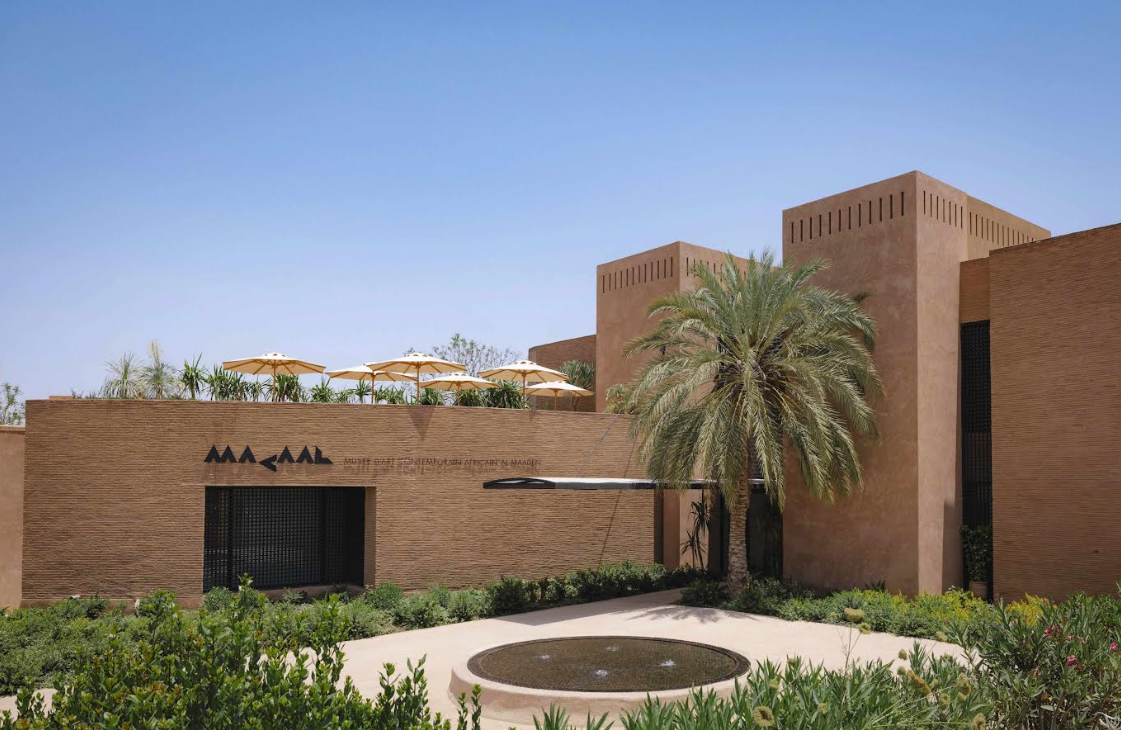
Seven Contours, One Collection, inaugurated in February 2025, brings together around a hundred works from the MACAAL collection and explores seven major themes, such as decolonization, spirituality, ecological issues, and Afro-diasporic movements. Through a diversity of media—including painting, sculpture, photography, video, textile, and installation—Seven Contours, One Collection sets modern and contemporary artists such as Josèfa Ntjam, Sammy Baloji, and Chaïbia Talal into dialogue, affirming MACAAL’s commitment to making contemporary African art accessible to the public.
Within its permanent circuit, MACAAL reserves three spaces for temporary installations that resonate with the museum’s themes. The Atrium hosts Statues Also Breathe, a collaborative sculptural project by artist Prune Nourry, accompanied by a documentary retracing its making. The museum staircase is taken over by Crazy Lines, an in situ installation by Yassine Balbzioui. The Artist Room will host Ila Turab, an immersive and ephemeral work by Fatiha Zemmouri.
Statues Also Breathe: A work of memory and collective resilience
MACAAL presents Statues Also Breathe, a major sculptural project that celebrates the power of the collective. Supported by the Catharsis Arts Foundation, this installation was born from a collaboration between the Department of Fine and Applied Arts of Obafemi Awolowo University in Ile-Ife (Nigeria), students from across Nigeria, women potter-artisans, the families of the Chibok girls—then secondary-school students—who went missing following Boko Haram’s kidnappings in 2014, and artist Prune Nourry.
Rooted in Ile-Ife, the historic cradle of Yoruba civilization, this project reactivates the ancestral tradition of terracotta work applied to the human figure, notably through the representation of sculpted heads. Conceived as an indivisible whole, the work consists of 108 sculptures made from local clay, inspired by eight initial portraits and shaped by a multitude of hands. It invites visitors to gather themselves before the silent strength of the clay army carried by Prune Nourry, offering a moment of contemplation and reflection.
Beyond aesthetics, Statues Also Breathe bears a clear educational and social mission. On the one hand, the transnational collaboration places the Nigerian university at the heart of the creative process, ensuring a lasting transmission of knowledge. On the other hand, the work acts as an act of remembrance: the entire set of sculptures pays tribute to the Chibok schoolgirls and aligns with a global struggle for girls’ education and a refusal to forget. The installation continues with a documentary film that gives voice to the mothers, survivors, and participants, making storytelling an essential component of the work. The Catharsis Arts Foundation supports this project so that it may remain a lasting tool for dialogue and repair around the world. After being presented in Lagos and internationally, the project continues its journey in Marrakech, reaffirming the museum’s commitment to an artistic dialogue that is both poetic and socially conscious.
Crazy Lines: A visual cosmology by Yassine Balbzioui
Created specifically for MACAAL, Crazy Lines goes beyond the scope of a conventional installation to assert itself as an artistic integration at the heart of the architecture. Yassine Balbzioui takes over the museum staircase—a place of passage—to unfold an immersive work conceived as a transitional space, inviting visitors to move through his universe, where the gaze settles as much as it travels. Produced between December 2025 and January 2026, this intervention attests to the artist’s mastery and the density of his personal cosmology, the result of preparatory work carried out during his residency at MACAAL.
The installation combines a wall fresco, oil paintings, and sculptural framing in a dense composition that evokes the idea of set design and staging. The painting spills out of the frames to occupy the space, extending the narrative and placing the visitor in a position close to that of a theatre spectator. The mask, a recurring motif in the artist’s practice, becomes here a visual constant rather than a sign to be interpreted, pointing to a performed—sometimes caricatural—humanity in which the characters seem trapped in their own roles.
Each element of this work functions autonomously while still connecting with the whole, forming a coherent ensemble. The diversity of materials and the precision of the dispositif reflect a rigorous approach, through which Crazy Lines fits seamlessly into MACAAL’s architecture, accompanying the visitor’s natural movement and transforming the passageway into an inhabited space that invites pausing and observation.
Ila Turab: Writing on the ground between earth and passage
Presented in the Artist Room by Fatiha Zemmouri, Ila Turab is a floor intervention composed of writing in earth executed in Arabic diwani calligraphy.
The installation brings into relation two sentence fragments whose lines intersect and overlap in space: min turāb (“from the earth”) and ila turab (“to the earth”).
Made in situ, the work presents itself as an invitation to silence, a meditative accompaniment along a circular movement. Starting from an area of dense earth, the writing heavily overlaps and becomes partially illegible. As one moves forward through the space, this density gradually decreases: the signs separate, and the phrase ila turab appears more and more legibly, structuring the progression toward a central point.
Here, writing leaves the sign to become matter and deposit. Language becomes earth, drawn down to the ground by a form of gravity. Reading is experienced through walking and through the body, across the variations in density. The work opens a sensorial experience of returning to the earth, without religious assignment, linked to burial, silent memory, and transmission through gesture.
The earth, used as the sole material, retains its texture and fragility. Part of it comes from the Tahanaout region, and another part comes from the work In the Arms of the Earth by Salima Naji, exhibited last year in MACAAL’s atrium. Conceived as a welcoming “house,” that work symbolized Mother Earth, the common origin of all human beings. Ilā turāb thus stands as a gesture of homage, extending material drawn from an earlier work into another context, through another form of writing.