Kingdom
These Derivatives That Multiply the Value of Phosphate (1/2)
Moroccan phosphate is not just about fertilizers. Its derivatives, currently being exploited, range from uranium to electric battery components. With its rare earth content, it is becoming a global stake in cutting-edge industries.

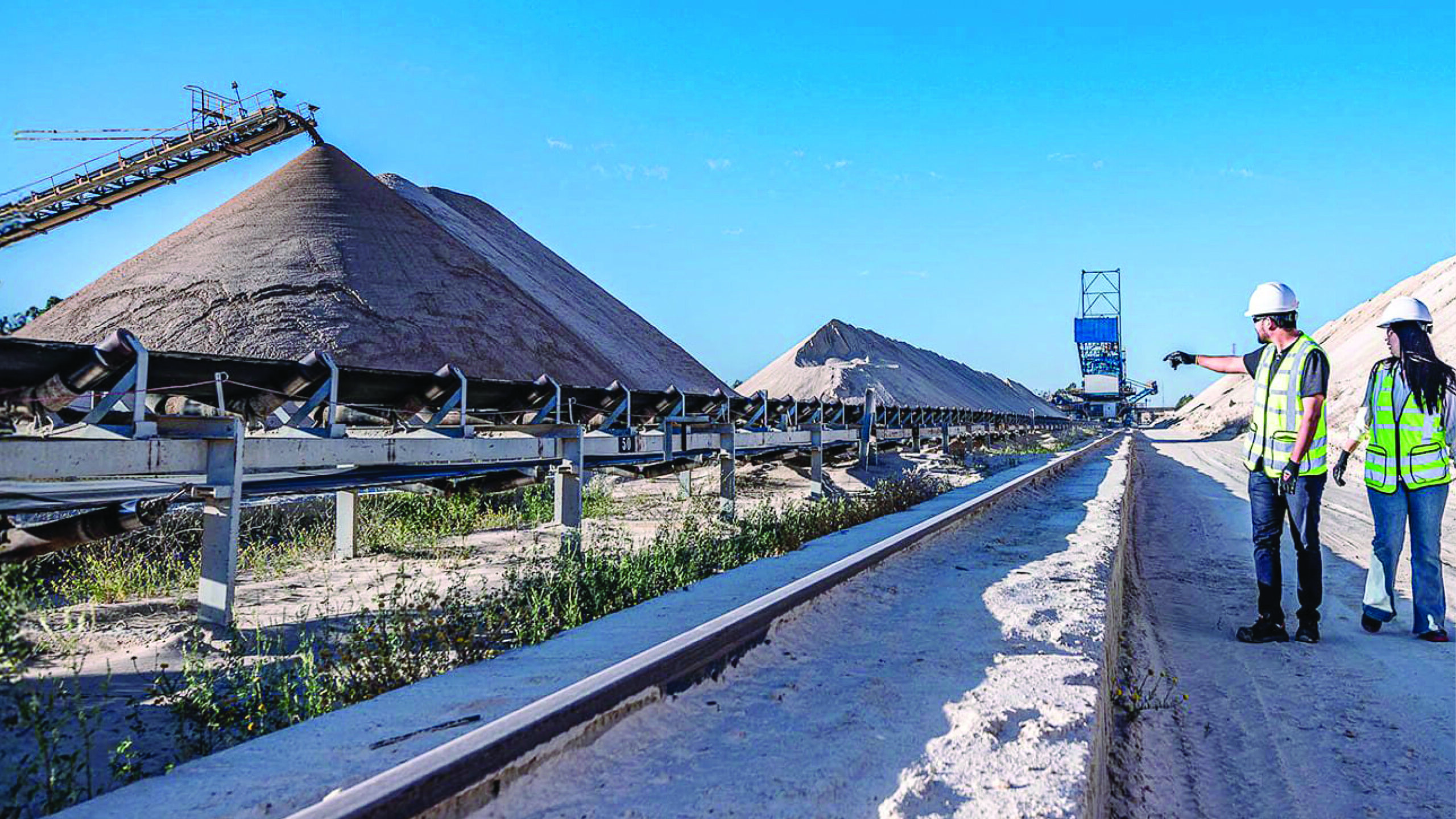
In an emerging country, this is an industrial revolution. The Cherifian Office of Phosphates has just placed an order for its green energy storage needs: the very first batteries based on phosphate “made in Morocco.” OCP does not only supply the main element, phosphate, but also other battery components like electrolytes manufactured in one of its subsidiaries, Fluoralpha.
The loop is thus closed, so to speak, and a large part of the value chain of this new industry is located within the Kingdom. Furthermore, the battery produced using a decarbonized process, through the use of non-conventional source water produced by OCP Green Water and renewable energy supplied by OCP Green Energy, will have as its very first use in Morocco the storage of green electricity.
In a rather rare case for countries exporting natural, mining, and hydrocarbon resources, the ratio of raw rock in exports is diminishing as shipments of finished products or industrialized derivatives abroad increase. This is one of the few cases, if not the unique one in Africa, where the natural resource is not considered as mere rent and exported as such, but as a lever for development for the entire country. Even as an instrument of influence on the international level.
Exports from the phosphate sector have undergone a major transformation, marked by a strategic shift towards local processing. The Kingdom has massively invested to transform raw phosphate on-site into higher-value-added fertilizers, thereby reducing the relative share of raw rock in its exports.
Concretely, the proportion of rock in total phosphate exports has decreased significantly over the last decade, falling from about 40-50% by volume in the early 2010s to 15-25% on average for the period 2014-2024.
Rock exports fluctuated around 20-25 Mt per year during the 2014-2016 period, before stabilizing or slightly decreasing to around 10-15 Mt annually starting in 2020. In value terms, statistical data indicates that fertilizers now represent approximately 69% of the OCP group’s revenues. This trend has been accelerating for several years already.
Recycle and Revalorize
For nearly two decades, the credo of the flagship of the national chemical industry has embraced an adaptation of the famous phrase by French chemist Antoine Lavoisier. “Nothing is lost, everything is transformed.”
Thus, residues from the transformation of phosphate into fertilizers like fluorite or phosphogypsum, or even uranium once unexploited due to high extraction costs, are now at the heart of new cutting-edge industries. Fluorite, for example, goes from an “industrial waste” to an essential component in modern lithium-ion batteries due to its stability and safety.
From batteries to nuclear energy, through medicine, agri-food, and industry, phosphate derivatives are finding uses previously never suspected.
Indeed, beyond agriculture, phosphate derivatives are used in animal feed supplements, detergents, food additives, medicine, and even in high-tech applications, like batteries and semiconductors, as well as in the defense and cardboard industries.
According to experts, the industrial applications of phosphate currently represent a relatively small share of demand, about 5%, but they are strategically important and expanding rapidly. The growing adoption of LFP batteries is leading to a significant increase in phosphate demand forecasted for energy storage and electric vehicles.
According to estimates, the LFP battery market is expected to grow by 25.6% per year, from $15.3 billion in 2023 to $124.4 billion in 2032. The demand for phosphate for batteries could thus exceed 3.8 million tons per year by 2030, slightly more than 10% of Morocco’s current production, highlighting its strategic role in the global energy transition.
In parallel, fertilizer demand is expected to grow, for its part, by 4.3% per year between 2024 and 2032, also accentuating OCP’s strategic role in global food security.
Rare Earths, OCP a Future Strategic Actor
A clarification first. Rare earths are a group of seventeen metallic elements. They are essential to many industries and are considered strategic elements or critical raw materials. They are also at the center of a major political issue and a trade war between China and the United States.
Global mining production amounted to 210,000 tons of rare earth oxide equivalent (REO) in 2019, according to figures published by USGS in 2021. According to slightly older data, dated 2014, the average REO content of Moroccan phosphate deposits ranges between 415 and 900 ppm.
Approximately 15,000 to 30,000 tons of REO, or 7 to 15% of the world’s annual REO production, are thus extracted each year from Moroccan phosphate rock and transferred into solid phosphogypsum (PG) in the phosphoric acid manufacturing process, the global demand for which, by the way, continues to grow.
Just as for uranium in the past, extracting these rare earths from phosphogypsum is economically difficult. However, according to experts, recovering rare earths from liquid phosphoric acid using low-cost techniques could be economically viable.
Now, according to a study on the subject, “the Khouribga residue, with a total rare earth concentration of 577 ppm (328 ppm of heavy rare earths and 249 ppm of light rare earths), in which yttrium (Y) constitutes the majority fraction with 240 ppm, is treated at the Jorf Lasfar El-Jadida chemical complex.”
The Youssoufia phosphate contains about 228.77 ppm of rare earths according to a study published in 2021, with a higher yttrium content (143 ppm). Y₂O₃ is also the most abundant rare earth oxide, both in quantity and value, in the Khouribga production residue. This residue is treated at the Jorf Lasfar chemical complex.
Silica being known as one of the best, if not the best, process for extracting rare earths from phosphogypsum, the launch, by an American group, of a polysilicon plant in Tan Tan, of which at least 15% of the production, which is around 30,000 tons, is destined for the local market, could be a lead. For now, no industrial project has been announced by OCP in this direction. It is known, however, that the Office is interested in rare earths.
The group is indeed working on extracting rare earths to turn them into high-value-added products as part of its diversification strategy. The subject is even covered by a framework agreement, concluded in 2022, between the group, UM6P, and the British company Rainbow Rare Earths, the objective of which is to develop rare earth extraction techniques.
It is also known that OCP, thanks to research conducted by UM6P, “holds the intellectual property, know-how, and expertise in the field of phosphogypsum treatment, including adapted complementary separation technologies.”