Kingdom
The war against corruption has been launched
The signals do not lie. Morocco has just engaged in a war against corruption. All means are mobilized: data, field actions, citizen contributions, judicial investigations… The battle plan.


Recent statements by the Minister of the Interior, Abdelouafi Laftit, in a parliamentary committee have sparked many reactions and a lively debate. Many see it as the announcement of a merciless war against corruption, which has already begun in Casablanca, he says, and will spread to other regions of Morocco.
An audit is already underway within the elected bodies of the metropolis. The minister declared in essence that anyone having put their hands on communal, land, or financial property must return it willingly or by force.
“We will not negotiate. And we intend to go back as far in time as necessary, and there will be accountability to the people”, the minister insisted. Some observers believe the minister would not have spoken this way if he were not convinced that the services of his department would not stop halfway.
The reality is that at his level, the Ministry of the Interior has already launched the battle against corruption, and more broadly against malfeasance, the infamous “Fassad”. Local governments are often cited in reports and investigations on corruption among bodies where the scourge is widespread.
That said, the minister’s words are supported by the changes taking place in institutional policies for prevention and fight against corruption. The signals are unmistakable.
Last June, barely appointed, the new head of the public prosecutor’s office gave strict instructions to all magistrates of the Public Prosecutor’s Office to forward all reports from the Court of Auditors and the General Inspection of Territorial Administration (IGAT which falls under the Ministry of the Interior), containing criminal dysfunctions, to the National Brigade of the Judicial Police (BNPJ) as well as regional brigades, and to the National Brigade of the Royal Gendarmerie (BNGR).
A second strong signal came on October 7, 2025, when the National Instance for Integrity, Prevention and Fight against Corruption (INPPLC) and the General Directorate of National Security – Territorial Surveillance Directorate (DGSN-DGST) signed a partnership agreement that goes “beyond a simple technical cooperation mechanism”. This agreement aims to reinforce the national anti-corruption system.
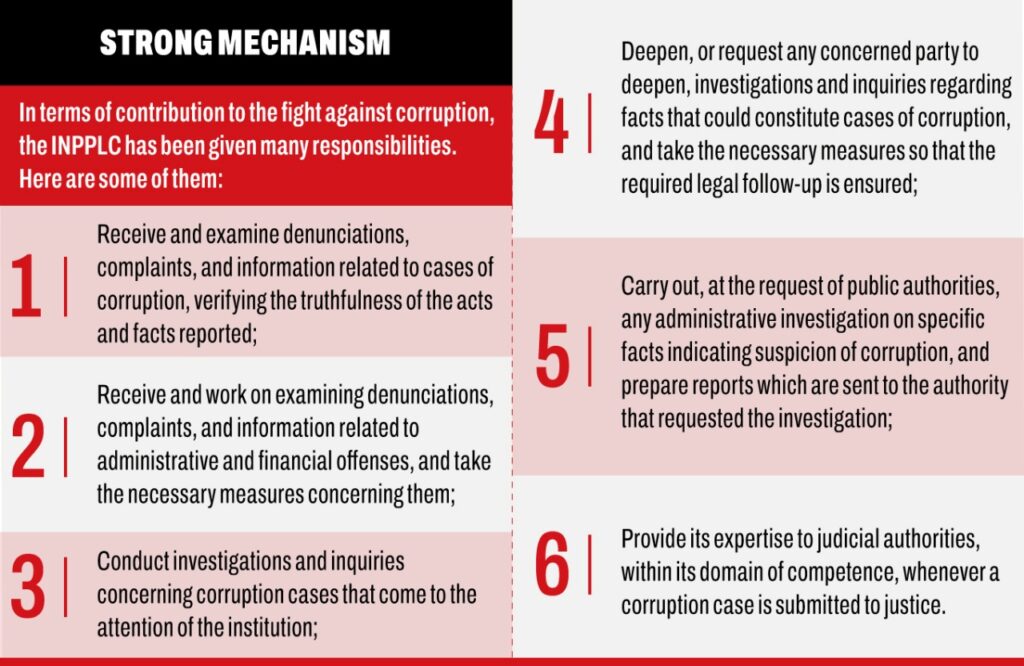
It lays the foundations of the new approach to fighting corruption in Morocco, consisting of establishing a complementary mechanism between a security body and an independent constitutional authority, the INPPLC in this case. It is precisely through the INPPLC, established as the spearhead of this anti-corruption war, that the Kingdom intends first to change reality on the ground and then, consequently, its global indicators.
This scourge is also cited as one of the obstacles, if not the main obstacle, to investment. With this war, not only will the negative impact, measured in GDP points, be reduced, but it will also lead to an improvement in foreign direct investment flows.
Concrete measures
Thus, the Kingdom intends, first, to develop a national system of quantitative and qualitative indicators to measure integrity, monitor corruption, and assess the effectiveness of public policies. This is essential to define the battlefield.
Specifically, the INPPLC now plans to conduct periodic thematic studies and reports contributing to knowledge production and better public decision-making concerning corruption prevention. This has always been its basic work since its creation.
For example, to start, the Instance has decided to contract, through a call for tenders, a study firm to create a map of corruption in the health sector. This choice is not accidental, since according to various studies and dedicated reports, this is the sector where the perception of corruption is the strongest.
The firm was indeed chosen, but for known reasons, the opinion of the National Markets Commission (at the General Secretariat of the Government SGG) must be awaited for the effective launch of this study. Another concrete action is that the Instance has started, a few days ago, a project to create a national knowledge base on corruption.
The objective is to “fill the deficit in reliable indicators and centralize dispersed data related to this phenomenon”, the institution said.
This database should serve as a strategic tool supporting the missions of the Observatory — a new body of the Instance — “responsible for analyzing the different forms of corruption in the public and private sectors, conducting field studies, and developing national indicators enabling the monitoring of the phenomenon’s evolution and evaluating the effectiveness of public policies”.
In the same spirit, a national secure corruption reporting system is planned, alongside targeted field initiatives “to anchor a culture of integrity and open up to youth, civil society, and the world.”
Among the planned actions is also establishing a legal and institutional vigilance system to detect legislative and regulatory gaps and ensure the continuous adaptation of the national legal system so that it complies with international anti-corruption standards.
There is also the practical objective of strengthening the capacities of Instance agents charged with research and investigation missions.
Ongoing strategy
Among the projects also announced during the Instance’s budget presentation to the first chamber is the creation and activation of regional offices to ensure territorial proximity and listening.
The INPPLC will also launch a national digital survey to collect citizens’ opinions, perceptions, and experiences regarding integrity and corruption in public service. A specialized call center will also be created to receive reports, complaints, and information related to acts of corruption.
It must be noted that this is a new approach: a methodical approach for better knowledge of the ground through the Observatory, created within the Instance under the authority of the president. This observatory, under law 46-19, carries out several other missions besides studies and investigations, notably the development and regular monitoring of national indicators.
This is also where the recent decision to set up a “national knowledge base on corruption” fits. This initiative, the Instance states, “is part of a strategic vision aimed at consolidating knowledge as an essential lever to illuminate public policies, optimize their effectiveness, and restore trust between citizens and institutions”.
This database relies primarily on inquiries conducted directly by the INPPLC, while also incorporating data from institutional reports produced at national and international levels, as well as administrative databases from partner public administrations.
The new approach also involves citizens through studies and surveys, but also through tools set up to collect complaints and denunciations, as well as the call center.
The judicial phase, according to the Instance’s new assignments, uses tools granted thanks to its partnership with the General Directorate of National Security (DGSN).
Above all, this is a complementary approach with other institutional actors. The circular addressed by the president of the Public Prosecutor’s Office to members of the Public Prosecutor’s Office concerning the reports from the Court of Auditors, the General Inspection of Territorial Administration (IGAT), and logically the General Inspection of Finance (IGF), fits perfectly with this logic. The objective is to bring about a radical, real, and lasting transformation that quickly and visibly reduces corruption.