Business
The new battle of Moroccan airports is being fought on the ground
Long kept in the shadow of airlines, ground handling has become a strategic lever for the competitiveness of airport platforms. Driven by the rise of cargo, traffic growth and the Kingdom’s ambitions for 2030, this discreet profession is scaling up. Breakdown.

In a warehouse at Mohammed V Airport in Casablanca, pallets of medicine are moved into cold rooms, while automotive parts destined for Moroccan factories are prepared to be loaded onto the next flight.
A few meters away, perishable goods are inspected before being shipped to Europe. Every package, every pallet and every minute count.
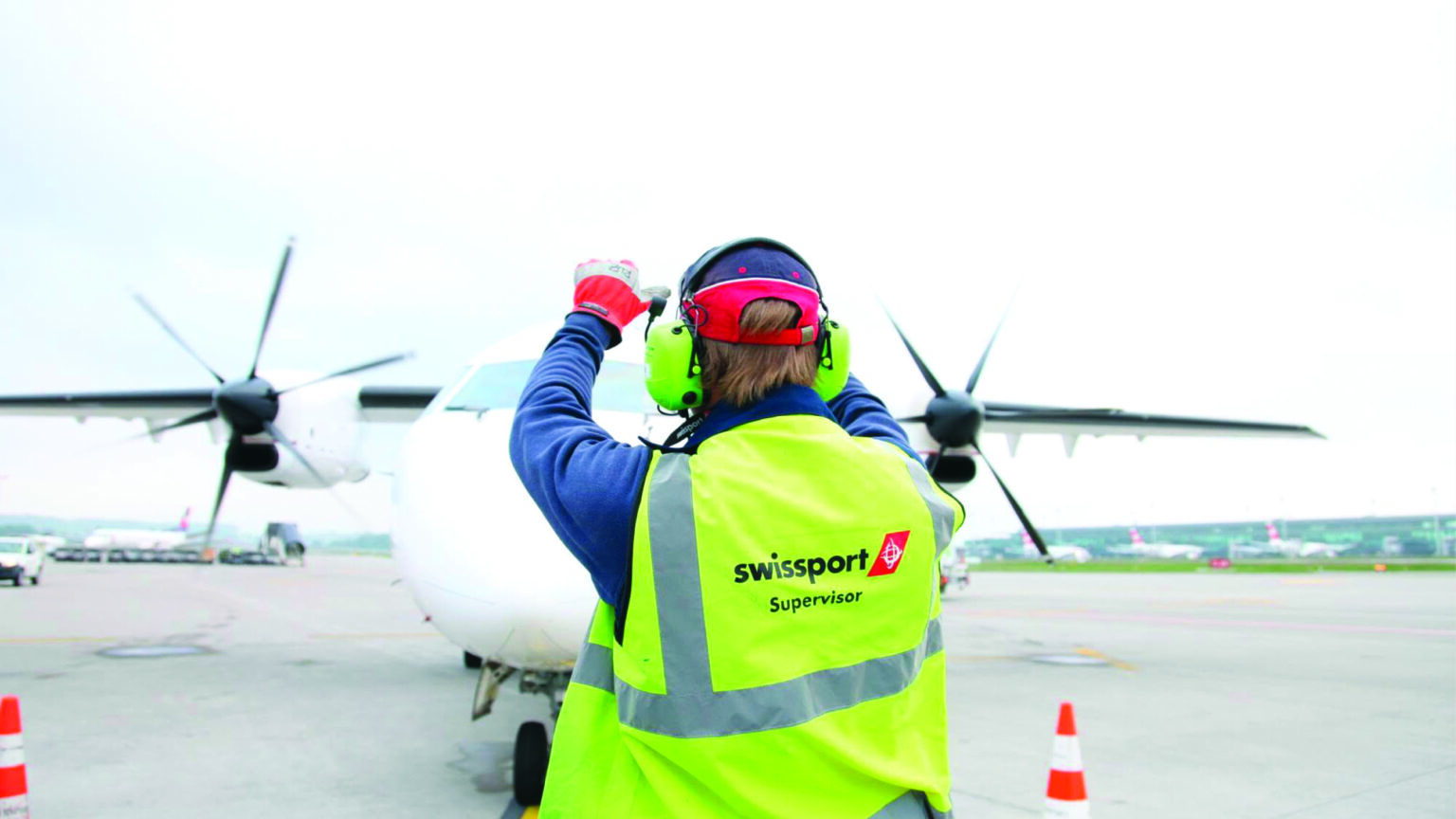
On the tarmac, the same precision mechanics are at work. While travelers check in at the terminal and their luggage is moved to the holds, teams guide aircraft to their parking positions, refuel the planes, load the cargo holds and perform final technical operations before the next takeoff.
All these operations fall under the same profession: handling, or airport ground assistance. Long perceived as a simple support activity, it has become an essential link in the air transport chain.
Because behind a flight’s punctuality, the smoothness of the passenger journey or the speed of cargo delivery, an essential part of airport competitiveness is now at stake.
In Morocco, the acceleration of air traffic, the development of cargo and the massive investments made in airport infrastructure now make it a strategic sector. An evolution perfectly illustrated by Swissport International’s acquisition of Swiftair Maroc.
Announced on May 21 and then notified to the Competition Council in early June, this acquisition far exceeds the scope of a simple external growth operation.
By taking control of the Moroccan subsidiary of the European group Swiftair, specialized in cargo handling at Mohammed V Airport in Casablanca, Swissport enriches its offering with a 3,700 m² logistics platform equipped with cold-chain infrastructure, notably for pharmaceuticals and perishable goods.
“Morocco is a dynamic market with high potential, whose role in international trade flows continues to strengthen. The acquisition of Swiftair Maroc fits fully within our strategy to accelerate the development of our cargo activities worldwide”, said Warwick Brady, CEO of Swissport International, at the time of the announcement.
Increasingly structured competition
Beyond strengthening its cargo offering, the Swiss operator is above all consolidating its presence at Mohammed V Airport, the country’s true logistics heart, which handles nearly 95% of national air freight.
This strategic position reflects the growing interest of major international groups in the Moroccan market. This operation comes in a sector that has been deeply transformed over the past decade. For many years, RAM Handling largely dominated ground assistance at the country’s airports.
Present on the main platforms in the Kingdom, the Royal Air Maroc subsidiary long benefited from a quasi-hegemonic position, with a market share estimated between 60 and 70%, supported notably by the national carrier’s operations and several Middle East carriers.
The market’s gradual opening, begun in 2012, however reshuffled the cards. The arrival of Swissport International, then Groundforce, a subsidiary of the Spanish group Globalia, introduced real competition into a previously highly concentrated sector.
Following an international tender launched by the National Airports Office (ONDA), RAM Handling and Swissport were renewed in July 2019 to provide ground handling services at the country’s airports for a period of seven years. The first now operates twenty platforms, while the second serves fifteen (see infographic).
Since then, Swissport has continued to broaden its scope of activity. First focused on classic handling, the company gradually built an offering covering the full range of airport services.
After obtaining a business aviation license, it created, in 2016, Swissport Executive Aviation Maroc, which operates terminals dedicated to private jets and business aviation in Casablanca, Marrakech and Tangier. In January 2025, it launched Aspire Swissport Morocco, a subsidiary dedicated to airport hospitality, after winning the contract to operate eleven VIP lounges spread across nine airports.
Cargo, the new engine
For many observers, this diversification illustrates the Kingdom’s rising importance in the strategy of major global operators.
“Morocco has become a strategic market for major international operators. The combination of tourism growth, airport investments and the Kingdom’s logistical ambitions creates particularly attractive prospects”, summarizes a strategy consultant based in Casablanca. While the rivalry between RAM Handling and Swissport plays out across all ground assistance activities, the cargo field is increasingly where a growing share of the competition is being fought.
Long relegated behind passenger transport, cargo is now asserting itself as one of the most dynamic segments of global air transport. The rise of e-commerce, the globalization of supply chains and growing demands for faster delivery have deeply changed business needs.
Morocco is no exception to this trend. In 2025, the Kingdom’s airports handled 100,000 tonnes of air freight, a volume expected to grow as export sectors scale up. The same pace continued this year, with more than 39,515 tonnes handled by the end of April 2026.
Thanks to its proximity to Europe and the development of sectors such as automotive, aeronautics, textiles and agri-food, the Kingdom has major assets to strengthen its position in international supply chains. In this context, the quality of handling operations becomes a competitiveness factor in its own right.
“We are witnessing a progressive integration of the entire airport value chain. Major operators now seek to offer a complete package from passenger processing to cargo management”, emphasizes a specialist in airport supply chain.
Air traffic boom
Swissport’s rise is taking place in a context particularly favorable to Moroccan air transport. Driven by the recovery of tourism, the development of international routes and the Kingdom’s economic momentum, Moroccan airports reached a new milestone in 2025.
They welcomed a record 36.3 million passengers, including 32.4 million international travelers, an increase of 11% in one year. At the same time, aircraft movements reached 265,000, while ONDA’s revenue stood at 5.8 billion dirhams (BMDH).
In the absence of official statistics on the number of bags handled, an estimate based on industry standards, which put the average number of checked bags at 1.2 per passenger, helps measure the scale of this activity.
Moroccan airports would thus have handled nearly 43.5 million bags last year. With an estimated market share of nearly 70%, RAM Handling would have provided assistance to more than 25 million travelers and handled about 31 million bags.
Those volumes alone exceed the annual traffic recorded at several major African airports, such as Hurghada (Egypt), Cape Town or Addis Ababa–Bole.
For its part, Swissport would have handled nearly 11 million passengers and some 13 million bags, more than the annual traffic of major platforms like Sharm El-Sheikh, Nairobi–Jomo Kenyatta or Algiers–Houari Boumediene.
These magnitudes illustrate the change in scale of handling in Morocco. In an interview given to La Vie Éco in 2018, Christophe De Figueiredo, then general manager of Swissport Maroc, said his company managed about 60,000 aircraft movements and 8 million passengers.
Seven years later, the volume of travelers handled would thus have increased by nearly three million. Competition is also intensifying on the client airlines front. RAM Handling now claims more than 120,000 flights handled each year for a portfolio of over 80 airlines.
Its Swiss competitor would now manage between 90,000 and 100,000 annual movements, confirming the rise of a market that has become highly competitive.
Expansion of major hubs
This evolution is only beginning. With its “Airports 2030” strategy, ONDA is preparing an unprecedented transformation of the national airport ecosystem.
The goal is clear: raise Moroccan airports’ handling capacity to 80 million passengers by 2030, more than double their current level.
To achieve this, the Office is mobilizing 38 BMDH, including 25 billion dedicated to extending main platforms and 13 billion intended for modernizing security systems, baggage handling and ground equipment. The flagship project is undoubtedly the future terminal at Mohammed V Airport in Casablanca. With an area of 600,000 m², it will be the largest airport construction project ever carried out in Morocco.
Designed to initially accommodate 20 million passengers, with expandable capacity to 30 million, it will be able to receive up to 45 aircraft on contact simultaneously.
The works, entrusted to the SGTM-TGCC consortium for 12.8 BMDH, are scheduled for completion in mid-2029. The Marrakech-Menara and Agadir Al-Massira platforms will also undergo significant expansion work to support growing tourist traffic.
Marrakech will see its capacity rise from 9 to 16 million passengers, while Agadir will almost double from 3 to 7 million. Beyond infrastructure, these investments mainly prepare Moroccan airports for the new operational requirements induced by co-hosting the 2030 World Cup.
The expected increase in passenger flows, air freight and business aviation will require unprecedented levels of punctuality, safety and fluidity in ground operations.
“The 2030 World Cup acts as an accelerator. It forces all players to anticipate tomorrow’s needs today and to invest much faster than planned”, notes our strategy consultant.
From this perspective, handling appears as a central link in the ongoing transformation, confirming its strategic dimension for the national aviation ecosystem. The battle of the airports is no longer fought only in the skies. It is now won on the ground.
Handling: ONDA prepares the roadmap for the next decade
Infrastructure development alone will not suffice to make Moroccan airports reference platforms. Ground operations must keep pace.
This is the whole point of the future strategic handling plan that the National Airports Office (ONDA) is preparing. As part of its “Airports 2030” strategy, backed by a total envelope of 38 BMDH, the Office wants to deeply modernize ground assistance in order to improve service quality, reduce operational delays and align Moroccan platforms with the best international standards.
To steer this transformation, the public entity led by Adel El Fakir entrusted, in late April, the Moroccan firm TGS CKE Consulting with drafting a roadmap covering the period 2026–2032.
Worth 5.28 million dirhams, this eight-month mission must produce a sector status report, analyze its competitive framework and propose a new organizational model for handling in Morocco.
The study also foresees an international benchmark covering several major airports recognized for the quality of their passenger experience, in order to identify best practices in organization, human resources management and operational performance. The conclusions should serve as the basis for future specifications and sector reform in the coming years.
In Casablanca, baggage speeds up
Baggage handling has become one of the main performance indicators of major international airports. The shorter the connection times, the more attractive platforms are to airlines. Aware of this issue, ONDA inaugurated, last July, the Fast Baggage Center at Mohammed V Airport in Casablanca.
This new automated 15,200 m² center was designed to streamline transfer baggage handling and support the strong traffic growth expected. The installation relies on two interconnected automated sorters, capable of processing transfer baggage for short and long connections separately.
It also integrates state-of-the-art screening equipment, including scanners and explosive detection systems that comply with international standards.
According to ONDA, the system can process up to 6,000 bags per hour, bring the average processing time down to five minutes and reduce energy consumption by 15%. A modernization that foreshadows the investments needed to support Casablanca’s rise as a hub by 2030.