Kingdom
The Same Troupe, Two Channels and a Next Generation in Dotted Lines
Behind the rising prominence of Ramadan drama, another question keeps coming back: who gets the screen time, and why is it always the same people? Between headliners who show up everywhere and only rare breakthroughs, the schedule also tells the story of an industry running on a short loop.

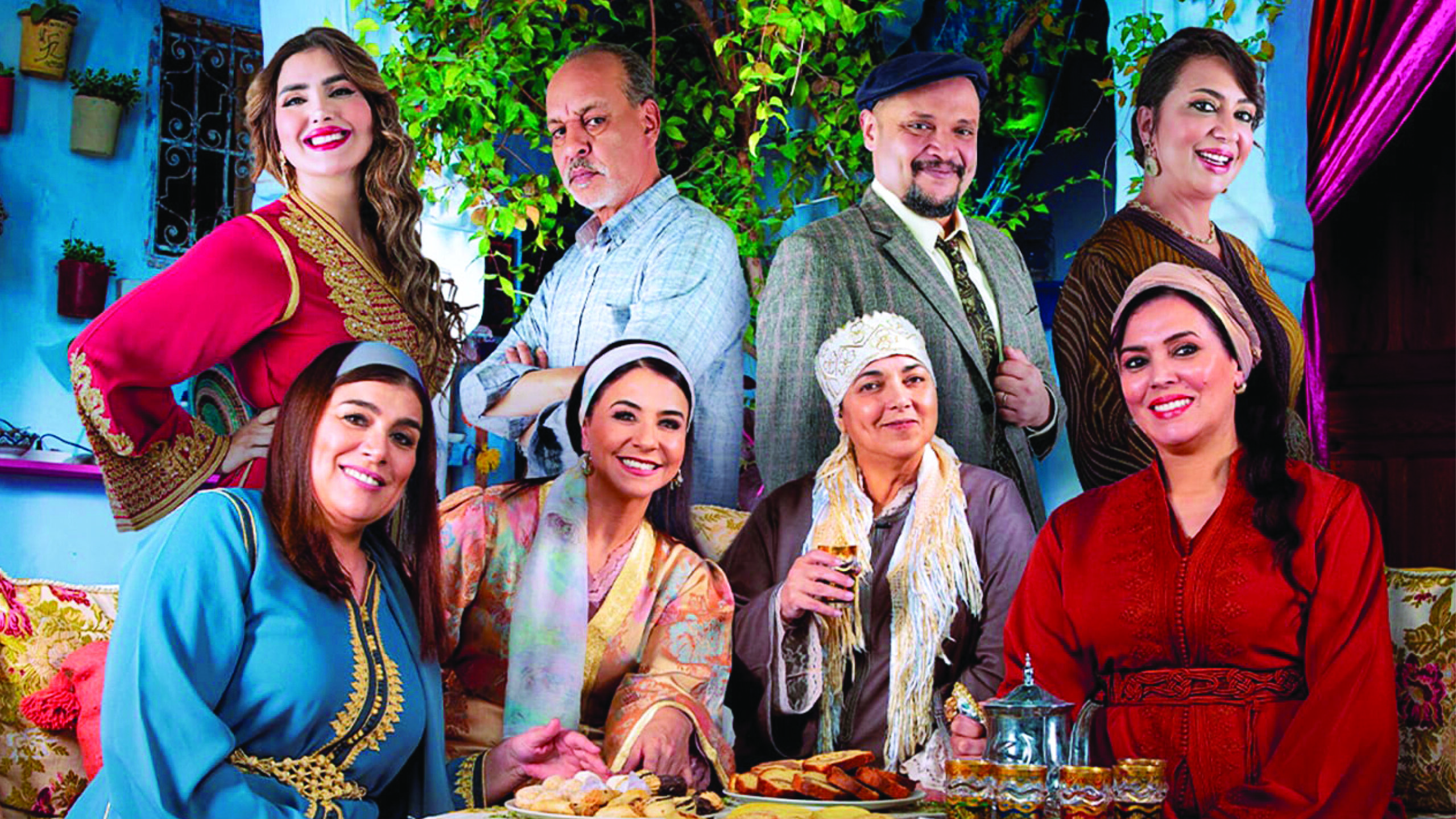
Moroccan Ramadan 2026 drama may well display greater narrative ambition, but with every opening credit it reveals a more stubborn mechanism: a cast that keeps repeating itself.
SNRT’s and 2M’s schedules give the impression of a landscape in motion, yet populated by a stable, almost interchangeable troupe that moves from one set to another the way you switch studio stages.
This is not about “talent”—there is plenty of it, and it often carries the stories—but about a reflex of concentration. When it comes to securing the ftour slot and prime time, channels fall back on tried-and-tested faces, the ones who “hold” the audience because they are already recognizable.
On the SNRT side, the sensitive post-adhan hour concentrates this logic. “Attaman” highlights Abdellah Ferkouss and Sahar Seddiki; “Al Mardi” lines up, notably, Haytam Miftah, Oussama Ramzi, and Meryem Zaïmi; “Och Tmâa” brings in Saâdia Ladib and Amine Ennaji; and “Chkoune Kane Igoul” brings together Ibtissam Laaroussi, Farah Fassi, and Meryem Bakouch.
Within a single slot, it is not only characters who return episode after episode: it is actors’ trajectories that intersect and intersect again—so much so that you sometimes end up watching a new drama with a feeling of déjà vu, even before you have entered the story.
The phenomenon becomes more visible when the same name spills beyond one role to occupy several territories in the same season. Meryem Zaïmi, for example, is announced both in an SNRT drama and as the presenter of the entertainment show “Mattihch Ela Lbal 2.”
At the level of a channel, it is a strategy of familiarity: a known figure acts as a magnet, placed wherever viewers need to be “kept.”
At the level of an industry, it is also a clue: the circulation of headliners is intense, while the pool of immediately bankable faces seems more limited.
On 2M, the logic is less head-on but just as telling. The channel announces “Ba Lahbib” with Abdellah Ferkous, Hasnaa Moumni, and other established names.
Yet the same Abdellah Ferkouss is also put forward by SNRT in “Attaman.” Ramadan creates hyper-visibility for a handful of profiles—so much so that a viewer can find, in the same week, the same actor on two competing channels, in two supposedly different worlds.
Repetition does not only affect comedy “stars.” It also runs through drama, by seepage. Sahar Seddiki appears in “Attaman” and also features in a prime-time series, “Caftan Khadija.” On 2M, she is also mentioned in the capsule “Yawmiyat Mahjouba wa Tibariya.”
At this point, it is no longer a simple presence, but a season in mosaic form, where the same faces become bridges between formats—from sketch to serial, from studio to set.
Ramadan irony
Yet the schedule also tells—more discreetly—of an effort to renew. The best example this year comes from a comeback-event: “Bnate Lalla Mennana” season 3. The show’s communication highlights the arrival of new faces, including Ghita Kitane, Tasnim Cheham, and Amr Assil.
The series keeps a historical core familiar to the public, and the documentation available on previous seasons is a reminder of how much this “foundation” long structured 2M’s imagination, with, among others, Saâdia Azgoun, Samia Akariou, Nora Skalli, Saâdia Ladib, Hind Saâdidi, Meryem Zaïmi, Yassine Ahajjam, Hasna Tamtaoui, Adil Abatourab, and Driss Roukh.
This mix (old pillars, new entrants) looks like a compromise solution. Fresh blood is injected, but without giving up the reassurance-casting.
The problem is that this renewal often remains localized: a “return” that opens a few spots, a new show that tries one or two new heads—then the ecosystem falls back into its habits.
And that is where the question goes beyond television to touch the making of careers. ISADAC, which trains artistic profiles in Morocco among other things, regularly awards diplomas to its graduating classes. The pipeline therefore continues to feed the market with young graduates. But Ramadan television sometimes gives the opposite impression.
A showcase where you catch sight of a few new appearances, without that necessarily translating into a broad renewal of casts.
At bottom, there is a Ramadan irony: writing is better, directing is more visibly “signed,” worlds are more carefully crafted, and the public is asked to believe in new universes. But viewers are often served the same troupe to inhabit them.
Actors carry the machine—they make it possible, they give it emotional continuity. In return, that continuity can turn against fiction itself: through over-recognition, the character risks dissolving into the face, and the face into repetition.
How far can fiction be modernized without modernizing, at the same pace, the people who populate it? Ramadan 2026 seems to have understood one thing: the appetite for stories.
The next step, more delicate, may be to widen the table—by opening more roles to a genuine new generation, and by making the “new face” not a seasonal exception but a normal feature of the schedule.