Business
The Projects to be Completed Before AFCON 2025
Final stretch for the host of projects and developments concerning, among others, the six major stadiums, the urban development of host cities, 5G, and also the various transport programs.

Several factual elements strongly confirm that the Kingdom is determined to make the organization of major sporting competitions, namely AFCON 2025 and the World Cup 2030, a genuine lever for economic and social development and, above all, for reducing territorial disparities.
For the organization of the continental sports competition, let us state from the outset that the State and its multiple branches (public enterprises, local authorities) have already injected billions of dirhams, among other areas, into sports infrastructure, mobility, and the urban development of host cities. The private sector is also involved as an investor or service provider for the success of what will be a full-scale test for the co-hosting of the 2030 World Cup by Morocco.
In short, AFCON 2025 can be seen as a showcase of the Kingdom’s great organizational expertise for major international events, capable of reinforcing its image on the international stage.
Government Monitoring
The Executive, fully aware of the multiple stakes involved in the continental competition, which will be held for the second time in Morocco, has set up mechanisms to ensure the success of the organization.
Indeed, in April 2025, a high-level meeting on the progress of work on the structuring projects was chaired by Abdelouafi Laftit, Minister of the Interior, and Fouzi Lekjaa, Delegate Minister in charge of the Budget and President of the Royal Moroccan Football Federation (FRMF).
This meeting, which was attended by the walis of the six host cities (Tangier, Fez, Rabat, Casablanca, Marrakech, Agadir) as well as several CEOs of public enterprises involved in the organization, proves the government’s determination to see the 120 construction, renovation, and development projects delivered well before December 21, 2025 (the opening date of AFCON).
Hence the importance of establishing a mapping of the main sports infrastructures, mobility, and urban development of the host cities, pillars of the national economy.
Six Major Stadiums Involved
It is commendable to note that despite some delays noted and which are entirely understandable given the titanic nature of certain projects related to the facelift of the major stadiums, no worrying blockages have been reported so far.
Thus, nearly 9.5 billion dirhams have been allocated to the renovation of six major stadiums, which will host the matches of the 35th edition of AFCON. These sports complexes must be delivered well before the pivotal date of December 21, marking the first day of the biennial football tournament.
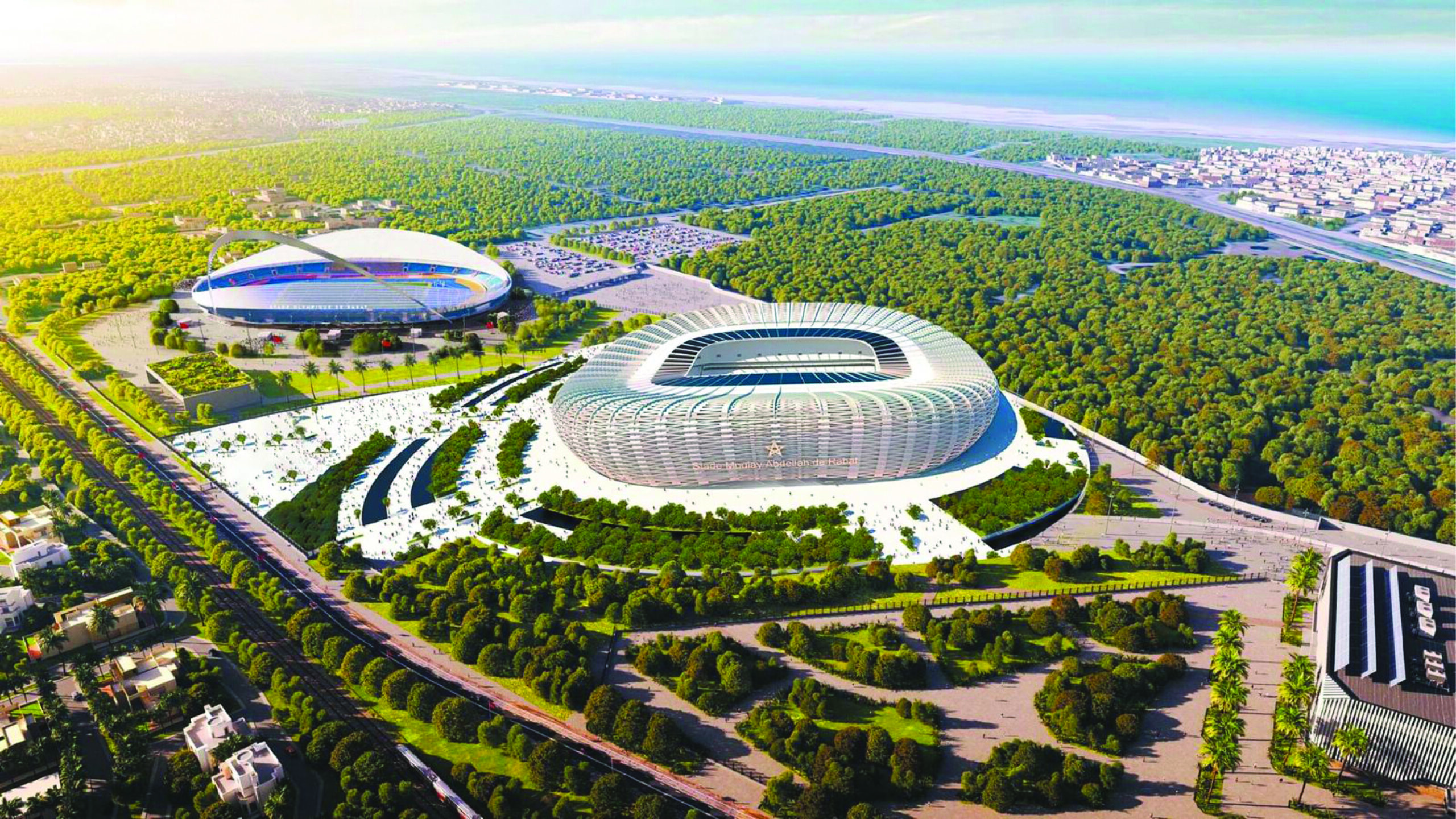
Specifically, the six major sports complexes are: the Moulay Abdellah Stadium in Rabat (over 68,000 seats), the Mohammed V Complex in Casablanca (with 45,000 spectators), the Grand Stade of Tangier (with a capacity of over 85,000 seats), as well as the stadiums of Agadir (with over 43,000 spectators), Fez (35,000 seats), and Marrakech (over 45,000 spectators).
The various renovation works, costing several billion dirhams, are beneficial as they elevate these infrastructures into modern, world-class sports facilities. One of the most emblematic examples of this exceptional qualitative leap is embodied by the mythical Moulay Abdellah Stadium in Rabat, which has been refurbished.
It hosted, in early September 2025, the Atlas Lions’ match against Niger, counting for the 2026 World Cup qualifiers. Equipped with all amenities (cafés, restaurants, VIP zones, parking), the capital’s sports complex is already operational with, among other things, a high-tech (LED) pitch, a panoramic roof, complete WiFi coverage (5G), giant screens, nearly 800 cameras with facial recognition, and intelligent access management. This clearly denotes, in terms of security measures, the upgrade of the Kingdom’s stadiums planned for the continental tournament.
Note that in addition to the six major complexes mentioned above, three smaller stadiums are added, namely the Moulay Hassan Stadium in Rabat (with a capacity of 22,000 seats), the Olympic Stadium in Rabat (21,000 spectators), and the Al Barid Stadium in Rabat (18,000 seats), where matches for AFCON 2025 will also take place. In summary, according to the Confederation of African Football (CAF), a total of nine stadiums (in six cities) will host the AFCON matches and must therefore be operational before next December.
Urban Development
The impact of hosting AFCON 2025 by the Kingdom is already perceptible in several host cities that have launched ambitious modernization and urban development projects.
Driven by SDL Fès-Région et Développement and its partners, projects aimed at improving the urban fabric related to roadways, lighting, and local sports facilities are being finalized in the spiritual capital of the Kingdom.
The city of Tangier is also the scene of several structuring projects capable of contributing to the organization of AFCON to the highest standards. They largely focus on the extension of several key boulevards of the Pearl of the North (Route de Rabat, Bd Moulay Rachid…).
In addition to several roadworks on, among others, Mohammed V, Bir Anzarane, and Zerktouni boulevards (which have changed the face of the economic capital of the Kingdom), the city of Casablanca has embarked on a race against time to complete four major highway projects before AFCON 2025.
They concern three highway interchanges (Sidi Maârouf, Aïn Harrouda, and Azbane) and the Tit Mellil-Berrechid highway. As an indication, besides an envelope of nearly 400 million dirhams, intended for the improvement of roadways around the Mohammed V Complex, an overall budget of over 1.1 billion dirhams has been allocated to the construction of the Sidi Maârouf and Aïn Harrouda interchanges (compared to nearly 100 million dirhams for the Azbane interchange).
For its part, the 30 km highway (Tit Mellil-Berrechid), which mobilized nearly 2.5 billion dirhams in investments and which is to be operational in parallel with the sporting event, showed a work progress rate of around 75% in July 2025. In Agadir, since March 2025, urban development projects have proliferated to allow the capital of Souss to host the continental tournament under optimal conditions.
In reality, from the first quarter of 2025, Agadir turned into a large open-air construction site: urban and landscape development of the urban park around the Grand Stade, renovation of connecting roads, upgrading of Al Amal square, landscape beautification and upgrading of several arteries in the city and at the entrance to the metropolis via Drarga, and rehabilitation of the Al Massira bus station.
To give an order of magnitude, an envelope of 31 million dirhams was allocated to the first phase of festive and safety lighting works, which should be completed before the sporting event.
5G Will Be Part of It
By 2030, Morocco should record a 5G coverage rate of around 85% of the population. This is thanks to a colossal investment effort of nearly 80 billion dirhams.
That said, under the 5G licenses recently awarded by the ANRT to the three operators (Maroc Télécom, Inwi, Orange), the first commercial activation of 5G is scheduled for November 2025, with initial coverage concentrated on 8 major cities (including the six host metropolises) and the strategic zones of AFCON 2025 (Stadiums).
In other words, the continental tournament will be a full-scale test for the three operators, who must redouble their efforts to install and test all the necessary equipment before AFCON 2025.
ONCF and RAM, Onboard for the Adventure
To ensure smooth mobility within or between host cities, ONCF has set up an emergency plan of nearly 3 billion dirhams, consisting of the acquisition of new trains and the renovation of cars and locomotives.
Royal Air Maroc is not left out. The national carrier, an official partner of CAF for the air transport component, is expected to transport over 500,000 supporters from Europe and Africa to Morocco during AFCON 2025. To do this, the company plans, among other things, to double seating capacity from qualified countries and increase frequencies on routes from European cities hosting significant African communities.
To meet this major challenge, RAM is counting on expanding its fleet, currently composed of 59 aircraft. Specifically, in anticipation of hosting AFCON 2025, RAM plans to acquire about ten aircraft in 2025, half of which had already been received by mid-August last.