Kingdom
Tanger Med’s Formula for Weathering the Storms
Recent weather conditions temporarily affected the port’s operations. However, a range of proactive measures helped substantially limit the impact of the bad weather on the port complex’s activity. Insight.

The climate shocks that struck the country—more particularly the Northwest—starting in late January, and which in February manifested in heavy rainfall, strong wind gusts and several floods, with a steep economic and social cost, have not been without consequences for port activity and maritime transport.
In practical terms, storms and heavy swells slowed activity at certain ports. By way of illustration, elsewhere, deteriorated weather conditions can cause longer waiting times for ships before berthing, as well as a buildup of vessels waiting at anchorage.
It bears recalling that at the peak of the weather deterioration in Morocco (under red alert), some waves reached six meters in height. Clearly, this dreadful weather situation posed serious challenges for the maritime and port sector, guided by the sacrosanct principle of safety.
Operationally, a vessel’s entry into a port under extreme weather conditions is both a threat to facilities and a danger to crew members.
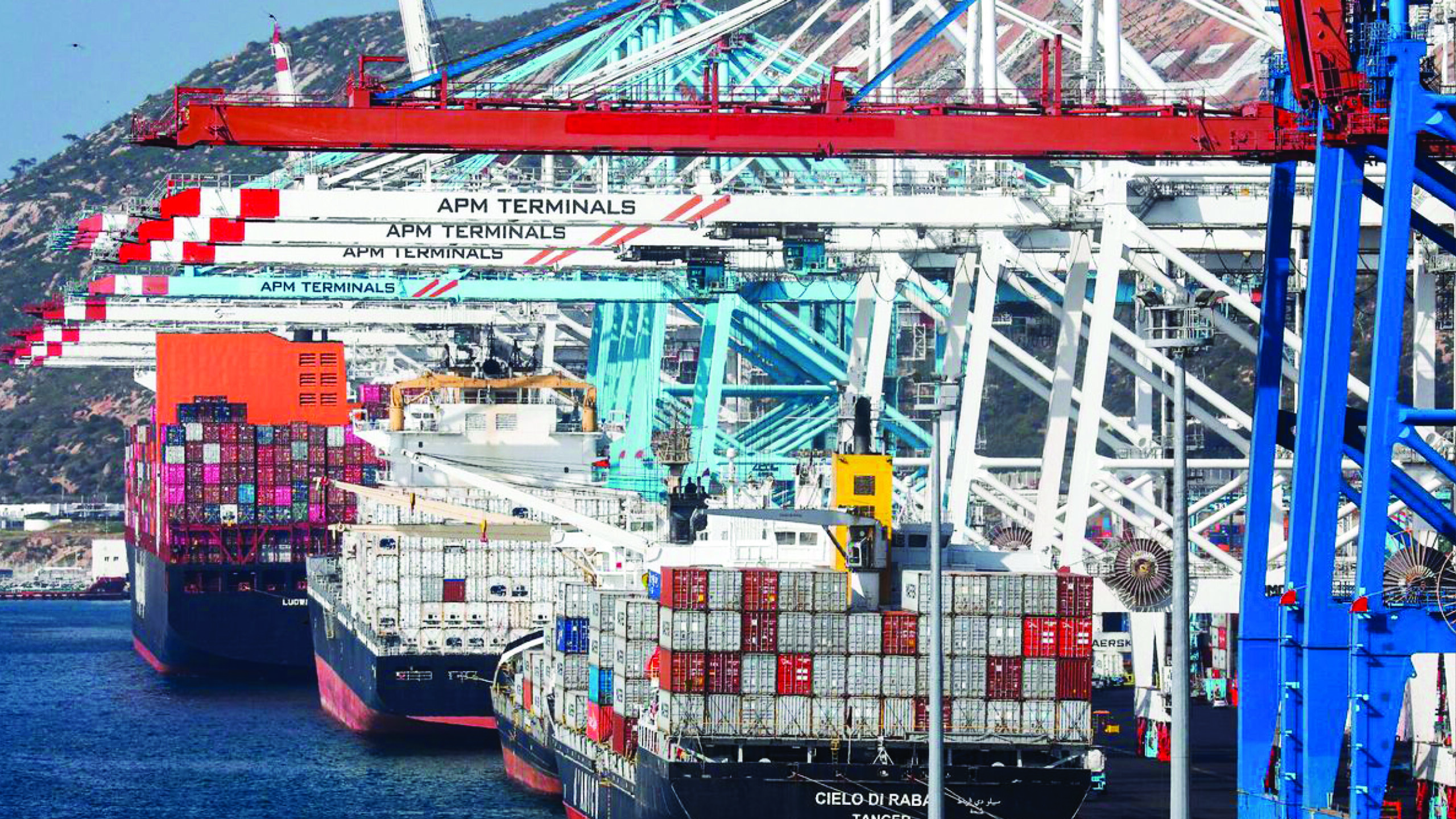
Given the many safety-related issues (port facilities, crews and operators), the disruption of port activity, maritime transport and sensitive logistics chains (hydrocarbons, industrial goods, perishable products, etc.), it is, for more than one reason, worth understanding how the leading container port in the Mediterranean basin (see box), Tanger Med, experienced the bad weather that particularly affected the country’s northwest.
Another crucial question is: what measures were taken at the port complex to best limit the adverse effects of difficult climatic conditions on the operations of the various terminals (containers, hydrocarbons, general cargo, vehicles, passengers, etc.), as well as on the different activity zones (Medhub, industrial zones, etc.)?
An authorized source at Tanger Med shared with La Vie Éco several elements of an answer, reflecting the proactive approach of the port authorities.
Temporary disruptions
Our source is categorical: recent weather conditions temporarily affected the port’s operations, across all types of vessels (containers, bulk, Ro-Ro, passenger, etc.).
Still according to our interlocutor, from February 10 onward, port operations resumed normally, in strict compliance with safety protocols.
Asked what measures were taken to substantially limit the consequences of the bad weather on the activity of Tanger Med’s various terminals, our source essentially states: “Information notes are systematically shared with the port’s customers and the industrial zones, ahead of the disruption period, to inform them of the situation and invite them to take the necessary arrangements for traffic destined for the port.”
In the same vein, Tanger Med has put in place an enhanced monitoring system (which has remained active), making it possible to adjust activity in real time according to changing weather conditions.
Mobilizing backup vessels
“In order to mitigate the impact of the weather episode, maritime rotations were reinforced and backup vessels were mobilized to ensure the transport of goods—particularly TIR trucks—and to absorb any potential delays,” our interlocutor explains.
The port authorities also set up extra-port regulation areas. The objective of this initiative is clear: to absorb upstream the flows of goods (containers and trucks) coming from industrial zones and headed to the port, in order to avoid congestion on traffic lanes.
It should be noted that at Tanger Med, the entire port community was fully mobilized (harbor master’s office, pilotage, towing) to ensure ships berth under the best possible conditions of safety and fluidity.
“Close coordination with the industrial zones, professional associations, local authorities and exporters made it possible to better regulate flows and optimize traffic organization. Thus, within 48 hours, all waiting flows were absorbed by the port,” our interlocutor assures.
That said, it is worth noting (from an official source) that no waiting at anchorage was recorded at Tanger Med. This port and maritime feat is the result of close coordination with shipping lines and port terminals to adjust port-call scheduling in line with the bad weather, which spared neither the southern Mediterranean seaboard nor the Kingdom’s Atlantic coasts.
Hegemony confirmed in the Mediterranean
Official data for fiscal year 2025 unquestionably corroborate Tanger Med’s stature as the leading container transshipment hub in the Western Mediterranean, ahead of renowned European ports (Algeciras, Valencia, Piraeus, etc.).
Over the past year, the multi-faceted port complex handled, across its four container terminals, more than 11.1 million TEUs (twenty-foot equivalent units). This represents an 8.4% increase compared with 2024.
This historic performance is linked to the commissioning of the latest extension of the TC4 terminal, operated by APM Terminals, a subsidiary of A.P. Moller-Maersk, the global leader in container shipping, operating in 130 countries.
Other, even more telling figures: Tanger Med handled—across all activities—161 million tonnes of goods in 2025, a substantial increase of 13.3% compared with 2024.
Regarding the strengthening of the port’s strategic role in supporting and promoting national exports, it is important to note that TIR truck traffic stood at 535,203 units in 2025, up 3.6% compared with 2024.
This upward trajectory was mainly driven by shipments of industrial products (+4.8%) and agri-food products (+4.3%). For their part, solid and liquid bulk traffic posted a decrease of 11% and an increase of 13%, respectively, year on year.
As for passenger activity, it recorded more than 3.2 million travelers and 895,341 cars in 2025. This corresponds to respective increases of 5.7% and 5% compared with 2024.