Business
Tanger Med: An increasingly indispensable player
Major disruptions in the Strait of Hormuz are creating a shockwave that is reshaping global maritime balances. The Strait of Gibraltar and the Tanger Med port complex are in pole position to benefit. Explanation.

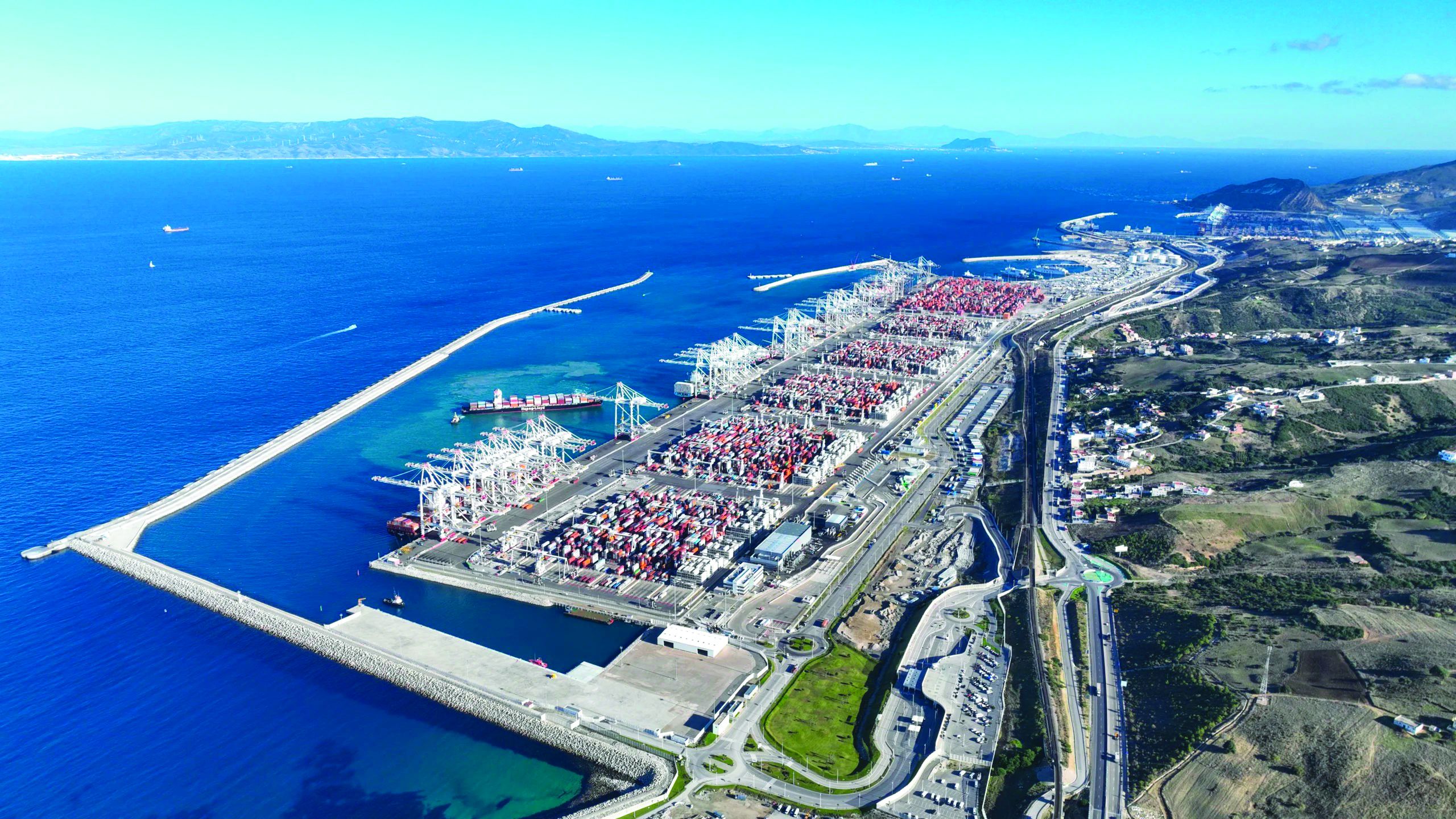
The war in the Middle East and the closure of the Strait of Hormuz are reinforcing the role of the strategic hub of Tanger Med, Morocco’s port platform on the Strait of Gibraltar, which more than ever appears as a solid pillar and a safe bet for global trade in the eyes of major shipping companies.
As early as 2023, attacks by Yemen’s Houthis on navigation in the Red Sea had led major global carriers to avoid the Suez Canal and the Bab el-Mandeb Strait, favoring routes around Africa and passage through the Strait of Gibraltar. The crisis in the Strait of Hormuz has intensified this shift. Major shipping companies, including Maersk, Hapag-Lloyd, and CMA CGM, have indeed announced that they are rerouting their vessels via the Cape of Good Hope. This detour does lengthen journeys by 10 to 14 days, but it becomes economically viable given the current risks.
This reconfiguration of maritime routes positions the Strait of Gibraltar and its main port as an almost unavoidable strategic alternative. It is becoming the only western gateway to the Mediterranean for ships coming from Asia via southern Africa. Its role as a strategic chokepoint is thus multiplied, as it now captures not only transatlantic flows but also diverted Asia-Europe traffic. It is no coincidence that the Strait of Gibraltar, much better secured, became in 2024 the world’s main crossroads for goods flows, with around 110,000 ships transiting annually, surpassing the Strait of Malacca in Southeast Asia (93,000 ships) and the Strait of Hormuz (between 40,000 and 50,000 ships). For Tanger Med, the main transshipment hub in the western Mediterranean, which has maritime connections to more than 180 ports worldwide, the opportunity is real.
“In general, in times of crisis and tension on logistics chains, particularly linked to route deviations, canceled port calls, or congestion at destination ports, major transshipment hubs play an essential role in regulating flows. In this regard, Tanger Med’s high processing capacity, combined with its strategic positioning, fully reinforces this role,” explains a well-informed source. The location of Tanger Med at the entrance to the Strait of Gibraltar thus allows it, in the transshipment segment, “to simultaneously meet redistribution needs in the Mediterranean and ensure an effective relay role for major European ports,” our source adds.
Expected increase in traffic
Port executives are already anticipating a possible increase in port calls and container traffic as a result of this rerouting. In a recent statement to Reuters, Idriss Aarabi, Managing Director of Tanger Med, confirmed that Tanger Med “expects a potential increase in the number of ship calls.” The impact on cargo flows “should not be visible before mid-April 2026,” he added.
Tanger Med teams are now focusing on capacity management and congestion prevention to absorb potential additional volumes without degrading the port’s performance. With a record 11.1 million containers handled in 2025, the Moroccan port has already demonstrated its ability to absorb massive volumes.
The Strait of Hormuz crisis now stands as a new full-scale test for the port platform. If successful, Tanger Med will further increase its strategic importance, making the Strait of Gibraltar an essential pivot in the resilience of global supply chains.