Kingdom
Social Protection: A Smooth Rollout
From the Social Cohesion Support Fund to direct social assistance, a revolution has taken place—at every level. Assistance is now targeted. The approach has shifted from welfare handouts to support and empowerment. Direct Social Assistance (DSA) is becoming a driver of social mobility.

Few people still remember this today. Towards the end of the term of the government led by the Istiqlal Party, during the time of Abbas El Fassi, the creation of a Social Cohesion Support Fund was approved.
Its launch was delayed by a year due to controversy among political actors over its authorship. Its implementation was eventually included in the 2012 Finance Bill.
Political parties had understood that the post‑2011 constitutional reform government could hardly have found a better initiative with which to begin its mandate.
A gift that the government resulting from the 2011 elections failed to appreciate at its true value. What was done with it afterwards is well known.
The government led by the PJD missed its rendezvous with history. Years later, the Court of Auditors would confirm that the management of this fund had been reduced to a purely “accounting” exercise.
This largely limited its real effectiveness. The Fund operated as a simple transfer mechanism: it received tax revenues and redistributed them to ministries.
Its success was measured solely by the rate of budget disbursement, rather than by social impact—namely, the number of target beneficiaries genuinely lifted out of poverty.
The same can be said of RAMED, whose rollout began under the El Fassi government as part of the implementation of Law No. 65‑00 on Mandatory Health Insurance (AMO).
Here again, emphasis was placed on counting the number of cards distributed, rather than on the real quality of access to healthcare or the reduction of out‑of‑pocket expenses for poor families.
The same applies to the Tayssir programme, introduced during the same period. We know how much money is paid out, but there has been no rigorous monitoring to determine whether, statistically and over the long term, it has actually reduced school dropout rates in the targeted areas.
It is clear that the government was heading in the wrong direction across the board. With the arrival of the Akhannouch administration in 2021, it was clear what needed to be done, after comparing Morocco’s still embryonic social assistance system with successful international experiences—in Brazil, Indonesia and India, to name but a few. Morocco adopted the best elements of each model.
From the Brazilian model, regarded as a global reference, the Kingdom retained the idea of conditioning direct social assistance on children’s school attendance and health check‑ups—hence, no doubt, the concept of the family doctor included in the government programme and the health reform.
The Kingdom also drew inspiration from the Indian experience, which relies on digitised databases to target beneficiaries.
Accordingly, drawing on the Unified Social Registry (USR) database, the system is now anchored in data analysis and objective criteria, breaking with the former administrative approaches that prevailed during the RAMED era.
Human intervention has thus become minimal. The mechanism now relies on a scoring grid that takes territorial specificities into account. This grid incorporates 35 variables in urban areas and 28 in rural areas, with a flexible eligibility threshold (or index).
A results‑based logic
The vision was there, and the Executive succeeded in giving it concrete form, strictly adhering to a clearly defined timetable. First came the completion of the National Population Register and the Unified Social Registry, followed by action.
1 December 2022 marked a historic milestone. Eleven million RAMED beneficiaries were transferred to Mandatory Health Insurance thanks to the implementation of the USR.
Three years later, with the introduction of three flagship programmes—AMO‑Tadamon, AMO‑TNS and AMO‑Achamil—the generalisation of health coverage became a reality. Today, more than 32 million citizens benefit from mandatory health insurance.
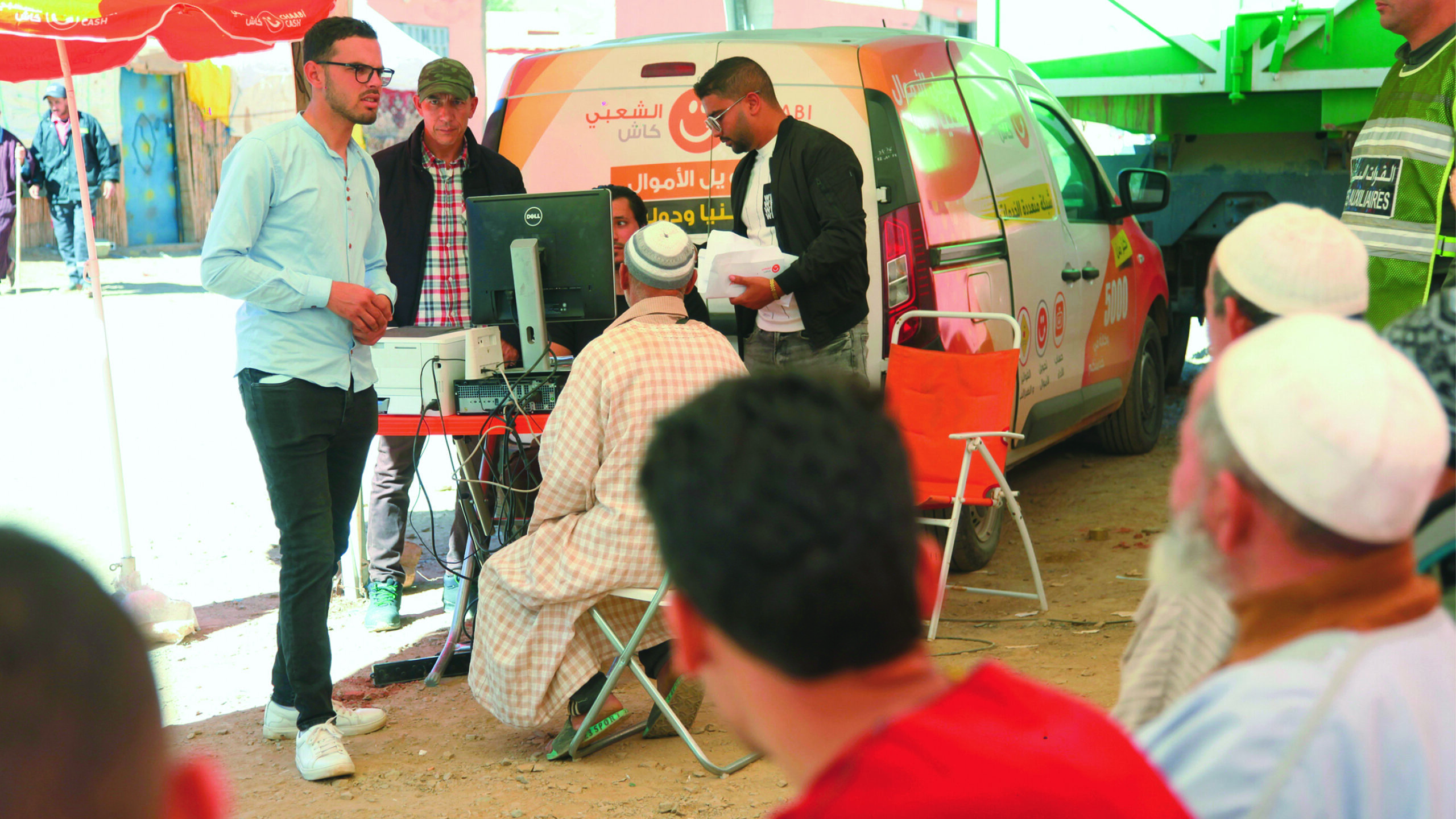
By the end of 2023, the first direct assistance payments were disbursed. Monthly transfers of at least 500 dirhams were allocated to households in precarious situations, targeting four million vulnerable households by 2026.
By the end of November 2025, 3.8 million families had benefited from this assistance, representing 42% of all households and around 12.4 million beneficiaries.
Today, four million families receive direct social assistance, amounting to a total of 52 billion dirhams (as of the end of January).
This time, the government did not fall into the same trap as its predecessors. Direct social assistance, alongside AMO, is no longer a matter of showcasing budget allocations or beneficiary statistics.
It has become a genuine tool for social integration. The government has moved from a logic of assistance to one of support, social inclusion and household empowerment.
Direct Social Assistance (DSA), particularly through its Tayssir component, is conditional on school attendance and has already begun to yield tangible results in reducing school dropout rates. Combined with health coverage, the expansion of healthcare infrastructure and services, and a major infrastructure programme (water, electricity and roads under the territorial inequality reduction programme), this social initiative has become a powerful lever for human development.
It is within this same logic that the newly created National Social Support Agency (NSSA) is now working to transform financial aid policy into a sustainable framework for economic inclusion.
This is achieved by linking financial assistance to training and integration pathways, in order to reduce dependency on welfare. The objective is not merely to provide aid, but to enable families to build their autonomy.
This approach marks a clear break with past practices. Monetary transfers through direct social assistance—much of which, it should be noted, benefits rural areas—now fall within a more integrated human development strategy. All social programmes have, incidentally, been merged into a single programme.
As the Head of Government has pointed out, this initiative “is an innovative institutional mechanism designed to support household purchasing power and strengthen school attendance and social assistance for families, elderly people and persons with disabilities”.
According to Aziz Akhannouch, it will have “several positive outcomes, including improved social and human development indicators, reduced poverty and vulnerability rates, strengthened intergenerational solidarity, and eased financial burdens on families caring for elderly relatives”.
Furthermore, the fact that part of the programme’s funding comes from a solidarity contribution by companies serves a dual purpose: ensuring the programme’s financial sustainability while relieving pressure on the Compensation Fund, and enabling businesses to fully play their social role.
A form of wealth redistribution, in effect. Morocco is thus undergoing a major transformation of its social programmes, moving from a reactive welfare logic to a preventive, supportive approach.
The government has also shifted from input‑based management to more effective and efficient, results‑based governance. The ultimate aim is to invest in human capital in order to create equal opportunities and promote social mobility.