Kingdom
Social Dialogue: The Final Round
In a few days, the government and the social partners will meet for the final round of this term. The dialogue process, which has helped establish a climate of trust between the parties, risks feeling unfinished.

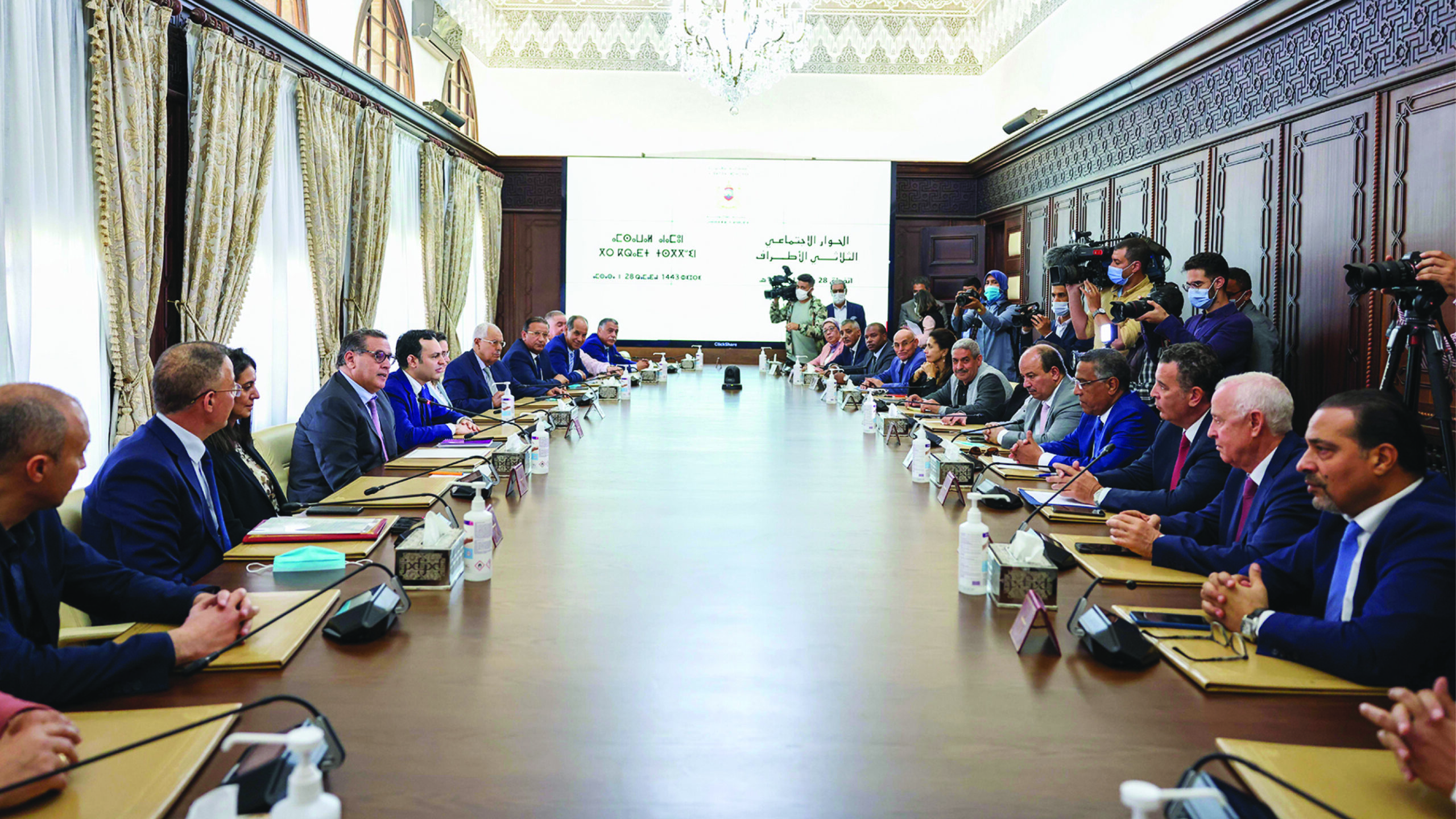
At the beginning of April, the government is preparing to begin, with its partners—trade unions and employers’ representatives—the final round of social dialogue of its term. A term already marked by the signing of two agreements and the institutionalization of this dialogue.
This final round is expected to be crucial, given the nature of its agenda and, above all, the broader context in which it is taking place, in addition to the strong expectations of the social partners.
Two key issues are expected to be addressed, taking into account the commitments of the April 29, 2024 agreement and their urgent nature: the reform of pension schemes and the overhaul of the Labor Code. In both cases, dedicated commissions have been set up, and the results of their work will be known shortly.
Regarding pension reform, the joint commission, which adopted an innovative working methodology involving visits to the headquarters of each of the concerned funds, is expected to visit the CIMR premises on April 6, concluding a tour of just over two and a half months that has taken it to the headquarters of the CMR, the CNSS, and the RCAR.
The technical commission in charge of pension reform held its first meeting on January 15 with the senior management of the CNSS at its Casablanca offices.
The main aim of these meetings was to speed up the process by reducing the time needed to produce the documents requested by the unions. The conclusions of these meetings have not been made public, but the unions nevertheless acknowledge the seriousness of the situation. The diagnosis is broadly shared.
While reiterating their principled positions—namely rejecting any increase in contributions, any postponement of the retirement age, and any downward revision of pension levels—the tone of the trade union centers is now more nuanced.
They advocate for a reform “that would not undermine acquired rights,” while calling for a “comprehensive and fair reform.” In essence, they favor a “structural approach based on harmonizing contribution rates and resource management methods across the different funds.”
That said, everything suggests that this reform, as desired by all parties, will not be initiated in the coming months. Nevertheless, to address the urgency, measures will be launched to delay the collapse of the schemes.
At the same time, the government has also initiated discussions on reforming the Labor Code with the social partners, unions, and employers. Here again, little information has been disclosed. What is known, however, is that a deadline was set for unions to submit their proposals—a deadline they have duly met.
Here too, as clearly stated during the CGEM board meeting on March 5, this is an urgent reform, but one that may only be undertaken under the next government’s term, even if a draft law is introduced into the legislative process during the April session starting next week.
In terms of approach, employers are calling for an acceleration of this reform because, among other reasons, they consider “the current Code to be the main obstacle to hiring in Morocco.” The CGEM is also calling for a “pragmatic reform that takes into account the rapid transformation of professions, particularly in micro, small, and medium-sized enterprises (MSMEs).”
While awaiting reform…
The main trade union centers favor an “article-by-article revision approach.” They would also look favorably on stricter sanctions against companies that underpay or fail to declare their employees.
It appears that, for the government, the objective of strengthening the punitive framework is to “make fraud more costly than compliance.” Needless to say, the reform goes far beyond that.
Its ultimate aim is to respond to technological changes and the demands for flexibility in the global market. These are the two main reforms to which the social partners had committed under the April 29, 2024 agreement.
In the meantime, the parties are also awaiting the implementation of certain provisions of this agreement. Employers are thus expecting the finalization of the legislative framework on the right to strike, along with the publication of all its implementing decrees.
They also stress the importance of a comprehensive reform of vocational training. The unions, for their part, are concerned about the slow pace of sectoral negotiations and the drafting of professional statutes for certain categories of civil servants that still lack them. However, given the context, their main concern at present appears to be negotiating a new increase in wages and, secondarily, in pensions.
A few days earlier, these same union centers had suggested that they were seriously considering the option of boycotting this round—“if it even takes place,” as some leaders of the UMT and UGTM put it—no doubt to express their dissatisfaction with the “failure to hold last September’s session.”
In any case, everyone agrees that even without that session, the government has made significant progress in fulfilling its commitments, particularly regarding raising and preserving workers’ purchasing power.
Salary increases for civil servants have been approved in both installments; the second phase of the minimum industrial wage (SMIG) increase was implemented at the beginning of last January, and that of the agricultural minimum wage (SMAG) comes into effect this April.
In certain sectors, particularly education and health, social dialogue is ongoing, while private-sector retirees have, since January 1, obtained an income tax exemption on pensions paid by the CIMR, similar to pensions covered by public funds and the CNSS.
Clearly, the unions, fully playing their role, are demanding more, which—combined with the proposed pension and Labor Code reforms—points to a very tense final round of social dialogue.
Wage increases: the main demand
Most trade union centers, including those that did not participate in the national social dialogue negotiations, have already stated it: their main demand is a new wage increase in both the public and private sectors.
Encouraged by the current context, they believe that the increases granted under the two social agreements risk being eroded by rising prices, a consequence of the current situation in the Middle East.
They are therefore calling for a further increase of at least 1,000 dirhams and a minimum wage of around 5,000 dirhams. The unions are also demanding an increase in family allowances to 500 dirhams per child, a rise in pension levels, and a reduction in income tax.