Kingdom
SIAM 2026: Morocco accelerates the transformation of the livestock sector
Faced with growing climate constraints and market volatility, the livestock sector is being called upon to undergo a profound transformation of its production systems. The Kingdom is at the forefront of managing these challenges, launching the GG strategy and continuing its efforts to support livestock farmers.

Animal production is facing climate-related constraints that heighten uncertainty for livestock farmers, weaken natural resources, and make it more difficult to stabilize production systems.
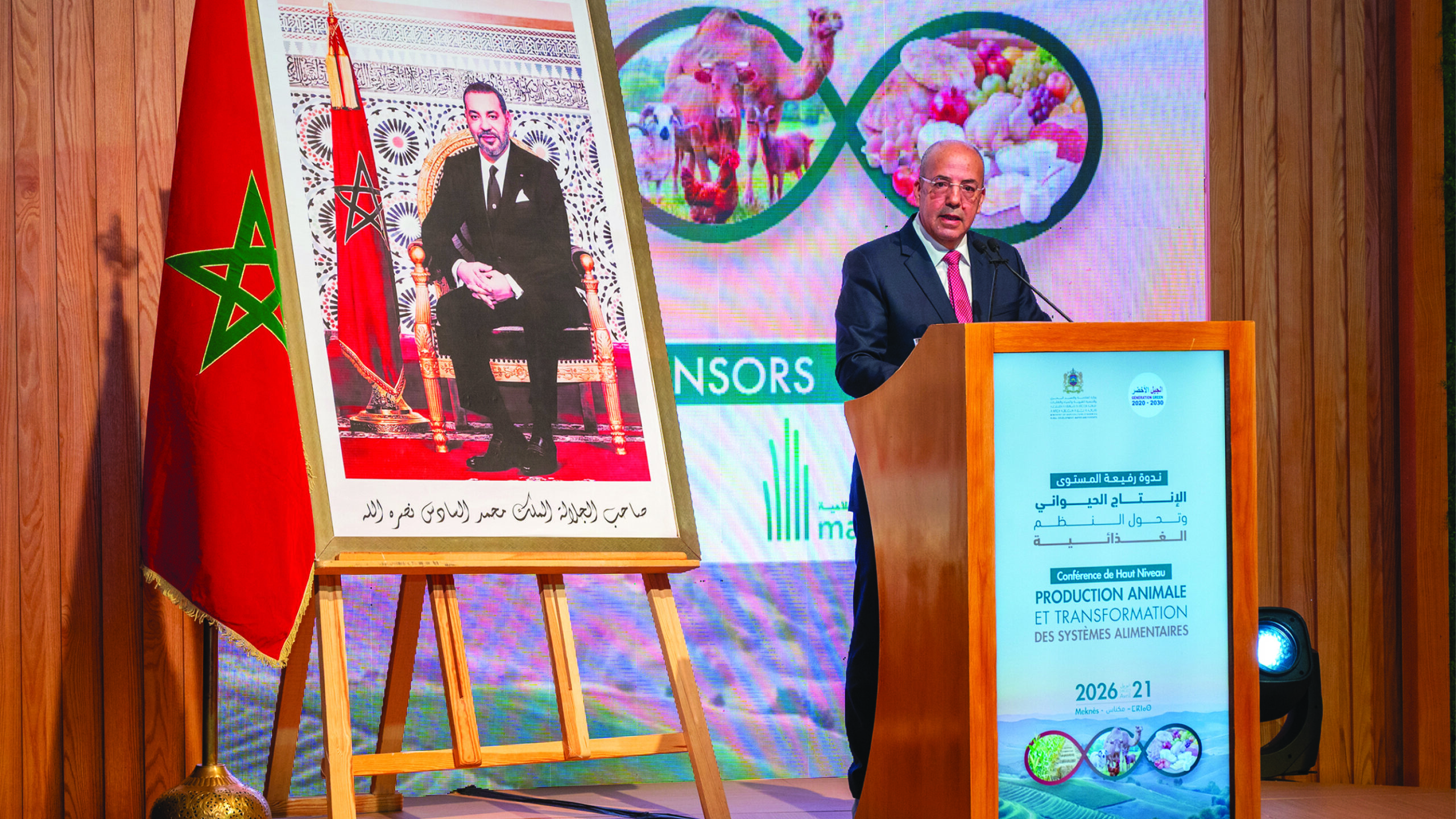
Yet, “it represents a major pillar of the national economy, as it contributes 35% of agricultural GDP, provides income for nearly 1.2 million livestock farmers, and accounts for 135 million workdays,” stated the Minister of Agriculture, Ahmed El Bouari, during the High-Level Conference organized by the Ministry on the sidelines of the 18th edition of SIAM.
This situation is set to become even more significant with population growth, increasing urbanization, and changing consumption patterns.
Hence the importance of ensuring quality, regularity of supply, traceability, and sanitary safety.
Given the years of drought the country has experienced—whose consequences have been exacerbated by international geopolitical conditions—the livestock sector has suffered considerably, both from the scarcity of fodder resources and the rise in livestock feed prices, as well as from declining reproductive and productive performance.
To develop sustainable animal production systems, Morocco has, since 2020, launched the Generation Green strategy with a horizon extending to 2030, placing sustainability, resilience, and the valorization of human capital at the heart of agricultural development.
It should be noted that this strategy builds on the achievements of the Green Morocco Plan, which helped drive significant modernization of animal value chains, notably achieving full coverage of domestic consumption needs in red meat and increasing dairy production.
Support Measures
To continue supporting the sector and livestock farmers, the government has undertaken several measures, including strengthening the production of animal feed as a key lever to improve sector performance—particularly through securing irrigation water in major irrigated areas; enhancing the animal health security system by reinforcing epidemiological surveillance, sanitary controls, and vaccination campaigns against infectious diseases; and boosting milk and meat productivity.
Moreover, given that beef accounts for 80% of national consumption, the development of the red meat sector will rely on improving cattle breeds intended for meat production, notably through the expansion of artificial insemination and the local production of high-yield semen.
The government also aims to develop the camel livestock sector, given its economic and social role in the Southern Provinces, where it constitutes a primary source of income while contributing to development with added value estimated at nearly 225 million dirhams per year and the creation of around 2.7 million workdays.
Marketing channels, for their part, remain a key focus. The objective is to rehabilitate them, modernize slaughterhouses, develop logistics infrastructure, liberalize cold-chain and transport services, and encourage fair contractual relationships, particularly for the benefit of small producers.
Finally, the Executive is working to promote training and scientific research in partnership with the various stakeholders.
A Moroccan–Portuguese Win-Win
This vision of sustainability and resilience embraced by the Kingdom is also shared by Portugal, the country honored at this 18th edition of SIAM.
“Two neighboring and friendly countries that share the same ambition: to build sustainable and inclusive food systems,” said José Manuel Fernandes, Minister of Agriculture and Maritime Affairs of Portugal.
According to him, pressure on water resources requires intelligent management as well as advanced use of technology. The same applies to the vitality of regions.
Indeed, Portugal has launched an investment plan extending to 2040 to secure its water needs.
A budget of €5.4 billion has been mobilized by the end of 2030, among other objectives, to ensure water resources for the Alqueva dam, also considered one of the largest artificial lakes in Western Europe. “On its own, it required a budget of €2.5 billion, or €330 million annually,” Fernandes added.
Alongside water management, the Portuguese government has identified several priorities also related to plant health and the use of drought-resilient crops.
To this end, numerous levers must be activated, including applied research, digital technologies, and artificial intelligence.
This underscores the importance of strengthening scientific cooperation between research institutes in both countries, continuing to explore investment opportunities, and enhancing trade exchanges.
“We will continue to position Portugal as a strategic ally of Morocco within the European Union and to contribute to the implementation of European programs, whether neighborhood instruments, financial mechanisms, or new initiatives such as the European Competitiveness Fund, which includes a research component in which Morocco could fully participate,” the Portuguese minister concluded.
For her part, the French Minister of Agriculture, Agrifood and Food Sovereignty, Annie Genevard, identified several shared priorities, notably securing animal feed, modernizing and professionalizing farms, genetic improvement, structuring value chains, and adapting to changes in consumption patterns. Ultimately, the goal is to “have predictability in an increasingly unpredictable world,” she concluded.
Cereals: 90 Million Quintals
Abundant rainfall during this agricultural season has made it possible to reach a cereal-sown area of approximately 3.9 million hectares, which should boost cereal production to 90 million quintals.
Fruit trees, for their part, recorded remarkable performance, notably olives, citrus fruits, and dates. As a result, agricultural GDP is expected to increase by about 15% compared to the previous year.
Furthermore, following the improvement in the hydrological situation—with dam reserves reaching 13 billion cubic meters and a filling rate of 75.7%—a recovery in irrigated agriculture is expected.
Especially as the Ministry plans to launch an ambitious irrigation program starting from the next agricultural season.