Kingdom
Sahara: “The Post October 31” Takes Shape
The “Madrid roadmap” has been set in motion. The autonomy plan, in an expanded version, is the only basis for discussion. A timetable for its implementation, within the framework of Resolution 2797, has been adopted. Morocco’s position is more firmly bolstered than ever. Analysis.

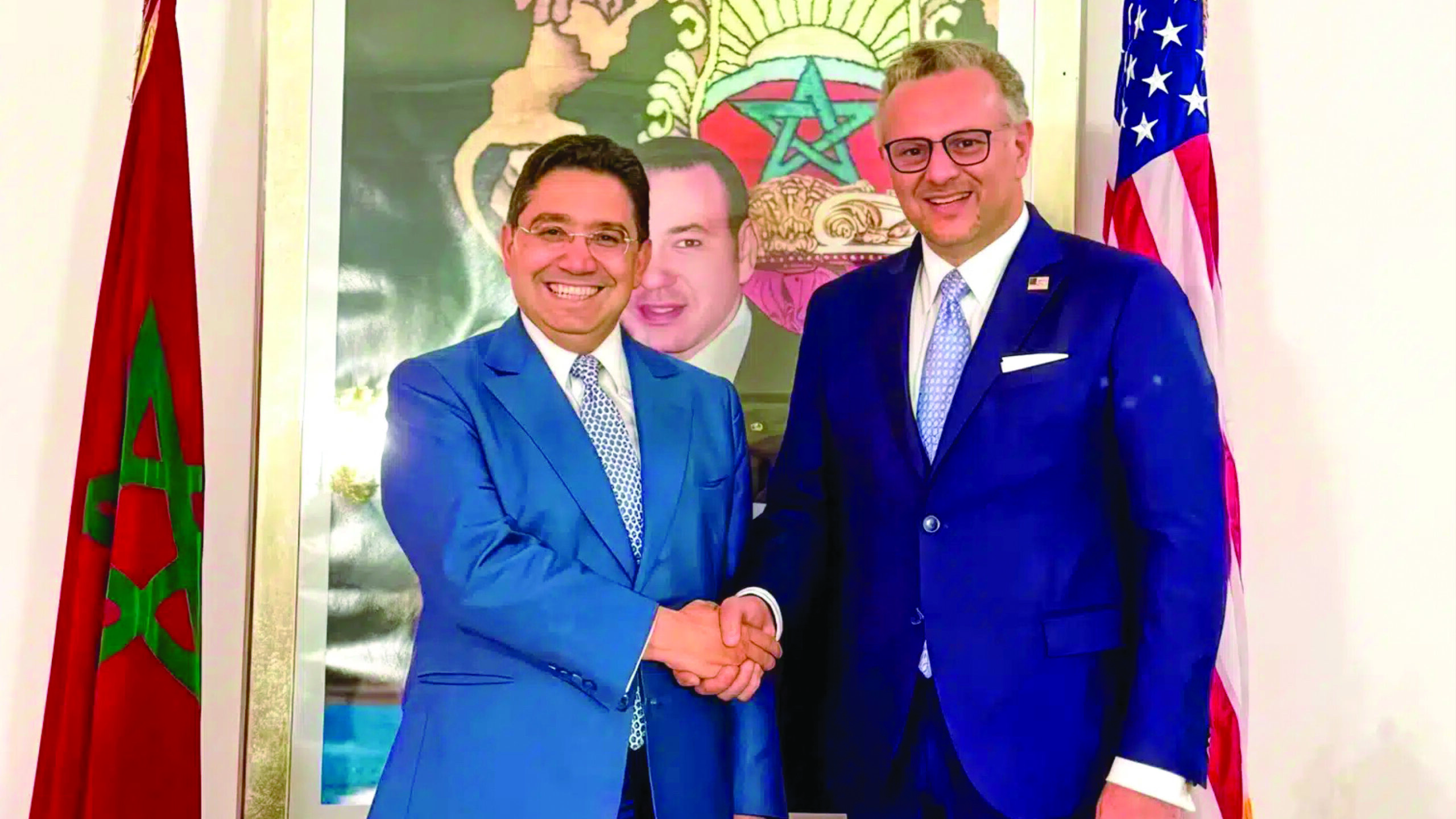
“High-level delegations from the United States and the United Nations facilitated discussions in Madrid, Spain, with Morocco, the Polisario Front, Algeria, and Mauritania regarding the implementation of UN Security Council Resolution 2797 (2025) on Western Sahara.”
These were the terms used by the U.S. mission to the UN to announce on the platform X that, on February 8 and 9, a meeting took place between Morocco’s foreign minister, Nasser Bourita; Algeria’s foreign minister, Ahmed Attaf; Mauritania’s foreign minister, Mohamed Salem Ould Merzoug; a Polisario representative; Donald Trump’s special adviser, Massad Boulos; the United States Permanent Representative to the UN, Michael Waltz; and the UN Secretary-General’s Personal Envoy, Staffan de Mistura.
“The American and UN delegations facilitated, in Madrid, Spain, discussions bringing together Morocco, the Polisario Front, Algeria, and Mauritania around the implementation of UN Security Council Resolution 2797 (2025) on Western Sahara,” Massad Boulos reiterated a little later.
This, while specifying that “under President Trump’s leadership, the United States remains committed to a just, lasting, and mutually acceptable solution that promotes enduring peace and a better future for the entire region.”
Official communication about this two-day meeting stops there. However, according to political analysts, brief and direct as it may be, the “X” post by the U.S. representative to the UN already provides some elements for analysis. The statement (the post) is in itself a deliberate diplomatic and political act.
Information on the matter is coming exclusively from Washington, which marks an inflection point in the search for a solution to this dispute. The information, as published by the U.S. mission, is now the authoritative account at the level of the United Nations, from start to finish of this new process.
And the United States becomes the party “that has the final say” on this issue. For any comment, the spokesperson for the UN Secretary-General, Stéphane Dujarric, merely recalled that “the Sahara issue has long been on the United Nations agenda.” And he indicated that “high-level UN delegations are present in Madrid,” while welcoming the United States’ mediation role.
That said, on the substance, the words used in the U.S. mission to the UN’s communication are heavy with meaning. First, it should be emphasized that this is not a matter of “negotiations,” but of “discussions.” That in no way means that the meeting was exploratory, consultative, or symbolic in nature.
The discussions focused on a single proposal on the table: the autonomy plan for which Morocco has just presented an expanded version, developed at the end of a consultation process that also involved political parties, in accordance with the terms of Security Council Resolution 2797.
And it is the United States that is setting the operational framework for implementing that resolution, which is, moreover, a historic Moroccan achievement.
In a few months, a framework agreement
Let us note in passing that, even though no official statement has been made about it, the fact that many sources—media sources in particular—have reported that Morocco presented a document that is so detailed, compared with the few pages of the version submitted in April 2007, is in itself revealing.
According to analysts, this means that “Morocco has made its choice and adopted a clear and precise model of autonomy, after having listened to the various political parties represented in Parliament.”
Likewise, the fact that Morocco came to the meeting with such a detailed proposal indicates that “the other party has abandoned its previous refusal to discuss autonomy as the sole basis for negotiations. It ultimately accepted the autonomy proposal in order to reach a definitive solution to a conflict that has lasted for more than half a century.”
To return to the statement by the head of the U.S. mission to the UN, it also refers to “high-level delegations,” meaning official representatives “able to make weighty political decisions.” This also points to the scale of U.S. pressure, which goes beyond the traditional role of a simple mediator. Hence the presence of influential diplomatic figures from the Trump Administration and the United Nations, in addition to the parties concerned.
This thus gives these discussions a “decisive” character, while reducing room for maneuver and extinguishing any inclination by the other parties to stall. Even so, it is clear, it is observed, that the United States “has not yet bared its claws, and continues to bet on soft diplomacy without direct pressure, wagering that Algeria will understand that the time has come to resolve this conflict.”
The term “implementation,” also used in the statement, clearly suggests that Resolution 2797—which Algeria has interpreted in a distorted way—is not a subject for analysis and discussion. It has become an operative, in-force roadmap. From that point on, the Madrid discussions focused on the mechanisms for applying it on the ground.
And the involvement of Algeria and Mauritania in discussions on its implementation underscores the notion of these parties’ collective responsibility. This, according to analysts, “aligns perfectly with the Moroccan view that settling the conflict necessarily requires a round table including all influential regional parties.”
Ultimately, again based on what has filtered out from these two days of talks, it emerges from this meeting that Washington succeeded in obtaining recognition from the parties (including Algeria) that the updated Moroccan initiative is “the only document on the table” for technical discussions. There is no longer any question of any “alternative proposal.” This is a resounding diplomatic victory for the Kingdom.
Now, in what follows, the parties agreed to create a “standing technical committee,” made up of legal experts under U.S.-UN supervision, to study the details of implementing “autonomy,” in particular aspects related to taxation, the judiciary, and local policing. Washington, moreover, reached a procedural agreement, with a next meeting—probably in May—in the United States for the signing of a political “framework agreement.”
Thus, what happened in the Spanish capital on February 8 and 9 was not a simple meeting, but the beginning of an entire process. Everything suggests that the discussions led to a formal agreement that includes a negotiation procedure defining what will be discussed, who will take part, where the next rounds will be held, and, above all, on what basis.
Why Spain?
The venue for the discussions is not accidental. For practical reasons, Madrid is geographically the closest point for all the parties concerned—so as to save time.
At a deeper level, choosing the Spanish capital as the meeting place carries a double symbolism: it cements international recognition of Spain’s new position supporting the Moroccan initiative and places the parties face to face in a city that has historically been the setting for the signing of decisive agreements.
This suggests that we are looking at a “Madrid Agreement 2,” but this time under U.S.-UN sponsorship. That is undoubtedly why people speak of a “Madrid roadmap.”
However, in order for the negotiations to remain on “U.S. soil,” Washington chose to hold the meeting within the walls of its embassy in Madrid, which constitutes a clear signal: the United States is not merely a neutral mediator, but an engaged mediator actively involved in the search for a solution to the conflict.