Kingdom
Rolling Stock: How the Current Fleet Will Be Expanded
Comprising 12 high-speed train sets (HST), 33 self-propelled TNR shuttle trains, and 5,000 wagons, the Kingdom’s railway fleet will be strengthened through an ambitious rolling stock acquisition plan.

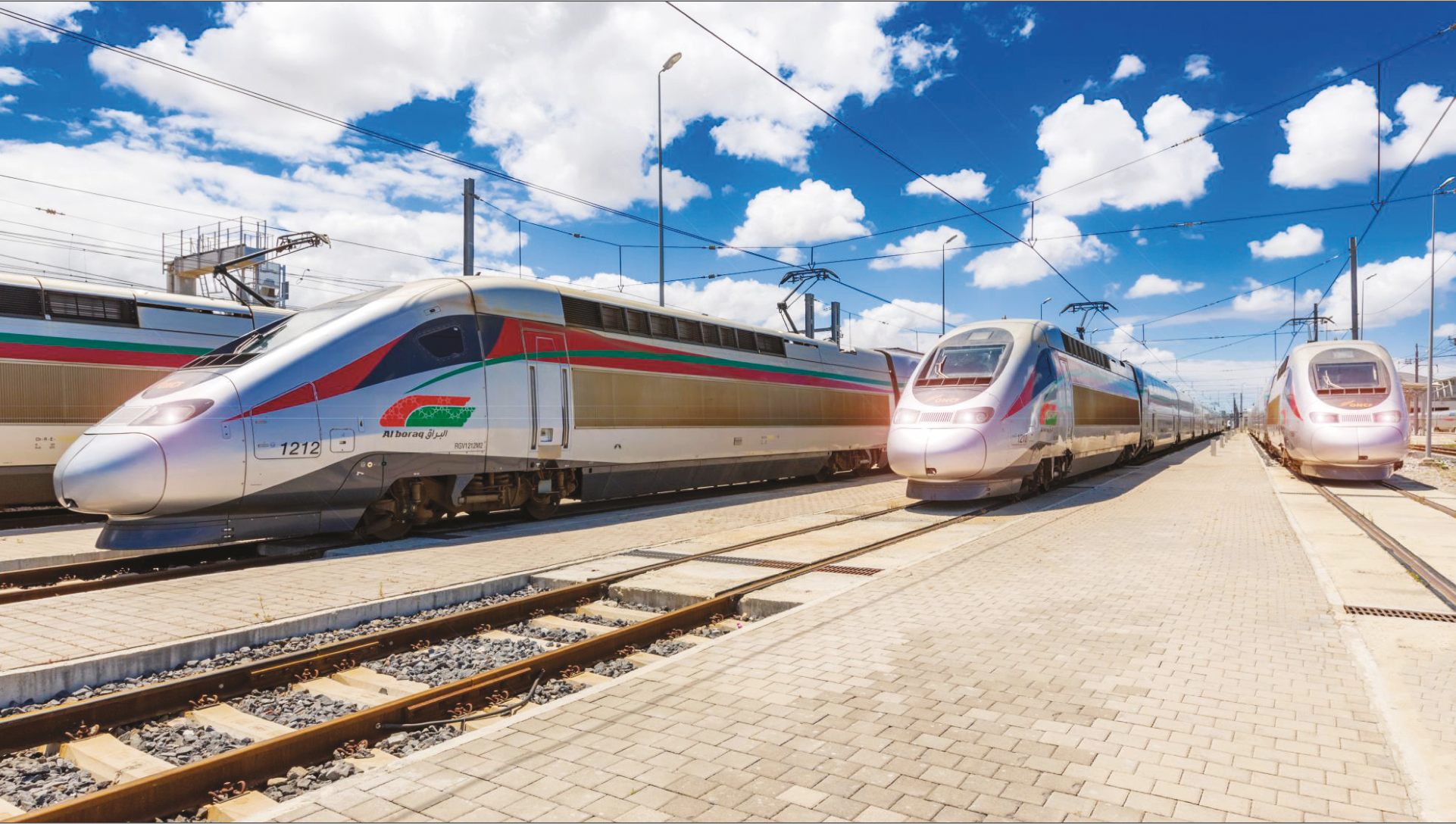
Morocco is cited as an example in terms of transport infrastructure and regional connectivity. Specifically, with over 2,200 km, the country boasts the most extensive railway network in the Maghreb region and the second-largest in Africa. This railway performance is the result of a colossal investment effort made over the past twenty years.
During the 3rd edition of the Rail Industry Summit held recently in Casablanca, Mohamed Rabie Khlie, the Director General of ONCF, revealed that “nearly 7 billion euros, equivalent to over 70 billion Moroccan dirhams, have been mobilized for several structuring projects over the past twenty years.” Clearly, the acquisition of rolling stock has attracted investments totaling several billion dirhams.
An update on the current rolling stock
According to figures provided by ONCF, the current fleet of the Kingdom consists of 12 high-speed train sets (HST), 33 self-propelled TNR shuttle trains, and 5,000 wagons. Additionally, 100 electric locomotives and 100 diesel locomotives transport passengers throughout the year.
Furthermore, 18 FG trains are also part of ONCF’s fleet. It is worth noting that one of the Office’s most emblematic projects, the Tangier-Kenitra high-speed line, which mobilized nearly 24 billion Moroccan dirhams for its realization, has proven economic implications.
In detail, nearly 1,000 Moroccan companies were positively impacted by working on the construction of the Kenitra-Tangier HSL, which generated over 30 million days of work for the national economy. At the same time, according to ONCF, 65% of the project’s added value was reinvested in Morocco.
Beyond the current fleet, with its flagship Al Boraq having transported over 5.2 million passengers in 2023, Morocco, through ONCF, has an ambitious rolling stock acquisition plan set to be completed by 2030, the year of the World Cup jointly hosted by Morocco, Spain, and Portugal.
Components of the acquisition plan
Mohamed Rabie Khlie states that “ONCF seizes the opportunity presented by the mega-program to acquire a hundred self-propelled shuttle trains to focus on the development of the local industrial ecosystem.”
As a reminder, the development of this plan is driven by the pursuit of operational performance gains for ONCF, the enhancement of regional services, and the expected increase in traffic by 2030. According to data released by the Office, what many experts consider an ambitious rolling stock acquisition plan will mobilize over 20 billion Moroccan dirhams by the 2030 World Cup.
In detail, alongside renovation projects, the current fleet will be reinforced between 2025 and 2026 with 5 self-propelled TNR shuttle trains, 70 new cars, 350 new wagons, and 40 diesel locomotives.
By 2030, with the commissioning of the Kenitra-Marrakech HSL, stretching 400 km, ONCF will rely on an extensive fleet consisting of 6,000 wagons, 30 high-speed train sets (built by Alstom), 90 self-propelled TNR shuttle trains, and 50 Metropolitian self-propelled trains. Additionally, there will be 214 cars, 40 HP intercity train sets, 70 electric locomotives, 140 diesel locomotives, and 18 FG trains.
“Made in Morocco” Wiring in Future High-Speed Trains
During the 3rd edition of the Rail Industry Summit, Mehdi Sahel, the General Manager of Alstom Morocco, made an important revelation regarding a part of the rolling stock that will be acquired by ONCF in the coming years.
Speaking at the round table on rolling stock, the head of Alstom Morocco revealed that the future high-speed trains acquired by the public Office from Alstom for the operation of the Kenitra-Marrakech HSL before 2030 will be equipped with wiring manufactured in Morocco. It is worth noting that the French group Alstom employs over 1,300 people in Morocco.
The industrial company, headquartered in Casablanca, also has a specialized signaling installation in Rabat and a factory for wiring and onboard transformers for trains based in Fes.
One notable feature of the latter’s industrial unit is its exclusive focus on exports. Another significant piece of information shared by Mehdi Sahel is that Alstom, which already has a strong industrial presence in Morocco, plans to establish an engineering center in the Kingdom soon.
Rolling Stock and Sustainability
The sustainability component is a crucial axis for the development of specifications when ONCF embarks on a rolling stock acquisition plan. The Office pays close attention to the service life, the sustainable nature of materials (recycling), and the energy consumption of the rolling stock.
In reality, these parameters are decisive for reducing the operating costs of the Office, which must deal with environmental and profitability requirements for the sustainability of its business. It is important to note that all high-speed train sets of Al Boraq operate at 100% with clean energy, particularly wind energy.