Business
Port Dredging: How Somagec Became the Master of the Seabed
The company has been securing the most strategic dredging contracts following the decline of its competitor Drapor. From Tangier to Dakhla, Somagec has become the key player in maintaining port draft depths. An analysis of a rise that is as rapid as it is undeniable.

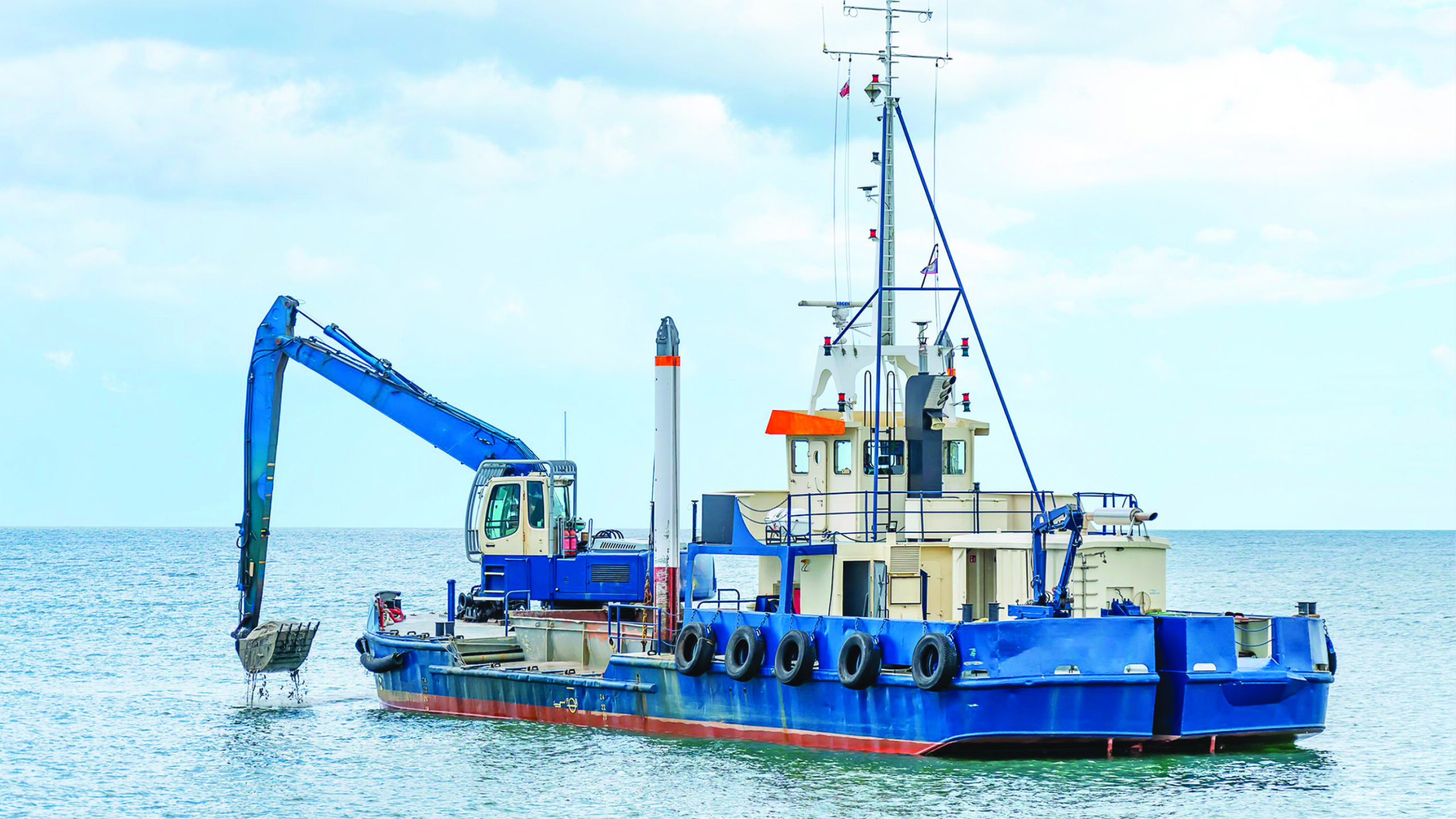
Hundreds of millions of dirhams. Ports one after another. Contracts piling up, and one name that keeps appearing in award notices: Somagec. In just a few years, the company founded in 1966 by Rizkallah Riad Sahyoun has risen to the top of port dredging in Morocco.
A discreet yet highly strategic sector: without dredging, there is no sufficient depth, and without depth, there is no logistical competitiveness.
Latest scoop: the contract for maintenance dredging works at 27 ports, awarded last February, with service amounts ranging between 64.8 and 123 million dirhams (MDH) per site. That represents more than 70% of the complexes managed by the National Ports Agency (ANP). A one-year contract covering underwater extraction, transport, and disposal of sediments.
A year earlier, in April 2025, the Société maghrébine de génie civil (Somagec) had secured a similar contract covering the ports of Tan-Tan, Tarfaya, Laâyoune, Boujdour, and Dakhla (old and new port), for amounts ranging between 53.7 and 102 MDH.
In 2023, the company led by Roger Sahyoun had already stood out by winning, from the ANP, the maintenance of depths for around thirty ports, for a total bill ranging between 44 and 84.6 MDH.
This dominance is no coincidence. It accelerated after the collapse of Drapor, the historic operator in port dredging in Morocco. Nature abhors a vacuum, and the bankruptcy (see box) of its main competitor opened a wide avenue for Somagec, which established itself as the new leader in port dredging in Morocco.
Drapor’s bankruptcy, a major turning point
The reshuffling of the cards began as early as 2021. The company won the dredging contract for eight ports for around 131 MDH, notably outperforming Drapor and Atlas Dredging Maroc. In 2022, it was once again selected for large-scale dredging of around ten ports, for an amount of 91 MDH.
Driven by these major contracts, the company reported a total turnover of 1.65 billion dirhams (MMDH) that year, confirming its change in scale.
In total, dredging contracts won between 2021 and 2025 have brought in more than 531 MDH. While its latest financial results have not yet been made public, it is highly likely that its revenues have increased significantly, driven by this substantial windfall and the consolidation of its dominant market position.
Proof of its growing grip: Somagec was the sole bidder in the last two contracts awarded last year, despite the ANP’s removal of the national preference clause in dredging contracts since April 2021.
Major maritime and hydraulic projects
In this sector where competition has become scarce, only Atlantic Dredging Maroc, a company specializing in maritime works and active in dredging in Morocco since 2010, appears as its main challenger.
The subsidiary of the Greek group Atlantic Dredging manages to secure some contracts, such as the one won in early February 2025, covering desilting works at around twenty ports for an amount between 25 and 47 MDH.
Building on this scale, Roger Sahyoun’s company has strengthened its position in major maritime and hydraulic projects in the Kingdom. In August 2021, its subsidiary Somagec Sud, in a consortium with SGTM, was awarded the construction works of the deep-water port of Dakhla Atlantique for 12.4 MMDH.
In consortium with Hamza Kabbaj’s group, Somagec also won, in July 2024, the contract for the extension of the passenger and ro-ro (PPR) port of Tanger Med.
With a budget of 5.5 MMDH, this project aims to strengthen the capacity for handling international road transport (TIR) trucks and passengers within the port complex. A complex that Somagec knows well, having been one of the key players in the construction of Tanger Med II and its current extensions.
The construction giant has also become a reference in hydraulic projects.
It is expected to complete, by the end of 2026, the raising works of the Mokhtar Soussi dam, in the province of Taroudant, increasing its height from about 52 m to 100 m.
Objectives: increase storage capacity, strengthen water security, irrigation, and flood protection. The company is also building the Tamri dam in Agadir, with a capacity of 204 million cubic meters, which is also expected to become operational this year, and is carrying out extension works on the Moulay Youssef jetty at the port of Casablanca, over a length of 400 m.
These three contracts amount to more than 5 MMDH. In partnership with the Korean company Hyundai, Somagec is also among the potential bidders for the management of the Casablanca shipyard.
Sustained expansion in Africa
Alongside these major projects in Morocco, Somagec is also deploying its expertise in sub-Saharan Africa.
The project to extend the autonomous port of Dakar, won in 2004, served as a springboard for its lasting establishment in this region. Its first subsidiary, Somagec GE, created in 2005 in Equatorial Guinea, built major infrastructures such as the deep-water ports of Malabo and Kogo. The group also launched in 2021 the construction of the first hydrocarbon storage terminal in Damerjog, Djibouti.
Initially specialized in port infrastructure, the company has expanded its scope to the energy sector.
On January 31, 2025, the group signed a memorandum of understanding worth around 13 billion dirhams (MMDH) with Angola’s Ministry of Energy and Water for the construction of a high-voltage line (400 kV) interconnecting Angola, the DRC, and Zambia. Structured as a public-private partnership (PPP) under the Build-Operate-Transfer (BOT) model over 25 to 30 years, this project, led by its subsidiary Somagec Holding Energy, aims to transmit up to 2,000 MW of surplus hydroelectric power from Luanda to the regional mining areas of these two countries. In Morocco, prospects remain favorable.
The upcoming commissioning of Nador West Med and the future port of Dakhla Atlantique, expected by 2028, should sustainably support dredging demand. Added to this are projects included in the Port Strategy 2030, which provides for the expansion and modernization of several of the Kingdom’s port infrastructures.
In this favorable context, Somagec’s dominant position, now established as a national champion in the sector, is firmly anchored.
A near-monopoly that does not seem likely to run aground anytime soon.
Drapor, the story of a shipwreck
Its troubles began in 2017, when the former Minister of Equipment, Transport, Logistics and Water, Abdelkader Amara, refused to renew the operating authorization for the Azemmour site, granted in 2007 during its privatization for a period of ten years.
Worse still, permits relating to the Larache and Mehdia sites, also covered by the agreement signed between the State and Drapor, were likewise refused by the supervisory authority on the grounds of environmental impacts on the mouth of the Loukkos River.
This situation plunged the company into a deep crisis. Despite favorable court rulings at first instance and on appeal between April 2021 and 2023, Drapor failed to recover.
These operational difficulties were compounded by internal conflicts, against a backdrop of allegations of embezzlement of several million dirhams, as well as family and managerial disputes that significantly affected the company’s management.
The bankruptcy of the former national flagship of dredging deeply marked the maritime sector. Nothing, at first glance, had suggested such a decline for this industry giant. Founded in 1984 and later placed under the supervision of the Ministry of Equipment, Drapor was privatized in 2007 before being sold for 327.6 MDH.
Placed under safeguard proceedings to restructure its debt, then into judicial reorganization in January 2023, Drapor was ultimately liquidated five months later. This decision was confirmed by the Casablanca Commercial Court after it observed the cessation of payments.
The bankruptcy was upheld on appeal in January 2024. The legal saga became even more complex last January, when the courts validated the claims owed to the ANP.