Business
OCP, CDG, Tanger Med… Catalysts of Development
Over the years, the three major public groups have evolved into sprawling, multi-sector giants, equipped with genuine expertise in high-value-added fields such as sustainable development, engineering, industrial planning, innovation, and education. This diversification plays a vital role in advancing the Kingdom’s strategic development objectives.

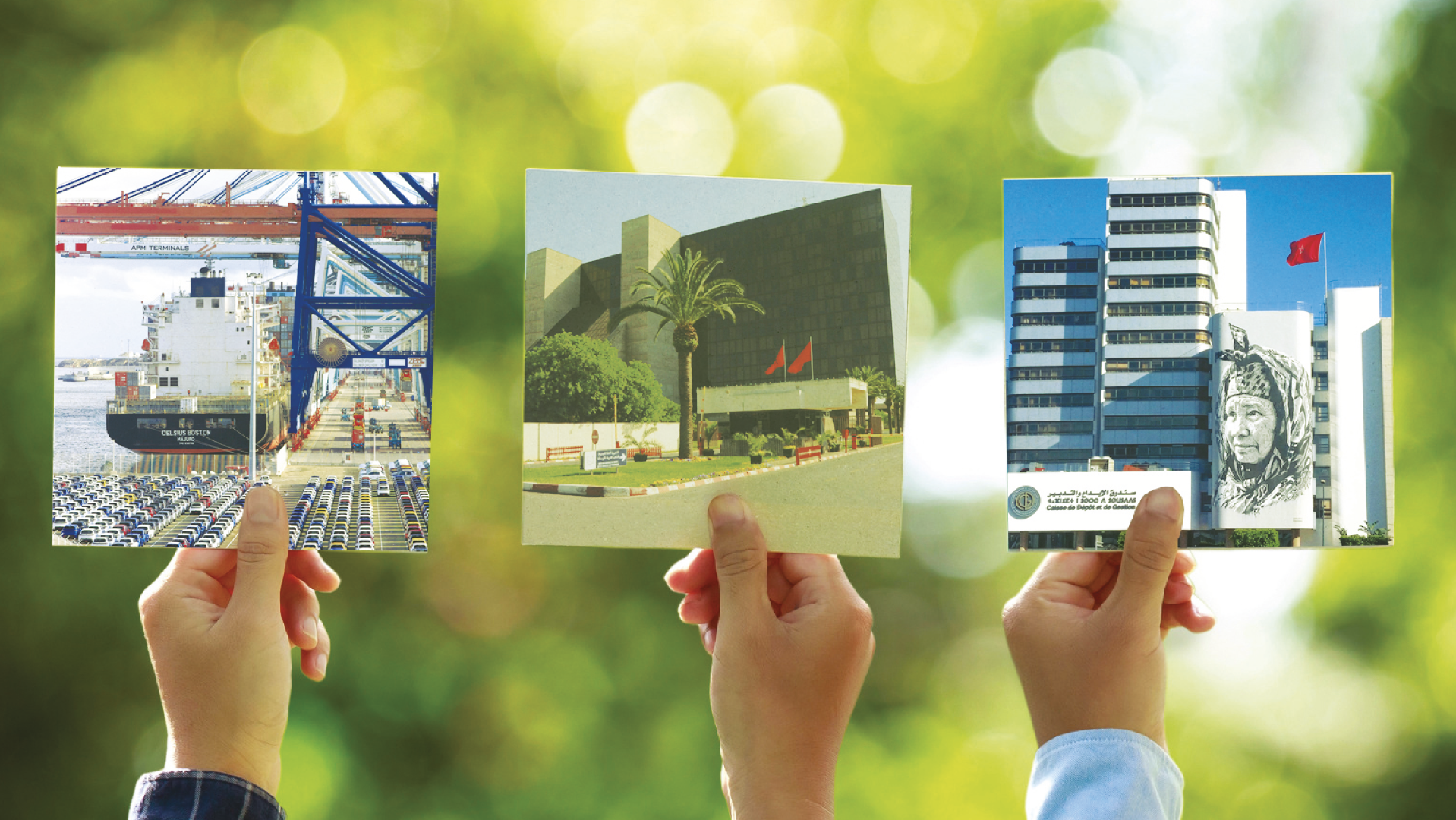
Within the constellation of public enterprises, groups like OCP, Tanger Med, and CDG stand out for their ability to transcend their core business activities, venturing into sectors dismissed by some unconvincing critics as superfluous, wasteful, and lacking prospects for immediate profitability.
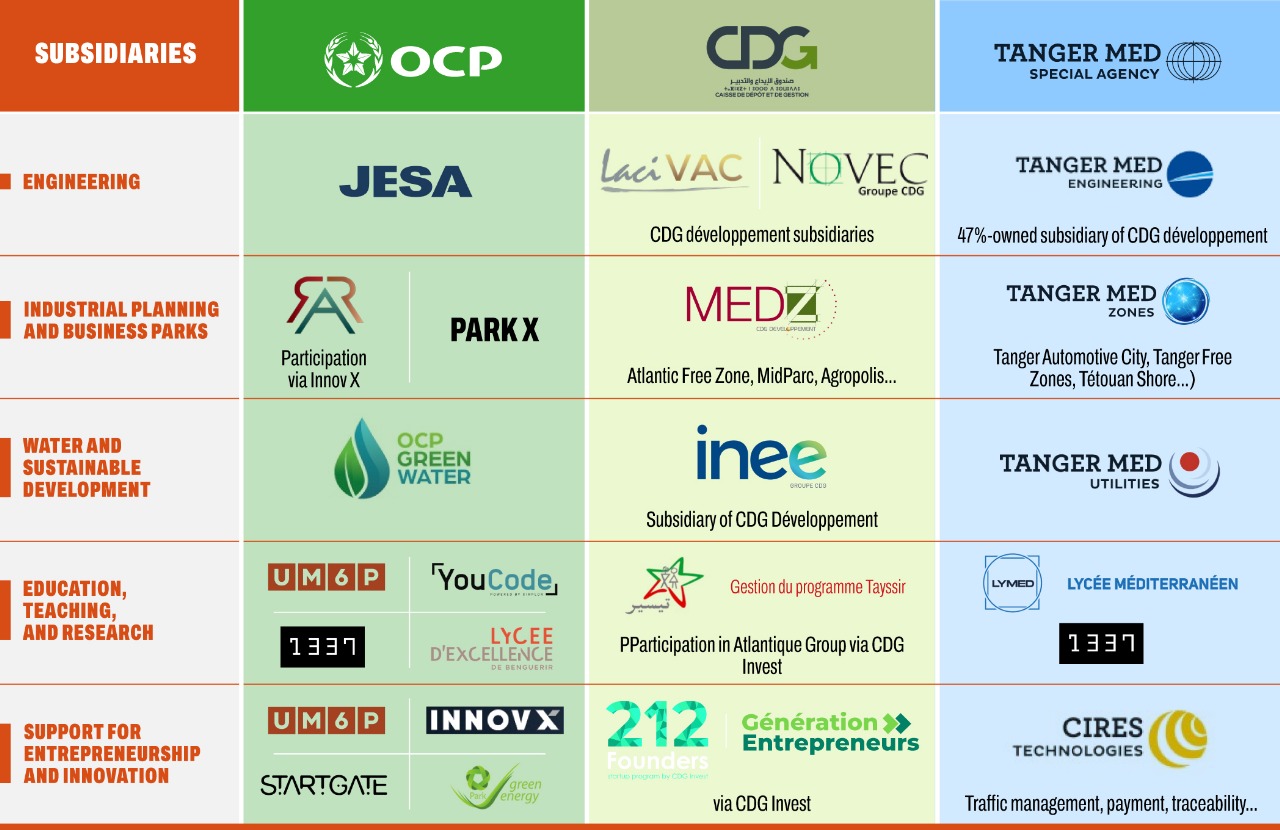
In reality, the comprehensive initiatives of these three groups deliver remarkable added value to the broader national community. By significantly expanding their scope of action and honing their genuine expertise—whether through dedicated subsidiaries or their foundations—they operate in strategic sectors such as engineering, industrial planning, water and sustainable development, education and higher learning, and entrepreneurship support. And the list is far from exhaustive…
While the initial development of these competencies internally was driven by the strategic needs of each group, this diversification now plays a broader role. It acts as a catalyst for the country’s economic and social development, aligned with government priorities.
It must be acknowledged that these groups merit recognition for their agility, largely because they are often exempt from the constraints of public procurement regulations. This represents a significant asset in terms of speed and efficiency in executing projects, which frequently involve urgent or innovative demands—such as the seawater desalination initiatives spearheaded by the OCP Group.
It is also worth noting that these well-structured (or restructured) groups, governed robustly and staffed by armies of engineers, financial experts, and highly skilled project managers, are exceptionally equipped for such tasks. Especially since they lack no resources.
Whether for innovative pilot projects or initiatives complementary to various sectoral strategies, the OCP, Tanger Med, and CDG groups are actively shaping tomorrow’s Morocco. In this regard, they are far more than a fertilizer producer, a port complex, or a financial institution managing long-term savings.
Industrial Development
The three groups are particularly active in developing leading industrial zones, playing a central role in advancing the country’s industrial strategy. The case of the Tanger Med Group is highly instructive in this regard.
The group has developed over 3,000 hectares of economic activity zones, hosting more than 1,400 companies and creating 130,000 jobs across 10+ sectors: automotive, aerospace, textiles, healthcare, agrifood, electronics, renewable energy, packaging, services, and logistics. The generated business volume exceeds 174 billion dirhams.
Tanger Med’s activity zones include those managed by Tanger Med Zones (a subsidiary of the Tanger Med Group, encompassing Tanger Automotive City, Tanger Free Zones, Tétouan Shore, etc.) and the new Mohammed VI Tanger Tech City, developed by SATT—a partnership between Bank of Africa, the Tanger-Tétouan-Al Hoceima region, the Tanger Med Group, and the Chinese firm CCCC-CRBC.
These zones are now internationally recognized as benchmarks: according to Financial Times’ fDi Intelligence ranking, Tanger Med Zones ranks as the world’s top automotive platform, hosting an ecosystem of nearly 120 automotive suppliers across complementary tiers 1, 2, and 3.
For the CDG Group, the design, development, and management of activity zones are handled by MedZ, a subsidiary of CDG Développement. Established in 2002, MedZ has become a leader in territorial development, expanding its scope to include industrial and offshoring zones.
It operates numerous industrial parks and business hubs nationwide, such as Midparc in Nouaceur (aerospace industries), Atlantic Free Zone in Kénitra (automotive sector, home to the Stellantis ecosystem with ongoing expansions), Casanearshore (North Africa’s largest business park for ITO, BPO, CRM, and engineering services), the Souss-Massa Industrial Acceleration Zone, and four agropoles. The group has also developed subsidiaries specializing in facility management, notably Exprom Facilities and Xperis Services.
As for the OCP Group, beyond its own massive industrial development projects in Morocco’s key mining sites, it also contributes to national efforts to expand activity zones across the country. Through its subsidiary InnovX, OCP participates in Rabat Région Émergence—a local development company—to create economic activity zones in the Rabat-Salé-Kénitra region. The company is working on projects like Rabat’s future gaming hub and an economic zone in Ameur, near Salé.
Additionally, Park X, another InnovX subsidiary, was launched to develop and manage innovative, sustainable industrial parks. Two initial projects are planned in Jorf Lasfar and Benguerir: the first for advanced chemistry industries and the second for innovative manufacturing.
Engineering
The engineering expertise developed by the three groups stands as a success story. Within the OCP Group, JESA (Jacobs Engineering S.A) exemplifies this achievement. Established in 2010 as a joint venture between two multinational leaders—OCP and Australia’s Worley—JESA has grown into a leading provider of end-to-end solutions in Morocco and across Africa, specializing in design, engineering, project execution, and asset management.
With nearly 4,500 employees (engineers, technical experts, planners, constructors, and managers) and offices in Morocco, Côte d’Ivoire, Ethiopia, Benin, Senegal, and the United States, JESA delivers innovative, sustainable solutions in mining, industry, energy, environment, water, and infrastructure. It has executed hundreds of complex engineering projects across the African continent.
The CDG Group is equally prominent through Novec, a subsidiary of CDG Développement. This engineering consultancy has cemented its reputation by delivering critical infrastructure projects for Morocco’s development, including the Tanger-Kénitra LGV (high-speed rail) and the Tanger University Hospital Center (CHU). With nearly 400 employees—200 of whom are engineers—and subsidiaries like Novec Gabon and Novec Mauritania, the firm has honed expertise in infrastructure vital for the 2030 World Cup (mobility, airports, stadiums, urban planning, hospitals). Novec is increasingly recognized as a key player in exportable “Made in Morocco” engineering.
Collaboration between the groups is also evident. Tanger Med Engineering (TME), a subsidiary jointly owned by Tanger Med Group and Novec (47.6% stake), founded in 2008, highlights this synergy. With a multidisciplinary team of over 200 consultants specializing in advanced technical expertise, TME played a pivotal role in developing Tanger Med Port. It has since expanded into design and scaling services for major infrastructure projects.
Beyond its advisory role in constructing port and logistics hubs in Morocco (Safi, Dakhla) and African nations (Cameroon, Djibouti, Nigeria, Ethiopia, Côte d’Ivoire), TME is involved domestically in road projects, industrial zones (Melloussa, TAC), factories (Sigit, Sogefi, Sealynx, Mitsui, Sentury Tire), and ventures like Rabat’s Grand Swimming Pool.
Water and Sustainable Development
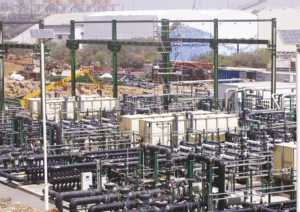
With the imperative of energy transition and decarbonization, our three public groups are highly active in this domain, contributing to the achievement of the country’s strategic objectives.
The OCP Group’s contribution is particularly significant, especially in providing potable water through desalination via its dedicated subsidiary, OCP Green Water, which specializes in managing and producing non-conventional water resources.
Its mission: to develop desalination and wastewater reuse infrastructure as part of an integrated strategy aimed at securing the group’s water sovereignty and sustainably preserving Morocco’s water resources. The goal is to meet the water needs of its industrial complexes while also supplying drinking water to hundreds of thousands of Moroccans threatened by water scarcity, thanks to desalination plants built in Jorf and Safi in record time.
To date, the group’s desalination capacity reaches 60 million cubic meters (m³) annually. By 2027, annual desalinated water production will rise to 560 million m³: 300 million m³ for the Jorf-Khouribga axis, 200 million for the Safi-Benguerir axis, and 60 million for the Laâyoune-Boucraâ axis.
Tanger Med also plays its role in sustainability and water supply, notably through its subsidiary Tanger Med Utilities. The firm has developed robust expertise in wastewater treatment, ensuring water potability, managing industrial and hazardous waste, recycling, energy efficiency, and renewable energy.
This expertise has enabled the Tanger Med port complex—Africa’s and the Mediterranean basin’s largest—to transition to 100% green electricity since January 1, 2025, and to position itself as a benchmark for projects in Morocco and across Africa, mirroring the success of its sister company, Tanger Med Engineering. Innovative projects are also underway, such as the 13 MW floating photovoltaic solar park at the Oued Rmel dam reservoir.
For its part, the CDG Group leverages Innovative Energy & Efficiency (INEE), a subsidiary of CDG Développement, for sustainable development initiatives. The company provides integrated solutions focused on energy efficiency, renewables, and decarbonization.
Its activities include conducting energy audits and carbon assessments, structuring projects and securing financing, as well as implementing renewable energy and energy efficiency solutions for industrial clients, transportation firms, and tourism enterprises.
Education, Teaching, and Research
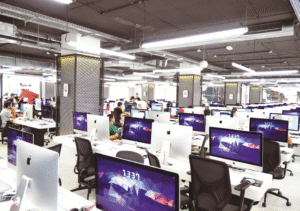
The three public groups contribute at various levels to the ongoing revolution in education and teaching. The OCP Group is at the forefront of this effort, heavily investing in innovative educational projects and research. Mohammed VI Polytechnic University (UM6P) stands as a flagship of the group’s commitment to high-quality education.
Launched in 2017 to realize OCP’s ambitious R&D goals—with resounding success—the UM6P campus in Benguerir quickly gained prominence nationally, continentally, and globally. By 2024, it entered the Times Higher Education global top 500 universities, ranking first in Morocco and North Africa. Today, UM6P hosts 5,684 students, including 721 PhD candidates from 33 nationalities, guided by a distinguished faculty of renowned academics and industry experts.
The Benguerir Lycée d’Excellence (Lydex) is another flagship OCP initiative in education. Established in 2016 within the Mohammed VI Green City in Benguerir, Lydex has become a source of national pride. Its students, often from modest backgrounds, consistently excel in admissions to France’s most prestigious engineering schools, rivaling century-old institutions like Lycée Louis Le Grand (Paris) and Lycée Sainte-Geneviève (Versailles). Notably, Lydex secured 59 admissions to École Polytechnique in just three years.
Additionally, OCP has developed a network of next-generation coding schools: École 1337 (Khouribga and Benguerir) and Youcode (Youssoufia), which train cohorts of digital talent tuition-free. The group further demonstrated its educational commitment by co-launching a 1-billion-dirham fund with the Ministry of Education to boost academic research.
Inspired by OCP’s success, the Tanger Med Group established the Mediterranean Lycée (Lymed) in 2021 through its Foundation. Located in Tétouan Shore, Lymed serves high-achieving Moroccan students from all social backgrounds. Modeled after Lydex, its preparatory classes swiftly earned recognition in competitive engineering school admissions.
Building on the success of École 1337’s Khouribga and Benguerir campuses, Tanger Med Foundation partnered with UM6P and École 42 to launch a third campus, 1337 MED, expanding access to coding education for youth.
The CDG Group supports education through multiple channels. In 2022, CDG Prévoyance took over management of Tayssir, a critical program combating school dropout rates. Tayssir provides scholarships via cash transfers to over 2 million students.
CDG also invests in private higher education through its subsidiary CDG Invest, acquiring a 20% stake in Casablanca-based Groupe Atlantique. Additionally, the group partners with the national JobinTech initiative, aiming to train 15,000 digital talents in Morocco by 2026.
Support for Entrepreneurship and Innovation
The three groups provide multifaceted support to the entrepreneurial ecosystem and startups. At CDG, the “212 Founders” program, launched in 2019 by CDG Invest, assists innovative project leaders through mentorship, funding, and global exposure.
Since its inception, the program has supported 135 startups in ideation and seed stages, with 24 financings and two exits. It has expanded with two new initiatives: Expand212, to structure the international growth of Moroccan startups, and HQ212, to ease the setup of international startups in Morocco.
The OCP Group has built a comprehensive innovation ecosystem anchored by Mohammed VI Polytechnic University (UM6P) and its laboratories. Its goal: develop new solutions to address industrial challenges, particularly in global agriculture, by providing researchers with resources to test projects and accelerate innovations.
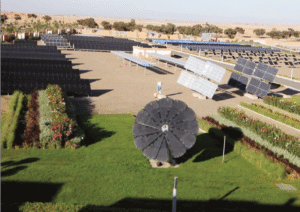
UM6P boasts flagship innovations, such as the lithium-iron-phosphate (LFP) cathode active material for electrical storage. InnovX, a UM6P subsidiary, was created to scale these innovations industrially. This entity also founded Hydrojeel, tasked with developing OCP’s ambitious green ammonia program. Additionally, the group established Africa’s largest solar energy research site in Benguerir—the 8-hectare Green Energy Park, dedicated to innovation in renewable energy.
Further, UM6P’s Impulse acceleration program supports agritech and biotech startups in market entry. UM6P Ventures, one of Morocco’s largest venture capital funds, has incubated nearly 1,000 startup projects, 70% in deeptech.
Innovation is equally prioritized at the Tanger Med Group. Renowned for technological excellence, the port complex is undergoing a bold internal and external digital transformation to position itself as a benchmark smart port.
Cires Technologies, a Tanger Med subsidiary, plays a pivotal role through its Digital Factory, developing advanced solutions in traceability, mobility, payment systems, integrated security, and more. Its clientele extends beyond ports, logistics, and industry to include telecom operators, ONCF, ONDA, OCP, and Morocco’s Ministry of Equipment and Water. To date, Cires has supported over 200 entities.