Kingdom
No more dropouts: second chances return to the classroom
Nearly 280,000 pupils leave school each year without any qualifications. To tackle this mass dropout, Second Chance Schools have gradually established themselves as a structured educational alternative. In 2025, the programme included more than 230 centres and around 24,000 young beneficiaries, offering academic catch‑up, vocational training and social support.

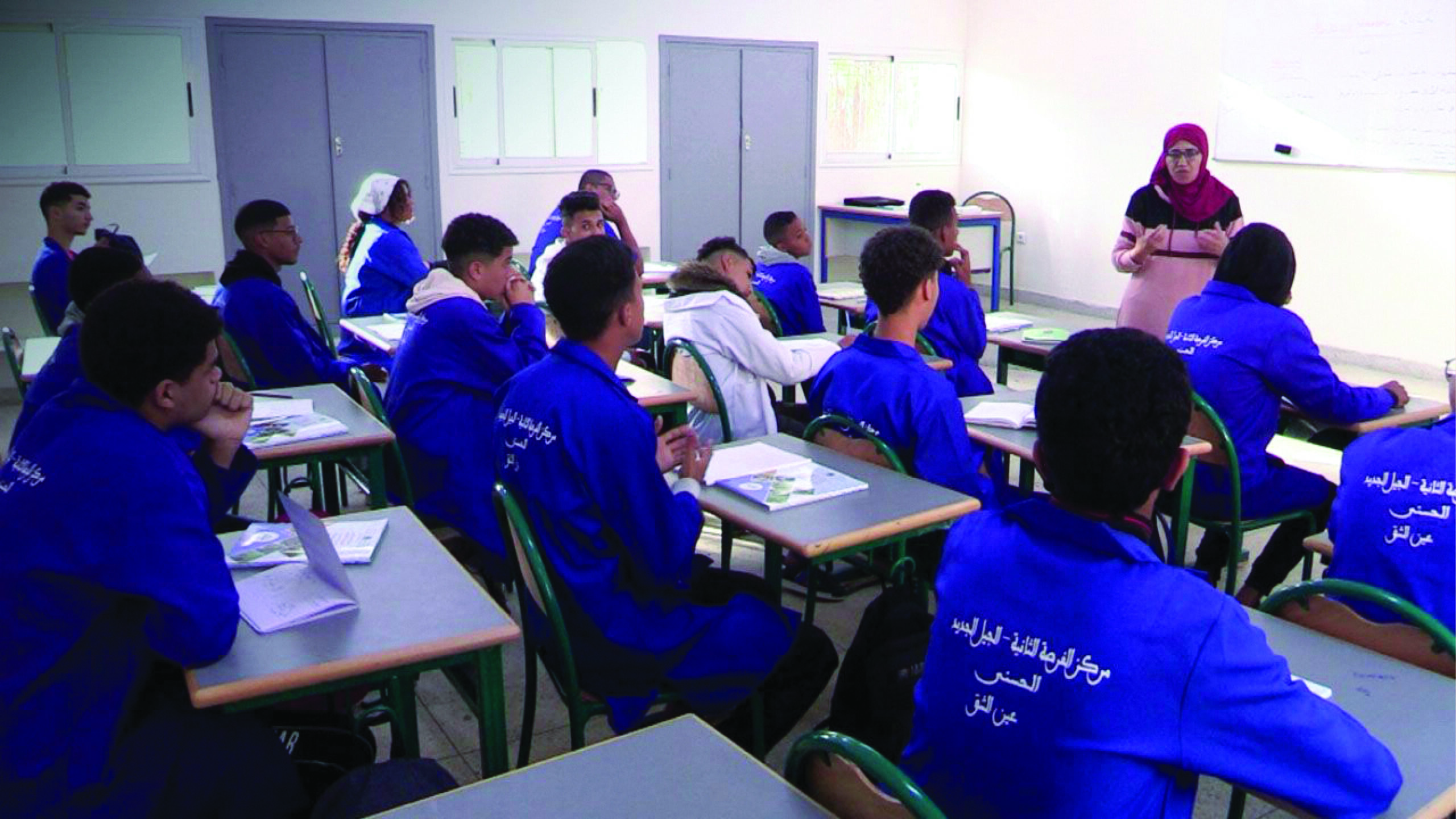
In Morocco, school dropout is no longer an abstract statistical concept, but a well‑established social mechanism that each year cuts short adolescent trajectories before they have even begun.
This silent haemorrhage fuels precarity, unemployment and long-term social disengagement, while directly calling into question the school system’s ability to fulfil its promise of social mobility.
Faced with this deadlock, Second Chance Schools have emerged as an intermediate response — neither a social stopgap nor a miracle solution — but above all as an organised attempt to repair what the traditional education system failed to retain.
In 2025, the programme entered a phase of deliberate scaling-up. Distributed across all regions of the country, just over 230 centres currently accommodate nearly 24,000 young people who have dropped out of school.
The stated objective is to increase this number to 35,000 beneficiaries in 2026, before reaching 80,000 young people by 2030 through nearly 400 schools.
On the ground, these institutions go far beyond simple academic catch-up. They offer hybrid pathways combining academic remediation, the development of behavioural skills and vocational training rooted in local realities.
Mathematics, languages and core knowledge coexist with project management, communication skills and career guidance. In some centres, specialised tracks help give meaning to learning.
In Laâyoune, for example, a Second Chance School dedicated to careers in sports, inaugurated in 2025, illustrates this desire to link training with tangible employment opportunities.
These initiatives form part of the 2022–2026 education roadmap, which places dropout prevention and youth reintegration among clearly stated national priorities.
Reintegration
In Casablanca, the Derb Sultan Second Chance School, inaugurated in January 2023 by the NGO Tibu Africa in partnership with Fromageries Bel Maroc, has become one of the most emblematic examples of this model.
The centre welcomes young people aged 14 to 25 who are unemployed and without qualifications, offering a one‑year programme combining languages, personal development, sport and technical modules.
Here, sport is not an optional extra but a fully-fledged pedagogical tool: discipline, self‑confidence and collective spirit are cultivated as much as academic knowledge.
Alongside this, workshops in digital skills, robotics, nutrition and yoga further strengthen the programme. The facilities — sports fields, gymnasium, library, multipurpose rooms and a co‑working space — have already benefited nearly 1,200 young people in the neighbourhood, making the school a living space as much as a learning environment.
This momentum is built on a close alliance between the State, civil society and the private sector. In 2025, more than 190 local associations were involved in the management and delivery of Second Chance Schools, enabling fine-grained territorial coverage and adaptation to local contexts.
This proximity-based work is also reflected in observed outcomes. For the 2023–2024 academic year, the overall reintegration rate reached 72%, with diverse trajectories: return to formal education, continuation of vocational training, or direct access to employment.
Beyond the indicators, these schools fulfil a broader social function. They become spaces of reconstruction, where psychosocial support, mentoring and work on behavioural skills help young people — often traumatised by academic failure — regain their footing.
Far from rigid classrooms, they prioritise relationships, experimentation and the recognition of individual pathways to break cycles of drifting and marginalisation.
In 2025, Second Chance Schools are no longer experimental projects or mere rhetorical commitments. They are now firmly embedded in Morocco’s educational landscape as a structural tool for the prevention and repair of school dropout, set to be strengthened in the years ahead.
Their gradual expansion, the increase in beneficiaries and the reintegration outcomes observed outline a dynamic that remains imperfect, but already tangible.
As the scheme expands, the challenge shifts from legitimacy to sustainability and coherence, so that this second chance can become a lasting part of the educational and professional trajectories of thousands of young people.
Where does the Second Chance scheme stand?
The network of Second Chance Schools in Morocco includes more than 230 centres spread across all 12 regions of the Kingdom.
These schools operate in coordination with over 190 local associations, ensuring effective territorial coverage and adaptation to the specific realities of each city.
Major cities hosting centres include Casablanca, with the Derb Sultan School; Laâyoune, with specialised tracks in sports-related professions; Rabat, Salé, Kénitra and Oujda.
In 2025, between 20,000 and 23,000 out‑of‑school youth had already benefited from the programme, with a stated goal of reaching 35,000 beneficiaries in 2026 and 80,000 by 2030.
This expansion is accompanied by a commitment to strengthening young people’s social and professional integration through a combination of academic remediation, practical training and psychosocial support.
The observed results confirm the effectiveness of the scheme. For the 2023–2024 school year, approximately 72% of graduates achieved a positive outcome, whether through returning to formal education, continuing vocational training or gaining direct access to employment.