Kingdom
Nador West Med: The Multiple Phases of a Much-Awaited Commissioning
The start-up of operations at the six terminals of the Nador West Med port will be phased in gradually, beginning in the fourth quarter of 2026. The industrial and logistics zone adjoining the port infrastructure is entering the final stage of development. Here is an update on the various stages.

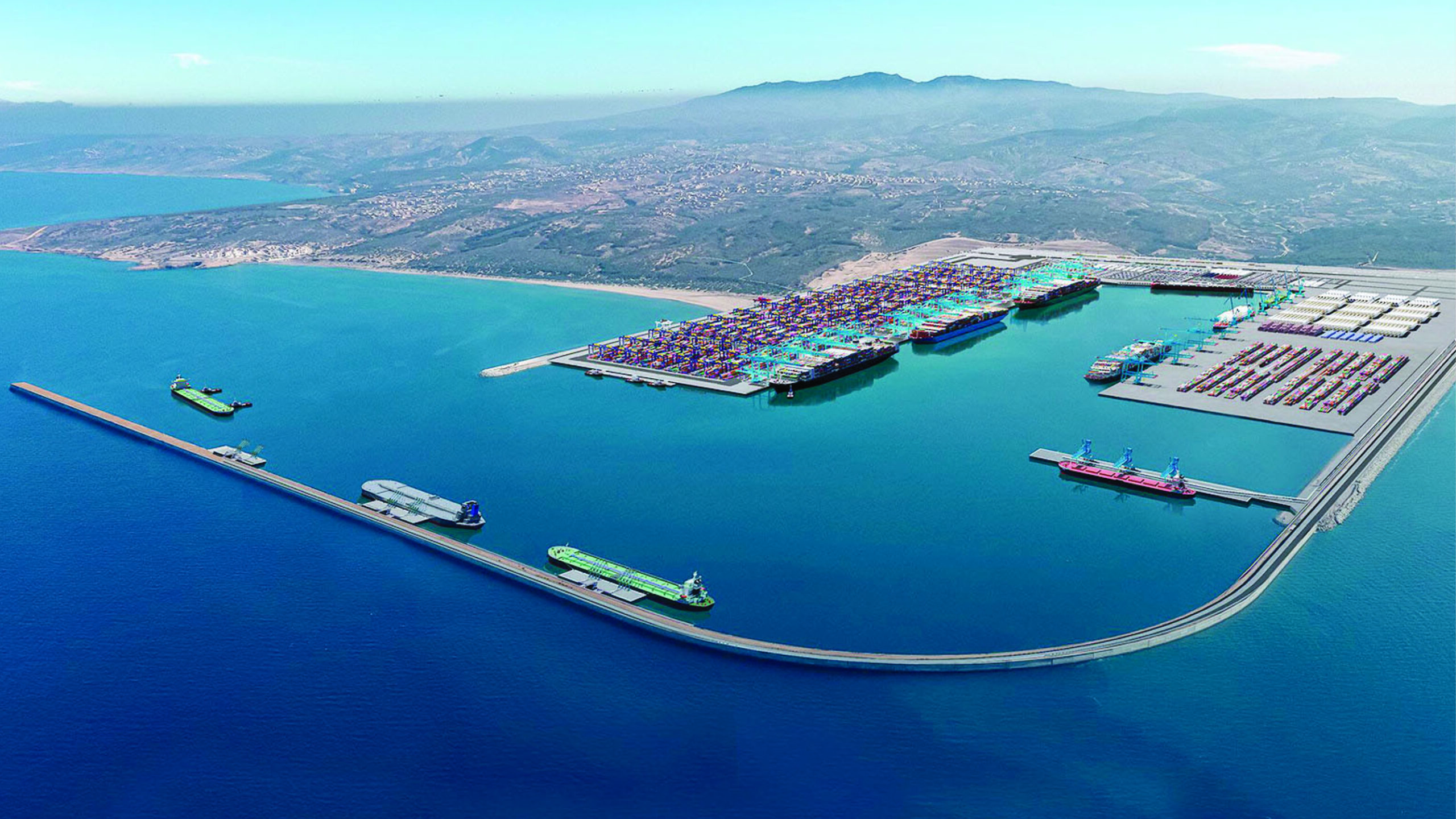
The Nador West Med industrial-port complex is one of the most transformative infrastructure projects the Kingdom is currently building. To date, the project—scheduled to enter service in the fourth quarter of 2026—has already mobilized no less than MAD 51 billion in public and private investment.
Moreover, confirmed private investment to date totals MAD 20 billion, unmistakably reinforcing international maritime and industrial operators’ confidence in Morocco.
The working meeting recently chaired in Casablanca by the Sovereign on the industrial-port project provided La Vie Éco with an opportunity to take stock—together with Mohamed Jamal Benjelloun, CEO of the state-owned company Nador West Med—of progress on the port works and the industrial zone.
Port component: Nothing to report
As regards the port component, Nador West Med—one of whose primary aims is to anchor the Kingdom’s economy sustainably in global value chains—already has all of its core infrastructure in place. This includes, among other things, 5.4 km of breakwaters, 4 linear km of quays, and 4 power substations.
“Today, the main East and West container terminals, as well as the general cargo terminal, have already been awarded under concession to operators—more precisely, consortia of operators,” Benjelloun recalls at the start of the discussion with La Vie Éco, while confirming the full completion of infrastructure works for the three terminals, as well as their commissioning in Q4 of this year.
The conductor of this highly strategic project for the National Port Strategy and the expansion of the industrial network shed instructive light on the commissioning schedule for the port infrastructure.
“It will be carried out gradually, with the operation of the two container terminals before the end of 2026 and the ro-ro terminal. In 2027, the three energy-products terminals (April), the general cargo terminal and the specialized bulk terminal will be operational,” our interlocutor said in essence.
In short, the ramp-up of port activity will be gradual. Asked about the future management model for the three terminals that have not yet been concessioned to date (bulk, hydrocarbons and ro-ro), the CEO of the state-owned company Nador West Med gives a frank answer.
“It should be borne in mind that the port authority’s role (Nador West Med Company) is not to be involved in terminal operations. In fact, the general trend in ports is for terminals to be operated by third parties,” our source explains.
He adds: “Specifically, for the three terminals not yet concessioned (currently being equipped), the port authority could potentially start operations initially, before considering, during 2027, the concession-based management model.”
Along the same lines, it should be recalled that the port will have an annual capacity of 5 million containers and 35 million tonnes of liquid and dry bulk, in addition to annual storage capacity of 5 billion m³ for liquefied natural gas (LNG). This helps position the country as a key player in this area in the Mediterranean.
It should be noted that certain ports—such as the port hub of Huelva (Spain)—stand out in the field of LNG regasification and export across the Mediterranean basin.
In concrete terms, thanks to this first natural-gas infrastructure in the Kingdom, LNG will be regasified at Nador West Med before being exported directly via a pipeline to the Maghreb-Europe Gas Pipeline (MEG) and to other end destinations.
It is worth noting, however, that one recent development regarding LNG is the Ministry of Energy Transition’s suspension of calls for tenders linked to the LNG terminal and the gas pipeline network between Nador West Med’s port facilities and the Maghreb-Europe Gas Pipeline (MEG), and between the latter and the industrial zones located in Kenitra and Mohammedia.
Still in terms of capacity, Nador West Med’s additional annual development potential is 12 million containers and 15 million tonnes of liquid bulk.
In the final stage of development
As stated, the other crucial component of Nador West Med is the industrial and logistics zone adjoining the port infrastructure.
Asked about progress on works in the priority zone, whose area ranges between 700 and 800 hectares, Benjelloun provides reassuring answers.
“Today, we can say we are in the final stage of developing the industrial zone, with works notably covering, among other things, roads and distribution networks. Moreover, some industrial players are already in the process of setting up, as evidenced by industrial units under construction and others already completed,” our source says.
As for the backbone infrastructure for the industrial platform—particularly the desalination and wastewater-treatment plants, as well as the electrical-transformation component—these are under construction, and the works should be completed between May and June 2026.
It should be noted that for reasons of efficiency and effectiveness, development works for the industrial zone are being carried out in parallel with those of certain industrial companies which, clearly, want to save time in order to be operational as early as possible.
In terms of establishment, so far the most represented companies in this industrial and logistics stronghold operate in the automotive sector (one of the pillars of national exports) and in renewable energies—to name only the Chinese wind-turbine giant Aelon.
By way of illustration, let us recall that as recently as 23 January 2026, another Chinese group, Shandong Yongsheng Rubber, through its local subsidiary Goldensun Tire Morocco, officially announced the start of construction works on a tire manufacturing plant in the Betoya industrial acceleration zone (part of the Nador West Med complex) for an investment of around MAD 6.7 billion.
Up to MAD 80 billion
On the industrial and logistics zone’s occupancy rate, our source confirms—without providing figures—the gradual establishment of companies.
“At this level, we are sufficiently well advanced. But you should know that certain areas cannot be marketed and others are made available or leased. In short, not all land in the industrial and logistics zone can be transferred through sale,” our interlocutor explains.
Ultimately, industrial players’ enthusiasm is very real, as new expansion projects are on the agenda. Moreover, the momentum recorded in the industrial zone legitimately allows for optimism about projections of 100,000 direct and indirect jobs to be created by 2034 by the port complex, designed to become a powerful lever for territorial development.
In this sense, beyond its national role of strengthening Moroccan exports and creating added value (GDP), the Nador West Med project—whose socioeconomic impact will be felt in the Oriental and Fès-Meknès regions (the neighboring region)—is expected, in the end, to mobilize between MAD 70 and 80 billion in investment from the public sector and private operators.
All parties involved in this structuring project for the Kingdom’s economic and social development are mobilized to ensure the effective commissioning of the port infrastructure and the industrial zone in Q4 2026, with a gradual ramp-up over the following years.
Update on connectivity infrastructure
As part of building the Nador industrial-port project, a host of connectivity infrastructures are planned to serve the Betoya Bay site, which is expected to enjoy international reach, like Tanger Med, which has just crossed the symbolic threshold of 11 million containers handled in 2025.
From Benjelloun’s assessment, works to dual the roadway between Nador and the port have been completed. The same applies to the project for the port hub bypass road, which should be commissioned shortly.
As for the Guercif–Nador motorway, our interlocutor confirms that works are still under way, with certain sections completed.
Regarding the Selouane–Nador West Med rail link (52 km of single track, with traffic at 160 km/h), works are continuing. Lastly, the Guercif–Nador motorway and the rail link will be operational between late 2027 and early 2028.