Kingdom
Morocco: Women’s Trajectories, Turning Points in History
For nearly 70 years, Moroccan women have entered every field: the skies, universities, courtrooms, businesses, stadiums, and literary stages. Pioneers, activists, leaders, or cultural icons, they have helped transform laws, perceptions, and institutions. Their trajectories tell the same story: that of a country that is evolving…

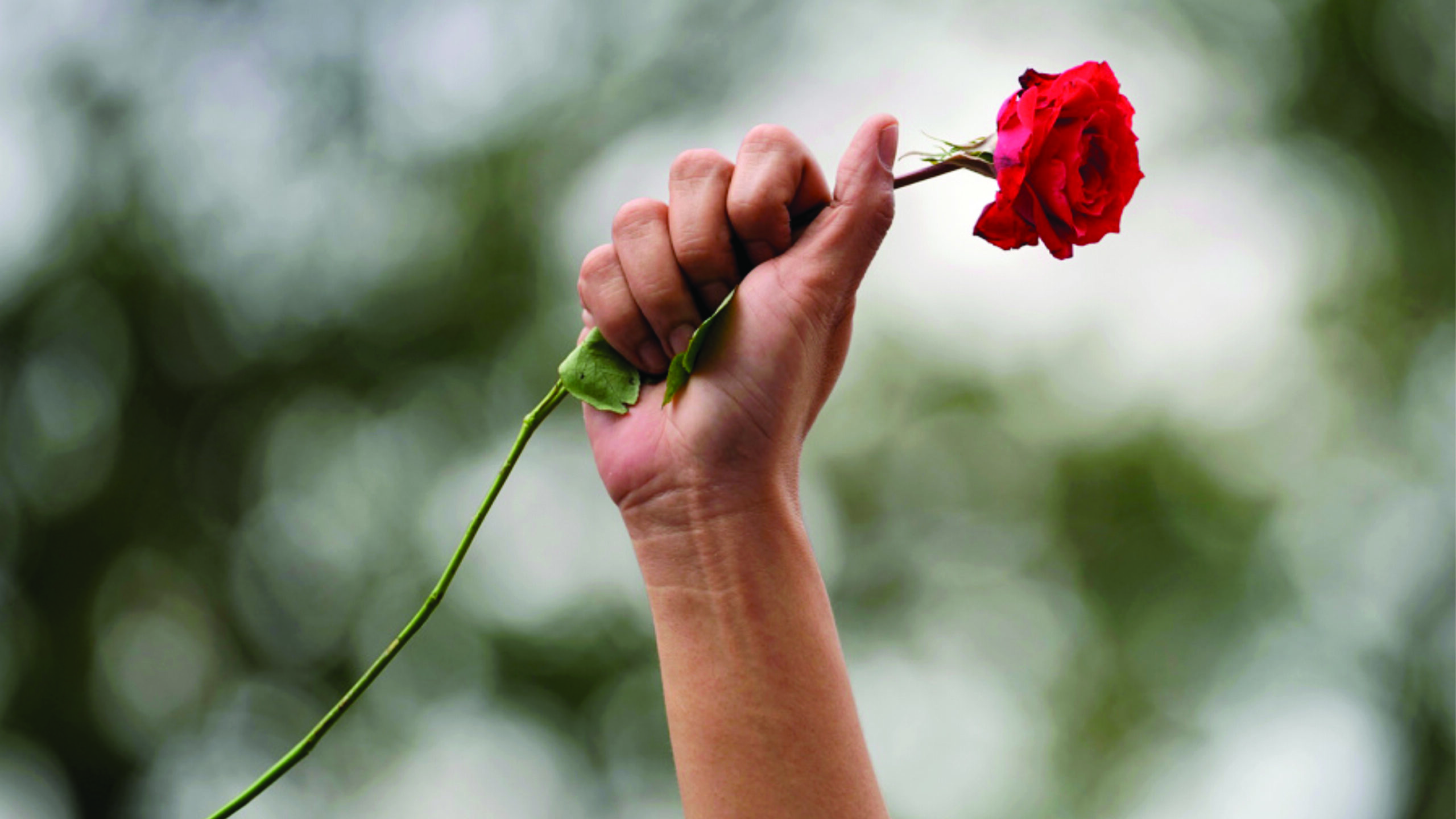
Since Independence, Morocco’s history has also been written in the feminine. Sometimes discreetly, often spectacularly, women have entered spaces that were not originally meant for them and have helped redraw the boundaries of what is possible.
They do not form a homogeneous movement or belong to a single generation. They come from different social, cultural, and professional backgrounds. Yet their paths tell the story of the same dynamic: that of a country in transformation.
Some paved the way in fields where the presence of women was the exception. Others organized long-term struggles to change mindsets and laws.
Still others asserted their talent on artistic, sporting, or intellectual stages, giving Morocco a new kind of influence. All of them shifted the lines, each in her own way. Their influence cannot be measured only by the positions they held or the distinctions they received. It is also reflected in the imaginaries they transformed.
Seeing a woman pilot an airplane in the early 1950s, teach sociology while questioning power relations, advocate for reform of family law, lead an employers’ organization, or carry the national colors on international fields: these are images that, decade after decade, have broadened the collective horizon.
These journeys do not claim that equality has been achieved. They do show, however, that it has been built step by step, thanks to figures who accepted exposure, controversy, or solitude.
By retracing eight emblematic trajectories, this feature offers a generational reading of emancipation in Morocco: that of a continuous movement, shaped by individual boldness and structural change. A history that is still being written.
 Princess Lalla Aïcha, a pioneer of diplomacy and women’s emancipation
On March 9, 1947, Princess Lalla Aïcha, the eldest daughter of the late Mohammed V, accompanied her father to Tangier and delivered the famous speech calling for the schooling of young girls and their participation in working life. This moment is considered a historic turning point in women’s emancipation in Morocco.
The Princess supported the schooling and education of girls and the development of women’s associations through the National Union of Moroccan Women, of which she was president. Her actions were part of a modernist vision: to educate women capable of participating in the building of an independent Morocco.
Appointed ambassador during the 1960s, under the reign of the late Hassan II, she represented the Kingdom in the United Kingdom, Greece, and then Italy. Her diplomatic presence helped establish the image of an active Moroccan woman on the international stage. This was a major step forward in the Arab world where, at the time, women diplomats were almost nonexistent.
Her speeches, her public presence, and her diplomatic career helped normalize the idea that a Moroccan woman could speak in public, represent her country, and assume international responsibilities. She remains today a foundational figure of institutional female leadership in Morocco.
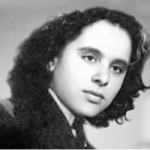 Touria Chaoui, the woman who touched the clouds
In 1951, Touria Chaoui made history by becoming the first female pilot in Morocco and one of the few in the Arab world. She was only 16 years old. In 1950, she joined the Casablanca aeroclub, encouraged by her father, at a time when aviation was a field reserved exclusively for men and Europeans.
In a country still under the protectorate, her pilot’s license was an unprecedented event, almost unreal for the time. Young, determined, and at the controls of an airplane, she became a symbol of audacity and modernity. Through her, an entirely new representation of the Moroccan woman emerged: educated and capable of entering the most demanding technical fields.
But her destiny was brutally cut short. On March 1, 1956, at the age of 19, she was assassinated in a tense political context on the eve of Morocco’s Independence.
Touria Chaoui did not have time to build a long career. Yet her pioneering act endures. She embodies the generation of trailblazers, those who opened doors that had been closed to women. Her name remains associated with a Morocco aspiring to independence and to social transformation. She is a symbol of freedom, boldness, and modernity.
 Nawal El Moutawakil, when Morocco becomes an Olympic medalist
On August 8, 1984, Nawal El Moutawakil made history by winning the gold medal in the 400-meter hurdles at the Los Angeles Olympic Games. She thus became the first Arab and African woman Olympic champion. At 22, her achievement went beyond a sporting performance: it reshaped perceptions both in Morocco and internationally.
El Moutawakil was not only a champion; she became a national symbol. Through her determination and discipline, she demonstrated that female excellence could assert itself on the greatest stages. Her victory came at a time when women’s sports were still little covered by the media. She thus opened the way for the recognition of Moroccan sportswomen.
After her career as an athlete, she became involved in institutional action. A member of the International Olympic Committee, she became Minister of Youth and Sports in 2007–2009 in the government of Abbas El Fassi.
Consolidating her role in the governance of global sport, she also participated in the organization of major sporting events. Her journey connects performance, leadership, and representation—three dimensions that continue to inspire new generations.
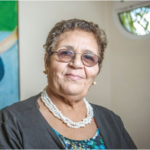 Aïcha Ech-Chenna, an activist without fear and without shame
In 1985, Solidarité Féminine for single mothers and their children was founded in Casablanca. With this association, Aïcha Ech-Chenna broke the taboo—without any shame—surrounding single mothers, as well as the social hypocrisy around sexuality, rape, incest, and prostitution.
Ech-Chenna deeply marked the Moroccan social landscape. A nurse by training and a social worker, she discovered in the field the distress of single mothers confronted with precariousness and family rejection.
Her association was therefore an innovative approach: offering these women not only moral support but also professional training and economic autonomy.
Known for her frankness and courage, which earned her the nickname “Mother Teresa of Morocco,” Ech-Chenna fought for fifty years to transform the way these women were viewed, to defend their rights, and to secure recognition for their children born out of wedlock, who had long been deprived of civil status.
The pressure from Ech-Chenna and other activists led, in 2004, to the reform of the Family Code, which finally granted single mothers the right to choose a name for their children. Until then, legislation prevented children born out of wedlock from having a family name without the father’s authorization. She thus moved this issue from the realm of morality to that of social justice.
A recognized and respected figure far beyond Morocco, Ech-Chenna received several international distinctions. Her legacy is twofold: an institution that is still active and a struggle that helped place inclusion at the heart of public policy.
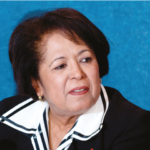 Zoulikha Nasri, the first adviser to His Majesty
In 1998, after a brief period at the Secretariat of National Mutual Aid, the late Zoulikha Nasri was chosen by the late Hassan II to join the circle of his advisers—a royal nod to women.
Originally from the city of Oujda and from a modest background, she had a strong affinity for the living conditions of Moroccans. This made her the ideal profile to help set the Mohammed V Foundation for Solidarity on track, enabling her to develop a support network for people in difficult situations.
Moreover, this feminist activist played a crucial role in the development of the 2004 Moudawana (Family Code). Within the framework of the Mohammed V Foundation, she also contributed to the fight against illiteracy among rural girls, notably through the creation of the “Dar Taliba” project to address the problem of distance from schools—the primary cause of school dropout in rural areas.
But Dame Nasri did not only wear this social hat. She began her career in the early 1990s at the Ministry of Finance as Director of Insurance and Social Welfare.
In 2010, King Mohammed VI entrusted her with the files previously handled by Abdelaziz Meziane Belfkih, who died the same year. She then supervised projects related to the Solar Plan and the high-speed rail (TGV) line.
Known as the Iron Lady, she backed down from nothing and achieved her objectives. This made her a unique adviser who, it was said, had the ear of the King.
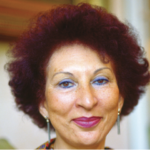 Fatéma Mernissi, the icon of Muslim feminism
In 1995, in collaboration with the Democratic Association of Women of Morocco, she founded the first listening center for women victims of violence in Morocco. Named the Space for Solidarity and Listening, this center was a major step in Fatéma Mernissi’s grassroots activism, through which she realized her desire to give a voice to silent women by supporting them in their legal and social procedures.
A Moroccan sociologist, writer, and feminist, Mernissi is the only Moroccan woman to appear in the 2012 ranking of the 100 most influential women in the Arab world compiled by Arabian Business magazine. She was ranked 15th in 2013. Her upbringing in a traditional and conservative family environment had a strong influence on her work as a researcher.
She fought for many years for the emancipation of Arab and Moroccan women. Writings, workshops, and public debates—every means was used to address women’s issues. She founded the “Civic Caravans,” a platform through which civil society actors seeking democracy could express themselves.
She also helped establish the collective “Women, Families, Children.” The sociologist devoted her research to power relations related to gender and to the evolution of Muslim societies. Her legacy goes beyond Morocco: her works have been translated into several languages and have shaped debates on women’s emancipation.
Neither a partisan activist nor an institutional figure, Mernissi remains a major reference in reflections on modernity and tradition.
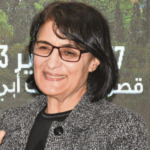 Latéfa Jbabdi, the voice of reforms and equality
In 1992, King Hassan II received at the Royal Palace representatives of the feminist movement and associations that had carried the petition for the reform of the Personal Status Code launched in 1991. An emblematic figure of the feminist movement, Latéfa Jbabdi was part of the delegation.
The president of the Union of Women’s Action, one of the main women’s associations, established herself from the 1980s as one of the key architects of legal advances in favor of women’s rights.
A long-time activist, she actively participated in structuring associative advocacy, particularly around the reform of the Family Code. This made her one of the actors behind the mobilization that led, in 2004, to the promulgation of the Moudawana. Her action was part of a strategy of institutional dialogue combining civic mobilization, legal expertise, and parliamentary work.
A member of the House of Representatives, Jbabdi continued her commitment to issues of equality, the fight against discrimination, and women’s participation. She also intervened on matters related to public freedoms and international conventions.
Her trajectory illustrates a form of lasting engagement: that of an activist who became an institutional actor without renouncing the demand for reform. Through Jbabdi’s mobilization emerges the idea of change built through law and perseverance.
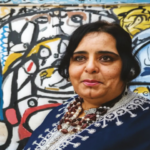 Chaïbia Talal, a symbol of emancipation through art
Self-taught and visionary, Chaïbia Talal established herself in an art world dominated by men. She grew up in a rural environment: married at the age of 13 to a much older man, she became a widow at fifteen with a child to support.
Despite all these hardships, she maintained a deep connection to her imagination. At 25, she began painting in the 1960s following a dream that she described as a revelation.
She is one of the most singular figures of modern Moroccan art. Without academic training, she developed a spontaneous and free style that broke with established artistic codes. Noticed by critics, her work was quickly exhibited in Morocco and then abroad, particularly in Europe.
Although her art is often associated with naïve art, Chaïbia always rejected labels. She painted scenes of women, celebrations, motherhood, and collective emotions. Women appear in her works as visible, colorful, occupying space and rarely erased.
Her journey proves that talent can emerge outside academic circuits and that female creativity can assert itself without seeking permission.