Business
Morocco at the Forefront of “Made in Germany”
More than 300 German companies employing over 35,000 people operate in the Kingdom. Automotive, aeronautics and drug production are among the high-tech sectors in which they operate. Analysis.

The Kingdom’s recent industrial news has been dominated by two major developments tied to the positioning and ambitions of German companies, which are renowned worldwide for their excellence and rigor in quality and reliability.
The two developments in question reinforce, to a certain extent, the German industrialists’ intent to make Morocco a major industrial base to supply global markets, particularly those of Europe and the United States, two highly promising strongholds.
As recently as May 6, 2026, the German automotive supplier SFC Automotive Solutions (a subsidiary of the German investment fund Mutares) inaugurated its new industrial unit on the Tanger Med industrial platform.
Specializing, among other things, in the production of automotive sealing solutions in rubber and thermoplastic, the site—located in Tanger Automotive City (TAC) and targeting, in the long term, revenues of €85 million and 900 direct jobs—required an investment of €28 million.
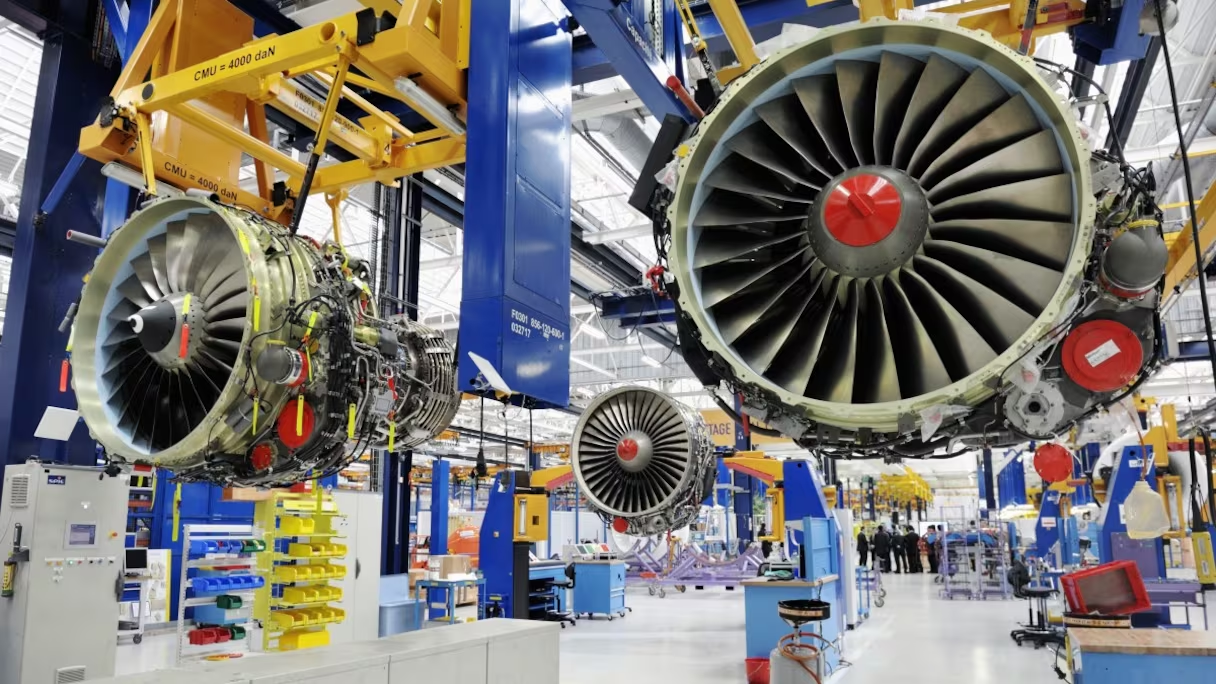
The second significant development this May, related to German industrial companies operating nationwide, is the announcement of ambitions by the German industrial group Masterflex SE for its new Moroccan aeronautics factory (Masterconduct Morocco), which is part of the ecosystem of aerospace giant Boeing.
Concretely, the German manufacturer of technical hoses recently stated that it is betting on the ramp-up of its new Moroccan aeronautics production unit and on contractual deliveries as the two main drivers of its growth in the second half of 2026.
That said, the figures speak for themselves and undeniably attest to the Kingdom’s rising attractiveness in the eyes of operators from Europe’s largest economic and industrial power.
More than 300 companies established
Today, Morocco hosts more than 300 German companies employing over 35,000 people.
Other significant data: in 2024 Germany—whose economic expansion is driven largely by the industrial sector (representing nearly one quarter of its GDP)—ranked as the second-largest foreign investor in Morocco, with €2.1 billion in net flows, thus surpassing the global industrial giant China (third place).
Beyond these numbers, which reinforce Morocco’s stature as a leading industrial hub for German operators, it is important to emphasize that the German presence in the Kingdom is significant, notably in high-tech industrial sectors.
Indeed, in the pharmaceutical industry, the German giant Bayer, operating in the country, announced in April 2026 an amount of 200 million dirhams destined for new investments over the 2026–2028 period. The pharmaceutical company’s goal is to multiply its production lines in Nouaceur to raise to 40 the number of formulations produced nationally.
Automotive, the spearhead
In the automotive sector, the German supplier Leoni, established in several cities and localities (Ain Sbaa, Bouskoura, Berrechid, Bouznika and Agadir), announced in April 2026 that it is pursuing six industrial projects in the Kingdom for an amount of 230 million dirhams.
By way of illustration, by 2027 the automotive supplier plans to employ a total of 23,000 people in Morocco. Along the same lines, it is worth noting that German companies also contribute, to some extent, to reducing industrial and economic imbalance through direct investments outside the traditional Tanger–Marrakech industrial axis.
As evidence, just over a year ago (March 2025), the industrial project of the German automotive supplier Fränkische Industrial Pipes GmbH in the Oriental region was unveiled to the public.
The project, which should generate 150 stable jobs by 2028, concerns the production of plastic protection and fluid systems for the automotive industry. It will mobilize, ultimately, nearly 100 million dirhams in direct investments.
Beyond the efforts made to equip this part of the country (the Oriental) with profiles suited to the needs of industrialists, other factors were decisive in attracting the German multinational (investment incentives, infrastructure improvements…).
In the same vein, in July 2025 the German group ZF Lifetec, a specialist in passive safety technologies for vehicle occupants, inaugurated a new factory at Tanger Med dedicated to the production of steering wheel systems. Located on an area of 8,000 m², the industrial unit began operations employing no fewer than 300 people.
Moreover, note that until 2025 the Tanger Med industrial platform counted around twenty German companies operating, among others, in automotive, electronics and logistics.
Their cumulative direct investments in this leading industrial stronghold of the Kingdom exceed the symbolic threshold of 3 billion dirhams, resulting in more than 10,000 direct jobs and total revenues of 9 billion dirhams for last year’s fiscal year.
The winning recipe
The strong interest of German industrial operators in the Kingdom can be explained by a combination of highly favorable factors.
These include the availability of quality profiles (aligned with the needs of industrial contractors), competitive logistical costs, and the existence of incentives and measures improved by the new Investment Charter implemented by the government.
In addition to other major Moroccan advantages—namely the quality of connectivity infrastructures and geographic proximity to Europe—there is another key benefit particularly prized by foreign industrialists, including Germans.
This is the existence of free zones, now called Industrial Acceleration Zones (Midparc, Tanger Free Zone, Kenitra Free Zone, Souss‑Massa, Technopolis, Tanger Automotive City…). They are seen as fertile ground for the emergence and sustainability of true industrial ecosystems nationwide.
Ultimately, to give an idea, Tanger Automotive City, a reference platform for the automotive industry in Morocco, hosts a dynamic ecosystem including more than 160 Tier 1, 2 and 3 automotive suppliers.