Business
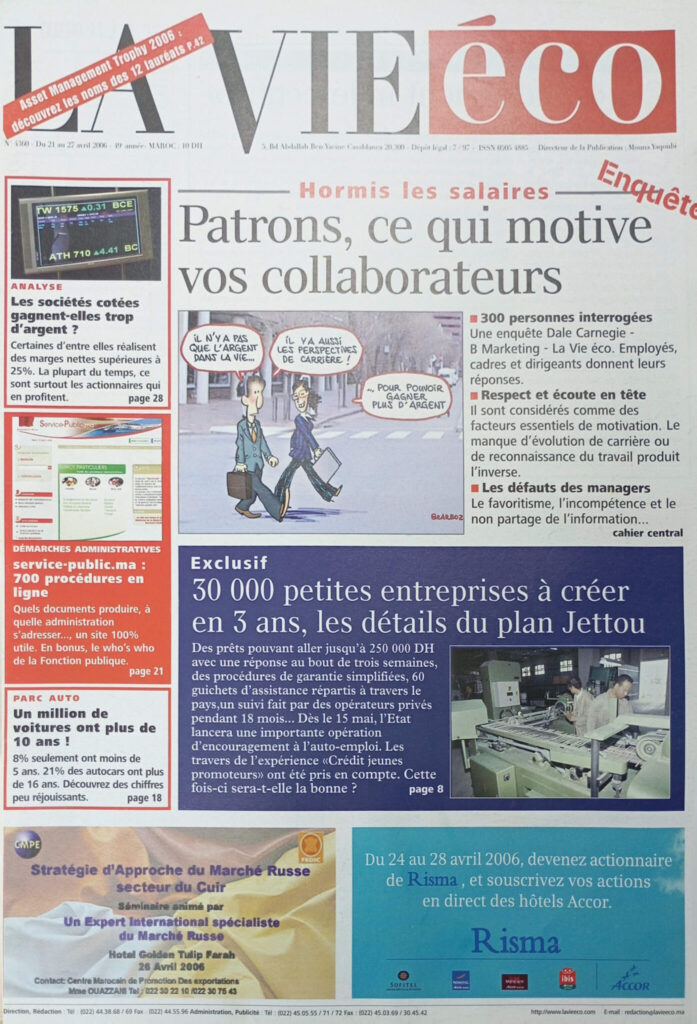
LVE Archives 2006. 30,000 very small enterprises to be created in three years
Twenty years ago, privately managed service desks were opened to support small project promoters. The latter could benefit from loans ranging from 50,000 to 250,000 dirhams, over a period of 10 years.


Since the Employment Initiatives Forum held in September, the commissions that emerged from it have not stopped working. The first concrete results on the ground should be seen very soon.
Indeed, the commission tasked with reflecting on self-employment has just finalized its work, and the public authorities are preparing to announce an unprecedented mechanism to support the creation of very small and small enterprises (VSEs), which Noureddine Ayouch—member of said commission and founder of the Zakoura microcredit association—even describes as “revolutionary.”
This mechanism is structured around the creation of service desks and spaces dedicated to supporting the creation of small businesses. The first 10 desks will be operational starting May 15, and the staff who will work there have already been in training since April 17.
The government’s objective is to very quickly establish an initial network of 60 desks across the country, which, according to forecasts, should enable the creation of no fewer than 30,000 VSEs and 90,000 jobs by 2008.
For the architects of this mechanism, this figure is even underestimated compared to the potential and quality of the proposed system.
How will this be achieved? The idea is to create, throughout the country—with particular attention to small towns, villages, and remote regions—points of contact whose mission will be to support young project holders.
However, these young people must have a minimum level of education, namely a high school diploma or a vocational training certificate.
The support provided through these desks will naturally begin with initial intake.
As Younès Sekkouri, an executive at ANAPEC (National Agency for the Promotion of Employment and Skills) and responsible at the Prime Minister’s Office for overseeing the implementation of this project, explains: “Young people are not required to arrive at the desks with fully developed projects.”
This is one of the original features of these desks. Young people may only be at the idea stage. At the desks, properly trained staff will therefore, among other things, help them turn their ideas into concrete projects.
Thus, an initial pre-selection is carried out based both on the idea and, above all, as Sekkouri explains, “on the basis of the young person’s profile and entrepreneurial aptitude.”
Once this first screening is completed, the desk forwards a more substantial file to a regional committee, chaired by the region’s CRI (Regional Investment Center), including more detailed information about the project promoter, the project, and so on.
The committee—comprising, alongside the CRI, other stakeholders such as ANAPEC, Chambers of Commerce, local authorities, and the private sector (CGEM or others)—will then rule on the applications to determine which files are truly bankable. Once the file is approved by the regional committee, it returns to the desk.
The young project holder must then undergo intensive training (one and a half months) in management concepts.
During this training, they will alternate between theory and practice, with the understanding that at the end of the six weeks they must have completed their market study and business plan. The entire file will then be submitted to the bank.
The bank will have 21 days to decide whether or not to finance the project and, if so, to specify the terms of financing, including the amount, duration, and interest rates.
According to the adopted scenario, the small entrepreneur will be offered loans ranging from 50,000 to 250,000 dirhams over periods of up to 10 years.
As soon as the file is approved by the bank, the project holder will immediately receive a state advance of up to 10% of the total investment, without exceeding a ceiling of 15,000 dirhams.
This advance will be repaid over a period of 6 years, with a grace period of 3 years and no interest. In principle, this advance is intended to cover the initial costs of setting up and launching the business.
Achieving these objectives will undoubtedly depend on the implementation of this action plan in a way that avoids the pitfalls encountered by its predecessor, the Young Promoter Credit (CJP).
From the outset, the designers of the mechanism insist that it is completely different from the CJP (…). To ensure broad participation, the government intends to allocate the necessary resources.
To begin with, a budget of 18 million dirhams has been allocated to cover expenses pending additional funding, notably from the Millennium Challenge. And to reach the largest possible number of participants, a wide communication campaign is being prepared and is scheduled to be launched on May 22.
Saâd Benmansour
CamScanner 20-04-2026 10.43