Kingdom
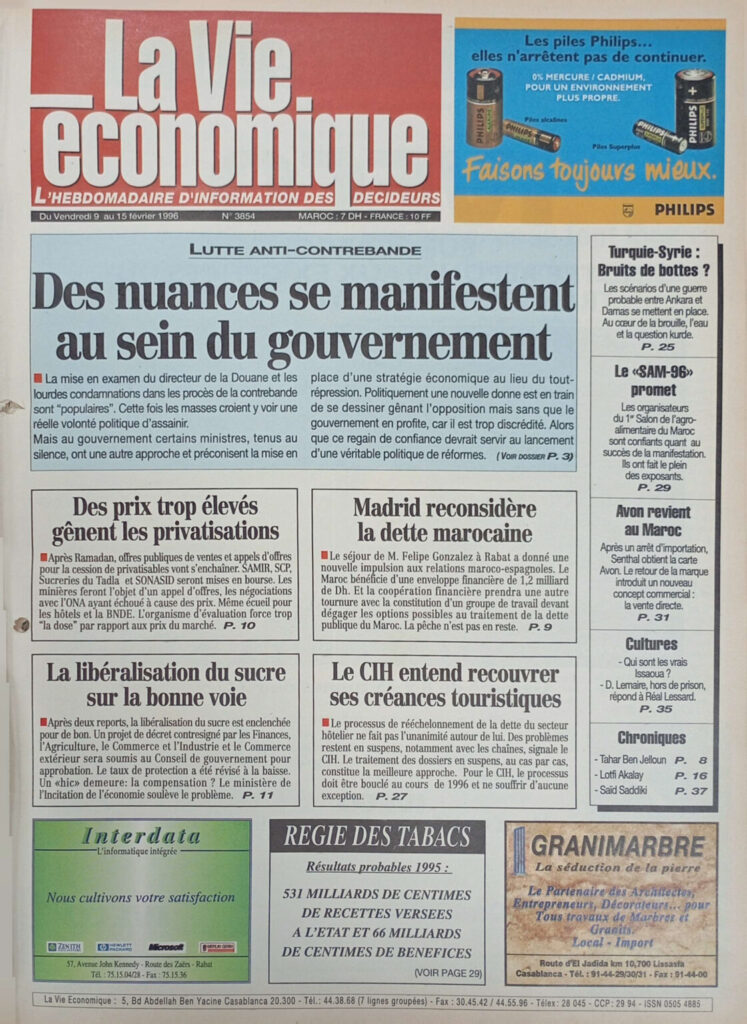
LVE Archives 1996. Anti‑smuggling campaign: Nuances
Thirty years ago, just as the population was beginning to believe in it, ministers privately questioned the “effectiveness” of the cleanup campaign.


“The fight against smuggling is a scourge that absolutely must be stopped, but this requires a genuine multifaceted strategy in which repression is only one aspect, and ultimately a minor one.”
This is explained by a minister who requested anonymity, as the government team is finally observing instructions for discretion that have just been forcefully reiterated to them.
According to several consistent sources, however, debate is open within the government, but on grounds that have nothing to do with the excesses of Mr. Mohamed Ziane. All ministers agree on three points:
• The necessity of ensuring the sealing of the borders.
• The potential sympathy generated by the current campaign, and especially by the latest developments implicating high-ranking dignitaries.
• The tangible and rapid impact on certain sectors of activity: thus, for the first time in years, tire manufacturers have received orders for Tangier.
No one therefore disputes the very principle of cleaning things up. But the criticisms raised stem from another approach, a more economic one. “If smuggling remains profitable, there will always be people willing to take risks,” the minister adds.
The statement is a little too quick, because the government actually began its fight against smuggling… 18 months ago. It was indeed at that time that Mourad Chérif, the former Minister of Finance, had agreed to reduce customs duties on nearly 500 products among the most exposed.
The objective was then to align the cost prices of these products with those of smugglers, in order to make the risk unattractive.
The current Finance Law has reduced customs duties for a thousand families of products, and the Investment Charter has durably eroded smuggling coming from Nador.
This is because it exempts “any spare part and any tool.” Yet it is engines and spare parts for various machines that are the main source of profit for smugglers in the Rif.
Moreover, the current campaign has been accompanied by measures in favor of the Nador region. A package of 200 million dirhams, but also a series of projects: • The Tangier free zone, which will be privately managed by the CDG and a Spanish group.
• Various industrial zones.
• The strengthening of the Northern Development Agency thanks to international assistance.
These facts having been established, certain concerns that have been raised nevertheless remain justified.
The first concerns the situation at the ports. The shaken customs officers are overzealous, and the delays in releasing the goods they must inspect are becoming uncontrollable.
The fear, therefore, is that clients may turn away from Morocco in favor of competing countries. But subcontracting is not the only sector suffering; the entire industry is affected by this situation.
One of the arguments for attracting investors has always been proximity to the traditional market of Europe. Yet by lengthening customs clearance times, this presumed comparative advantage evaporates.
The behavior of the customs officers also arouses a certain degree of understanding: this corps has been heavily affected, and it is normal that agents who have been frightened become excessively meticulous, systematically seeking protection.
However, while no one denies the degree of corruption in these services, it is also clear that customs lacks resources. One thousand two hundred men to lock down the entire territory is largely insufficient.
As for computer resources, they date back only three years and are reportedly largely inadequate. The result is that one of the methods most commonly used by smugglers is Temporary Admission.
This customs suspension regime is meant to encourage exporters. But few exporters have stock statements that match the ledger—that is, the customs registers.
As a result, it is difficult to determine accurately what has actually been re-exported or not. Now, in practice, there is no longer any customs service in Morocco. Because now that the last two directors general have been indicted and this corps has been decimated, it must be entirely rebuilt (…).