Kingdom
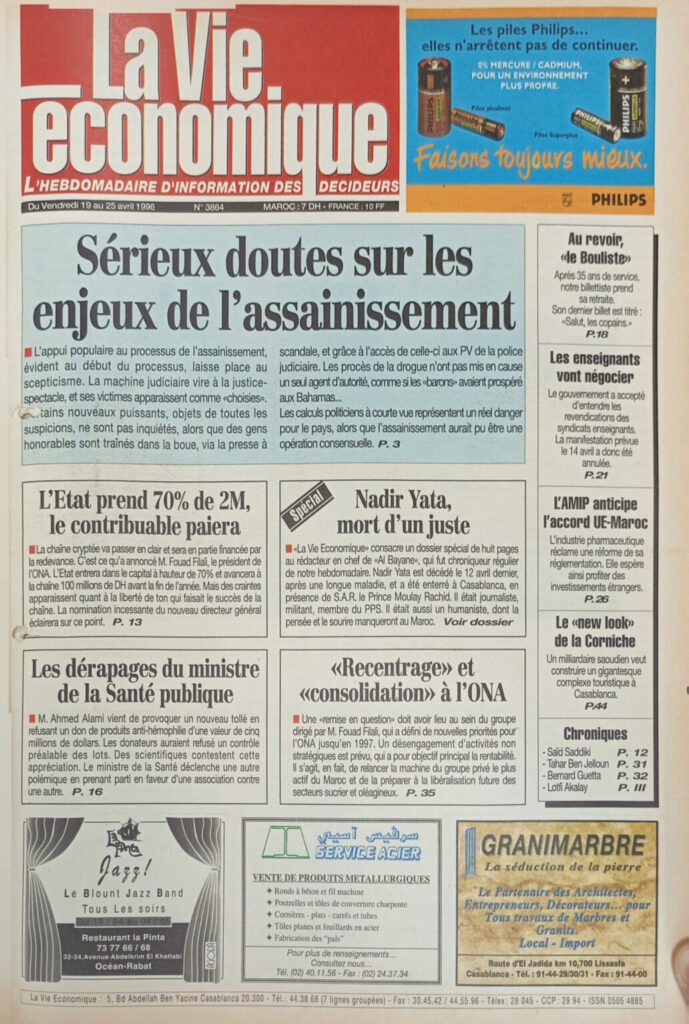
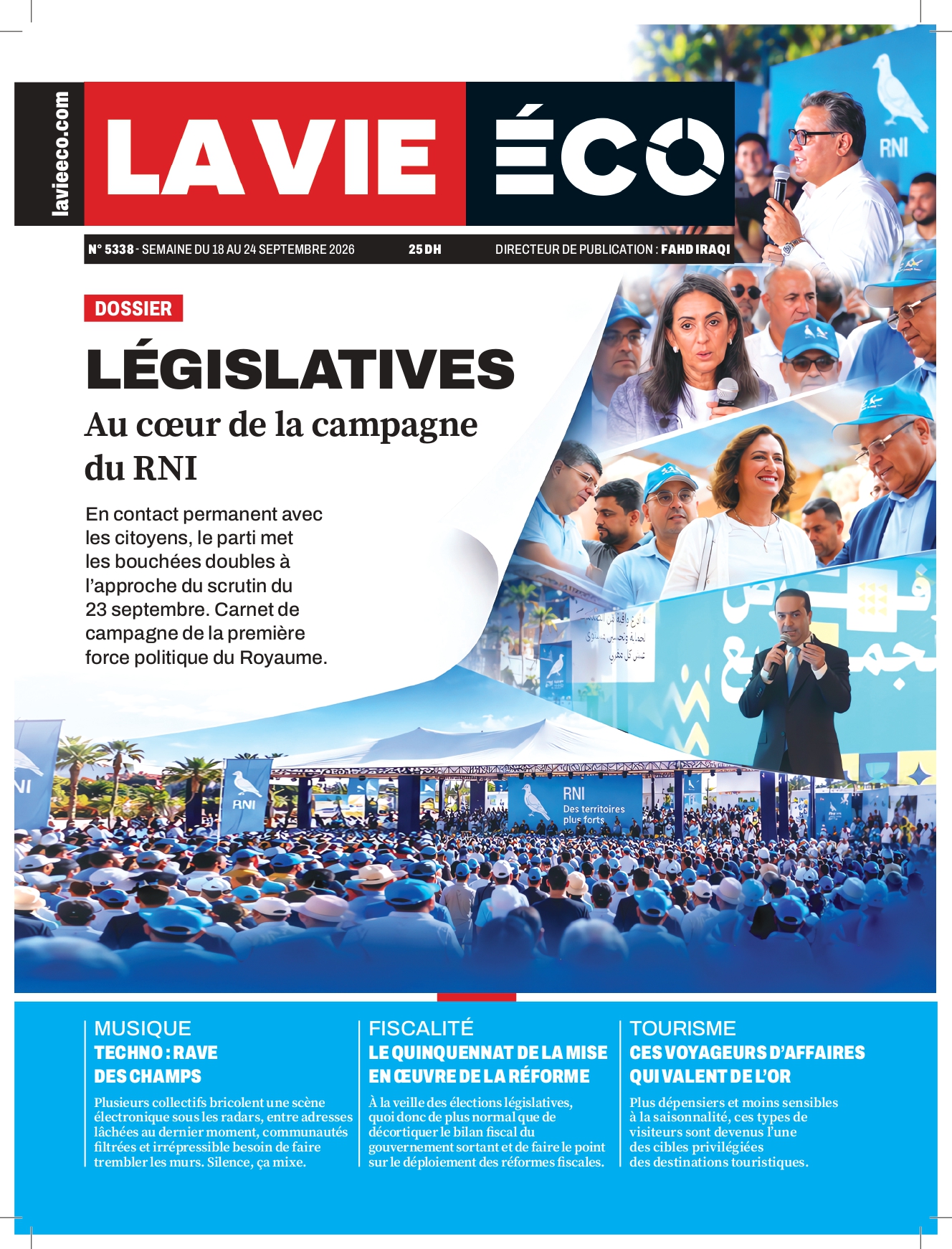
LVE Archives 1996: 2M, ONA throws in the towel
Thirty years ago, the encrypted channel switched to free‑to‑air broadcasting and became partly funded by the licence fee. The State took a 70% stake in the capital and injected 100 million dirhams.

The encrypted channel will switch to free‑to‑air broadcasting and will be partly funded by the licence fee. This was stated by Fouad Filali, President of ONA. The State will enter the capital with a 70% stake and will advance 100 million dirhams to the channel before the end of the year. (…).
The imminent appointment of a new Chief Executive Officer will shed light on this issue. “We made mistakes,” Fouad Filali declared at a press conference held on Monday, 15 April.
He was referring to the 2M venture. A venture, because the private operator entered the audiovisual sector more as a result of a political decision than an economic choice.
As for the mistakes, the list is more or less long depending on whether one looks at the matter from 2M’s perspective or from that of the public authorities, particularly the supervisory ministry.
Over‑sized investments, poor cost control, and above all a change in concept without any economic assessment are among the grievances most frequently cited.
Regarding the change in concept, it should be recalled that at the outset the channel positioned itself mainly on the international scene.
By opting instead for proximity programming, its costs exploded… without revenues keeping pace. However, economic reasoning cannot obscure one fact: 2M changed its concept under pressure from its shareholders and in response to a genuine public demand.
This is the core issue facing 2M: it was created and managed to fill a gap in the audiovisual landscape—a mission that is politically and socially essential, yet economically risky.
Cumulative losses exceed 400 million dirhams and have virtually absorbed the company’s capital. It is for this reason that Soread turned to the State—not as a private operator, but as a public‑service concessionaire. But this is where the first “glitch” lies.
The agreement between the State and Soread was never ratified by the Ministry of Finance. Some officials consider it “leonine”.
This agreement required the State to take on liabilities in the event of difficulties—which is precisely the situation that arose. Soread quickly realised it could not rely on this agreement, whose legality was questionable. As a result, 2M operated in a legally grey area.
Nevertheless, both the public authorities and ONA were committed from the outset to the continuity of 2M. Consequently, the State had no option but to assume its responsibilities and reach into the pocket… of the taxpayer. In this context, encrypted broadcasting is ruled out and free‑to‑air transmission becomes unavoidable.
The final agreement provides for the absorption of losses through a reduction in Soread’s capital, followed by a new capital increase, with the State entering at a level of 70–72%.
The Ministry of Communication will inject 100 million dirhams, drawn from the budget line “support for the audiovisual sector”, before June 1996. But this amount alone will not ensure 2M’s survival. Reliable sources of revenue must be found.
In the new context, there can only be two: advertising and the licence fee. These two options can evolve only within the framework of a new vision for the entire audiovisual environment.
TVM is no better off, and its budget is even smaller than that of 2M. The Ministry of Communication is opting for a reform of the advertising market, which is under‑invested, operates chaotically, and is dragged down by the pricing practices of TVM.
Raising advertising rates—yes—but the Ministry wants to go further. It is therefore considering transforming SAP, which handles advertising sales for TVM, into a private company. In the long term, SAP and Régie 3 should be merged, or at least find synergies. That leaves the licence fee.
Currently ranging from 5 to 20 dirhams, depending on household standing, it is collected by the local authorities and ONE. The 1996–1997 Finance Law will propose doubling it and sharing it between the two channels.
The parliamentary debate is likely to be heated, and the worst‑case scenario—rejection by MPs on the eve of early elections—cannot be ruled out.
Subsequently, the collection of this parafiscal tax will have to be improved, as the local authorities and ONE are not particularly prompt in remitting it, and existing arrears currently amount to three full fiscal years.
This solution is viable, but concerns are growing. The most widely shared relates to freedom of expression at the channel.
Officially, the specifications would maintain 2M’s current mission. And the profile of the new Chief Executive Officer, who is to be appointed imminently, is that of a private‑sector professional with a strong understanding of audiovisual issues.
However, with the State holding a majority on the board of directors, no one can realistically imagine that the temptation to exert pressure will not resurface. It is now up to 2M’s executives and its viewers to defend this space of freedom.
Jamal Berraoui