Business
Luxury Pastry: a Market Moving Rapidly Upmarket
Straddling artisanal heritage and international influences, luxury pastries in Morocco are enjoying a true golden age. Driven by a discerning local and tourist clientele, the segment is moving upmarket, focusing on premium ingredients and a gourmet experience.

Long associated with traditional sweets (cornes de gazelle, briouates, fekkas), Moroccan pastry-making has reinvented itself. It no longer simply aims to be indulgent; it is becoming an art of detail and a marker of luxury. The sector is still relatively unstructured, with a strong artisanal and informal presence, but the luxury segment is becoming more professional through premium houses.
Today, a new generation of high-end pastry houses offers contemporary creations inspired by French, Italian, or Japanese pastry, while still asserting a local identity. “Moroccan DNA is a major added value and allows us to add a personal touch,” says the manager of one of Casablanca’s luxury pastry shops.
In these Moroccan premium boutiques, clear hallmarks are shared. Their owners or managers believe that “local luxury does not deny its roots. On the contrary, it elevates them: orange blossom, rose water, Tafraout almonds, orange blossom honey, Taliouine saffron, Mejhoul dates…
These ingredients become reimagined signatures in entremets, macarons, or chocolate bonbons.” This hybridization appeals to a clientele seeking authenticity and differentiates the Moroccan offering.
Luxury sweets attract an urban clientele—upper socio-professional categories (CSP+)*—as well as 5-star hotels, prestigious riads, and the events market (weddings, receptions, corporate events). Marrakech, Casablanca, Rabat, and Tangier concentrate most of the offering.
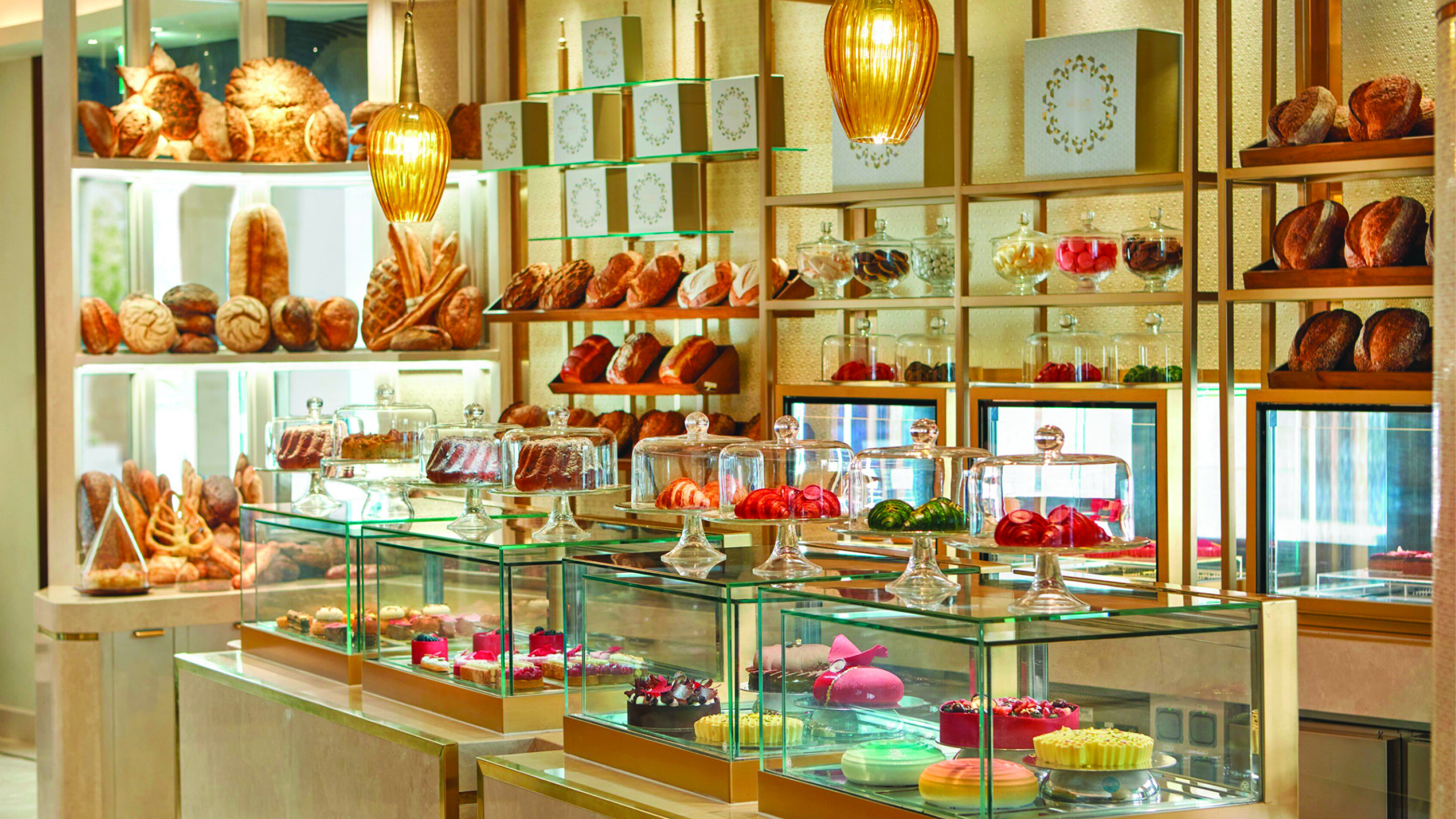
In Casablanca’s high-end pastry shops, it is clear that the codes of luxury are firmly in place: exceptional ingredients (grand cru chocolate, Madagascar vanilla, Sicilian pistachio, AOP butter, selected dried fruits, etc.). Highly advanced know-how: internationally trained chefs, mastery of textures and plating.
Along with a meticulous aesthetic—minimalist display cases, elegant packaging, and storytelling around the product. As well as refined tea rooms, personalized service, and limited editions for one-off events: Christmas, Valentine’s Day, or Easter.
Concepts that are driving the market…
The high-end offering focuses on cake design, personalized desserts for weddings and corporate events, and low-glycemic-index (healthy) creations. Current trends emphasize innovation (layer cakes, refined entremets, and French-Moroccan fusion flavors) and eco-responsibility through premium local ingredients.
Without claiming to be exhaustive, several concepts illustrate the market’s current direction: luxury-positioned pastry-boutique houses, and chef-entrepreneurs with a strong presence on social media.
This is the case of Rayan Néhmé, widely followed on Instagram, who influences gourmet trends in Morocco. The Rayan Néhmé atelier is emerging as one of the new benchmarks in luxury pastry.
The address embodies contemporary pastry where French technical skill blends with a Mediterranean sensibility. Precisely laminated viennoiseries with subtle pairings—from pistachio to chocolate or floral notes—make up most of its offering.
Each pastry highlights premium raw ingredients, most often imported, while also showcasing certain products from Morocco’s terroir. Thus, at Secret de Famille, the fourth generation of the Bennis family reinvents and revisits recipes for gâteaux beldis, made by the grandfather for more than 50 years, adding a modern touch that matches today’s tastes and trends.
Moroccans favor traditional sweet flavors (honey, almonds, spices such as cinnamon and saffron), adapted for a demanding audience at festive events. But demand is currently booming for sophisticated wedding cakes and corporate gourmet gifts.
To meet this demand, Lahlou & CO, a well-known address in Casablanca, stands out for a broad range of classic and contemporary pastries, while also offering premium chocolate and snacking options. Particular attention is paid to ingredient quality and design.
Prices comparable to those in European capitals…
Beyond creativity, premium positioning is also reflected in prices, which are significantly higher than in traditional pastry. The price of a signature entremets, a box of chocolates, or an assortment of mignardises can reach levels comparable to Europe’s luxury capitals.
For viennoiseries, the price is around 30 dirhams. For cakes and individual portions—without counting variations depending on the season, ingredients, and customization—the price ranges between 50 and 90 dirhams. For whole cakes and customized creations, prices fall within a range of 500 to 2,000 dirhams.
“It can be higher depending on complexity, fruit, and ingredients. It is higher than what is charged in classic pastry shops, because there is a creative component and a sophistication that meets the clientele’s needs,” explains a local pastry chef, who also emphasizes that “luxury pastry is an art based on a sense of detail.”
The sector targets an affluent clientele, sensitive to ingredient quality, refinement, and the rarity of creations—customers that brands intend to pamper through signature pieces, customized orders, and a privileged relationship. All of this is far from standardized consumption.
Despite its growth, the segment faces several challenges: the high cost of real estate in upscale neighborhoods, imported raw materials, dependence on a solvent clientele, the need for continuous team training, and protecting know-how in the face of standardization.
While remaining discreet about the amount of their investments, operators in this segment stress that “it is substantial, because it is necessary to meet hygiene and aesthetic standards, in order to guarantee quality production and luxury service.”
Beyond store fit-outs, appropriate equipment, and raw materials, professionals point to the major investment in human resources—especially pastry chefs, many of whom have international experience—as well as sales staff and those responsible for reception and advisory service.
Indeed, in these pastry shops, a dedicated person is in charge of presenting the product range, the ingredients, and, where applicable, the services provided by the house. Clearly, this high-potential segment is a true art.