Kingdom
Livestock, the “bleating” political controversy
Two investigations published in the press and an investigative book written by a seasoned member of the lower house once again revisit a tired and overused subject: the subsidy for Eid sheep—offering a distorted reading of figures that are, in fact, quite clear.

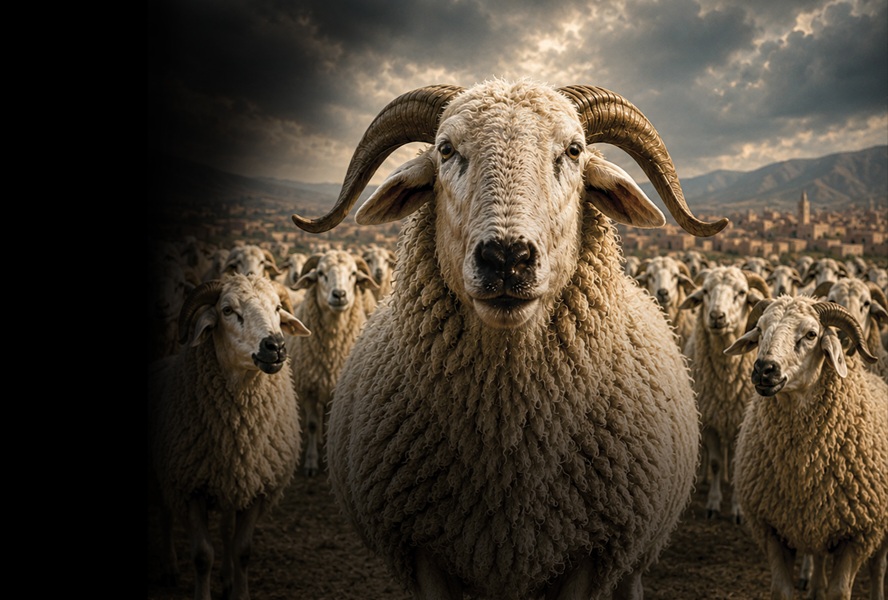
A little over a year ago—in April of last year—based on a document submitted to parliamentarians, the PPS claimed to be dropping a bombshell: the government had allegedly granted 13 billion dirhams in subsidies to importers of live sheep, without this being reflected in the price of the animal at the souk or per kilogram at the butcher.
The argument is appealing and opens the door for everyone to add their own ingredient, turning a simple accounting entry in an official document into a political scandal—one that ultimately misleads the citizen.
At its core, the PPS, followed by the rest of the parliamentary opposition and social media, deliberately conflated “budgetary expenditure” with a theoretical “tax expenditure.” What the government actually disbursed in direct subsidies to importers amounts to 438 million dirhams. That is what was effectively paid out from the State treasury.
At the same time, however, the government suspended customs duties (200%) and import VAT (20%). According to a simplistic fiscal reading, this would translate into a theoretical loss of revenue of 13.3 billion dirhams. Except that, prior to this temporary exemption coinciding with Eid al-Adha (see opposite), and again after the reinstatement of import duties in 2025, no operator imports live sheep—for the simple reason that it would never be competitive.
To demonstrate: at present, the price per kilogram listed on the Salamanca exchange is €5.2 for a sheep weighing around 28 kg. Applying only customs duties and VAT, a lamb imported from Spain would cost about 5,042 dirhams, excluding transport costs and the margins of importers and intermediaries.
That is roughly double the reference price of the local Sardi breed, sold at around 87 dirhams per kilogram in large retailers. The choice is quickly made. As a result, there are no imports—and therefore no customs or VAT revenue, nor the so-called “loss of revenue” mentioned above. This shows that the central argument underlying this entire campaign does not hold.
Let’s redo the calculations
Be that as it may, a year later the same controversy—this time with slightly different data—has resurfaced.
Now the PJD is brandishing a so-called investigative book in Parliament, which some media outlets have unquestioningly swallowed.
Published by Abdellah Bouanou, MP for Meknès since 2002, the book revisits the same issue from another angle, using different figures—just as questionable—but with the same underlying narrative.
Subsidies—public money—allegedly misdirected, ending up not where they should but in the pockets of “rent seekers.” One of the key indicators cited in the PJD document claims that “public aid actually covers 84% of the purchase price of sheep,” and that “the return on the operation for importers exceeds 2,500% in some cases.”
In other words, the flat subsidy of 500 dirhams per head would account for 84% of the purchase price of a 40 kg sheep ready for slaughter, bought at €141.6 based on the price at the end of March 2024 on the Salamanca exchange (€3.54/kg), a year during which nearly 490,000 sheep were imported for Eid.
Reworking the calculations is enough to show that the subsidy does not exceed 33%, without even accounting for transport, feed, and other costs. There is no need to go further to see that the premise is flawed and the conclusions erroneous.
Transparency and the institutional state
Another “discovery” by the Islamist MP concerns the number of companies created or that updated their business activity on the eve of this operation. He finds it “scandalous” that 51% of companies importing live animals were created after 2022—“just before the launch of the subsidy scheme”—and that some existing companies amended their purpose to include the importation of live animals.
According to him, this was done “to capture public aid and dominate the value chain from import to distribution, including fattening.”
In reality, before 2023, no one imported live sheep for slaughter (as import duties were at 220%); the activity simply did not exist.
It should be noted, however, that over seven years, between 2015 and 2022, Morocco imported on average 20,000 sheep and 3,000 cattle per year duty-free (dairy heifers and goats). But these animals were intended for breeding, not slaughter.
Logically, therefore, specialised companies had to be created and others had to revise their statutes in order to bid for import tenders issued by the ministry under specific terms of reference. Moreover, new companies potentially create jobs and, above all, generate taxes and other fiscal contributions to the State.
In any case, in the interest of transparency, the list of eligible importers—160 in total—was published progressively on the ONICL portal as the operation advanced.
Bouanou’s claims do not stop at these alleged subsidies supposedly enriching what he calls “new frakchiyas” (cattle thieves). He goes so far as to question national livestock figures, often taking shortcuts in interpreting their evolution, not to mention his unfounded criticism of the Green Morocco Plan.
Yet statistics published by the Ministry of Agriculture (see opposite) are unequivocal: they show a national herd rebuilt to 40 million head as of April 2026 and demonstrate the relevance of the government’s choices in managing a sector that is central to the agricultural development strategy. They also highlight its capacity to implement appropriate measures to mitigate the effects of the crisis on livestock and breeders.
Media relays: incompetence or bad faith?
Some media outlets have merely repeated the distorted figures and claims put forward by Abdellah Bouanou without bothering to verify them. This is the case of our colleagues at TelQuel, who produced a report riddled with contradictions, likely drawn from Bouanou’s purported exposé—which they were proud to have obtained exclusively.
For example, the article mentions “an oral instruction from the (Agriculture) ministry, relayed by the National Sheep and Goat Association (ANOC), suspending the artificial insemination operation.” Yet artificial insemination concerns cattle, and ANOC operates only in the sheep and goat sector, making the reasoning border on the absurd.
At times, the article even veers into misleading information, such as when it claims that “the subsidy of 500 dirhams per head was extended until 5 June 2025, even though Mohammed VI had already called in February to forgo the Eid sacrifice due to insufficient livestock.” This is incorrect: the subsidy was in fact extended until June 2024, not 2025.
The catalogue of errors and inaccuracies continues with the confusion between the total sheep population (32.8 million head) and those available for Eid slaughter (1.7 million head), when investigative journalists speak of a “factor of 19 in six months, between February and August 2025.”
Similarly, when they state that “over seven years, between 2015 and 2022, Morocco imported on average 20,000 sheep and 3,000 cattle per year,” they fail to specify that these animals (dairy heifers and goats) were intended for breeding, not slaughter. The difference between the two categories is significant and should not escape a careful and rigorous investigative journalist. (F.I.)