Kingdom
Legislative action: The stakes of a final session
Operationalization of advanced regionalization, completion of justice reform, transformation of the role of the shareholder State… the final session of this legislature carries symbolic significance. At all levels.

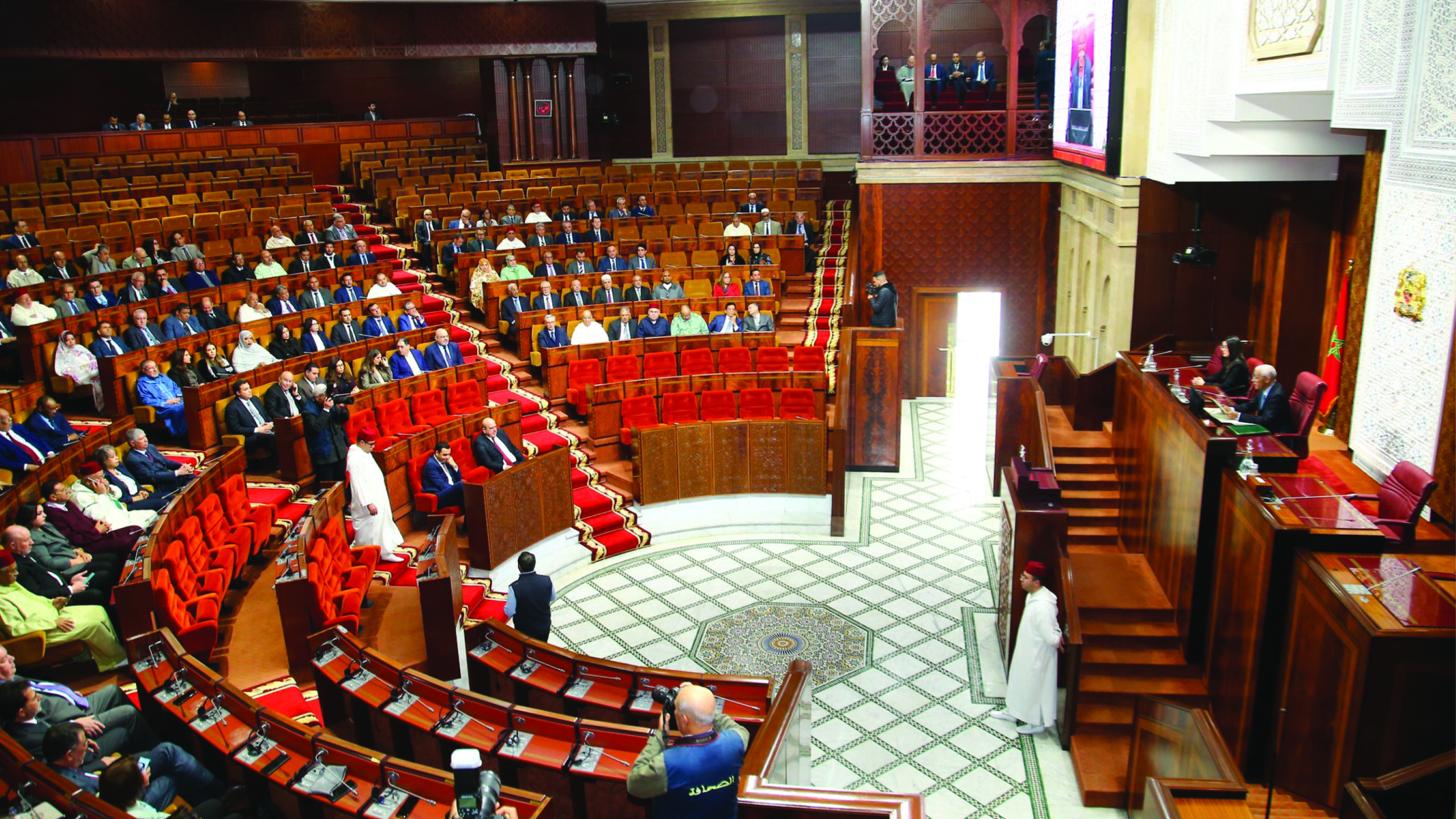
Final stretch before the end of the First Chamber’s term. The last session, opened on Friday, April 10, of the current legislature is far from being an easy one. The stakes are high.
Unlike in the past, it is not an “electoral session” whose sole purpose is to vote on electoral laws and during which deputies, once they have approved the texts governing the next legislative elections, quietly leave to prepare their campaigns.
This session is different, first because the texts in question have already been adopted during the previous session, and second because the agenda is particularly heavy. In figures, the Chamber’s work program currently includes 39 draft laws.
More than half, namely 23 texts, concern the approval of international agreements, both bilateral and multilateral. Others, approved at the last Council of Ministers, should already be arriving before the Chamber’s bureau.
This reflects, as the Speaker of the Chamber, Rachid Talbi Alami, also emphasized, “the level of our country’s influence, its international and regional positioning, as well as the diversity of its partnerships, particularly in the economic, social, financial, and fiscal fields.”
However, within this session’s agenda, what particularly draws attention is the draft organic law amending the law relating to regions.
Behind what appears to be a technical amendment, also adopted at the last Council of Ministers on Thursday, April 9, lies a major institutional transformation.
This text, which involves transforming the Regional Project Implementation Agencies (AREP) into public limited companies, effectively signals the real deployment of advanced regionalization after a phase of foundation and construction that has lasted around fifteen years.
Until now, even in its most advanced stage, the region has managed to become a lever for development, a facilitator of projects, but not yet a key actor in development.
Regions vote on projects, sign partnership agreements, contribute to mobilizing funds, but often do not have control over their implementation agenda.
In other words, the region depends on other partners—municipalities, groups of municipalities, and ministerial departments, among others—to turn approved projects into concrete achievements.
However, it only takes one partner, most often municipalities, to withdraw from its commitments or be unable to fulfill them for those projects to fall through.
The importance of this amendment is that the future “AREP SA” will be responsible for implementing integrated development projects.
It is hardly necessary to recall that the fact that the president of the region also chairs the board of directors of these agencies makes the region a development actor.
Another notable feature is the new status of the agencies, transformed into public limited companies, which automatically subjects them to oversight by the formidable General Inspectorate of Finance (IGF), in addition, of course, to the IGAT, as well as the Court of Auditors.
Ultimately, this amounts to “reconciling the requirements of governance and public oversight with management flexibility and performance efficiency inspired by the private sector,” to use the terms of the statement from the Royal Cabinet issued following the recent Council of Ministers.
In this new configuration, some analysts observe, “the president of the region now has broad management powers through their chairmanship of the AREPs.”
They will use these powers notably in the deployment of the new generation of integrated territorial development programs, which will extend over the next eight years.
The reform continues
That said, during this session, elected officials will finally vote on the draft law concerning the reorganization of the National Press Council, the subject of intense debate and sharp divisions, but which has above all suffered from narrow partisan calculations that have delayed by several months the progress of the profession’s self-regulation.
Another significant text, which indeed led to a standoff with the government but above all highlighted the arbitration role of the institution of the Head of Government, is the draft law regulating the legal profession.
This text, with its 146 articles, has been in the hands of deputies since April 9 and will once again likely give rise to a lively debate.
The same cannot be said for a similar text relating to judicial experts, voted in committee on Monday, April 13, but to a lesser extent, nor for the text concerning the profession of Adouls (notaries under Islamic law), which has been adopted and is currently before the Second Chamber.
These draft laws constitute the final phase of a process launched in 2012, with the start of the national debate on justice reform.
As a reminder, this process began with the project of establishing the independence of the judiciary as a full-fledged power, with the creation of the Supreme Council of the Judicial Power and the Presidency of the Public Prosecutor’s Office.
This was followed by the revision of the judicial map, the rehabilitation and upgrading of courts, alongside an advanced digitalization process. The final stage of this reform concerns judicial professions, which is currently nearing completion.
Like advanced regionalization, this is a project whose effective implementation has taken years. Also noteworthy on this session’s agenda is the draft law transforming the National Ports Agency into a public limited company.
This is the second in a long series of public institutions to take this step after ONHYM. As is known, this is an approach governed by framework law 50-21, which aims to “improve their governance, increase their performance, and open their capital to the private sector, particularly for commercial entities.”
Also on the list of texts currently before the deputies of the First Chamber is draft law 19-25, adopted in the Government Council in July 2025, aimed at regulating the management of stray animals (dogs/cats) for reasons of public health safety and cleanliness.
This text is important because the issue it addresses has recently been used as a pretext to harm the Kingdom’s reputation, in connection with the co-organization of the 2030 World Cup.
As for the rest, these involve amendments and improvements to already existing laws, whose adoption does not necessarily present an urgent character.
During the recess… work continues as best it can
Even though many of them only resumed their meetings a few weeks before the opening of the session, parliamentary committees theoretically continue their work regularly between sessions.
Thus, during this interval, deputies continued to ask oral and written questions, for a total of 2,481 questions addressed to the government, including 865 oral and 1,616 written.
Likewise, as stated by the Speaker of the Chamber, the chairs of the standing parliamentary committees received requests to organize meetings on matters within their oversight remit, in the presence of the ministers concerned.