Kingdom
Jidar Rabat Street Art Festival: The City as Canvas
From spray cans to XXL murals, Moroccan street art has stepped out of the shadows and climbed onto building façades. In Rabat, Jidar makes the capital’s walls burst in an explosion of color. But who is this generation of artists rewriting the city? Focus.

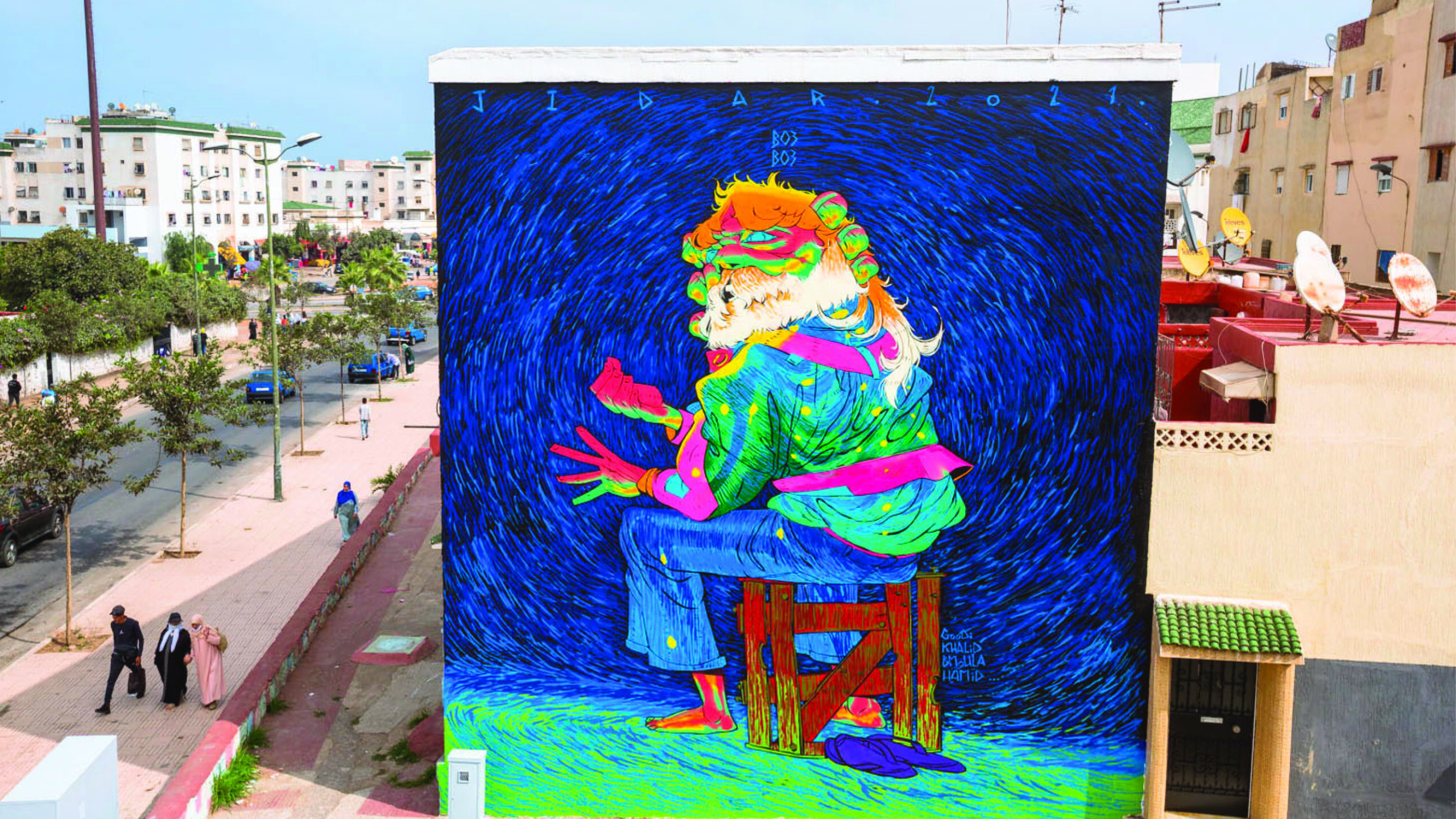
There was a time when, in Morocco, painting a wall had less to do with artistic intervention than with a nocturnal escapade. The street was not yet a gallery, let alone an open-air museum.
It was a terrain of risk-taking, a space seized with spray cans, in haste, between two patrols and three sideways glances. Moroccan street art was born there, in that gray zone where creative impulse flirted with illegality, where tagging, graffiti, and stenciling first asserted themselves as acts of presence before becoming a language.
What was written then along national roads, on railway retaining walls, under bridges, or on the crumbling surfaces of the outskirts did not yet have the legitimacy of today’s large-scale works. But the essentials were already there: a visual impulse, a quiet rage to leave a mark, and a generation that refused to let concrete speak on its own.
In this Moroccan prehistory of street art, one name stands out like an initial burst, almost a founding detonation: Rabie El Addouni. Born in Meknès in 1983, he was among those who very early on exploded forms and colors across surfaces that no one yet regarded as artistic supports.
His visual vocabulary, blending Latin 3D lettering with Arabic calligraphy, opened up a singular path—neither a simple import of Western graffiti nor a superficial layer of folklore, but a local syntax, nervous, structured, and immediately recognizable.
In 2008, he was among the first artists of the genre to be exhibited within an institutional setting, at the Croatian Embassy in Rabat—a pivotal moment when graffiti began to emerge from clandestinity without entirely losing its edge of friction.
His disappearance a few years later did not close the breach. On the contrary, it left a symbolic debt for an entire scene that would later rush into it.
Free spray cans
Because the rest of the story is not written in a straight line, but in a gradual rise. At first timid, sometimes hesitant, the movement nonetheless grows visibly.
In Casablanca, Rabat, Tangier, Marrakech, taggers, graffiti writers, aspiring muralists, and artists influenced by illustration, comics, or design begin to occupy public space.
Among the early figures, Mohamed El Bellaoui, aka Rebel Spirit, quickly imposes his pop and alternative style on the walls of Casablanca before extending that universe into his drawings and installations.
Elsewhere, Morran Benlahcen is part of that young pioneering generation that shakes up the codes of national graffiti and eventually expands his field of experimentation toward contemporary art. In the same vein, signatures like Trick establish another tradition—drier, more protest-driven, more fleeting as well—where the repeated tag alone becomes an act of presence, almost a strategy of poetic occupation of territory.
The real turning point, however, comes in 2013. In Casablanca, the association EAC-L’Boulvart, already active in contemporary music and urban cultures, launches Sbagha Bagha. The festival quickly becomes a decisive focal point.
It is no longer just the artist against the wall, but an organization, a program, a city that agrees to be painted. Giant murals, graffiti battles, workshops, screen printing, dance, residencies, and exhibitions…
In other words, the event gave a collective grammar to practices that had until then been scattered. The gesture changes status. The wall ceases to be merely a surface of defiance and becomes a surface of storytelling. What once took place at night begins to unfold in broad daylight. But it has lived what roses live!
It is precisely in this wake that Rabat, in turn, joins the dance. When Jidar is launched in 2015, the festival clearly states its ambition: to make street art visible and accessible, for both artists and the public, while opening up prospects for a scene that was still struggling to find its place between galleries, art schools, and institutions.
Launched by EAC-L’Boulvart, Jidar also benefits from the support of the National Foundation of Museums, and its inaugural edition features “Main Street,” presented as the first urban art exhibition at the Mohammed VI Museum of Modern and Contemporary Art.
The signal is strong. It says that the street is no longer relegated to the background of cultural policies, that it has now entered the official conversation. And in Rabat—a city often perceived as orderly, administrative, restrained—this graft is far from anecdotal. It acts as a revealer.
Since then, the rise has been spectacular. In nearly ten years, more than 100 murals now cover the walls of Rabat, across all neighborhoods. The façades of buildings, schools, administrative or commercial structures have become open-air screens onto which imaginations from Morocco and beyond are projected.
Rabat, once crossed mainly for its institutions, ministries, and well-kept avenues, has begun to see itself differently. It is no longer only the city where one works; it is also a city where one looks up. And that changes everything, including the way public space is inhabited.
Creating transmission
The 2026 edition, scheduled from April 16 to 27, follows this continuity. The “Collective Wall,” another highlight of the festival, will take place from April 20 to 26 and will bring together twelve candidates around a monumental work, under the mentorship of Bakr.
This detail is not insignificant. Because Jidar does not merely hang murals on the city; it also creates transmission. The Collective Wall functions as an incubator where the next generation learns to think in large formats—composition, dialogue, technique, urban constraints, and collaborative work.
The festival has therefore not only beautified Rabat; it has also helped professionalize, structure, and legitimize a scene. This partly explains why so many Moroccan muralists now receive commissions from schools, institutions, or private actors.
And this is where the focus on Moroccan artists takes on its full meaning. Each year, Jidar invites muralists from around the world, but one of its most decisive achievements has been to make visible very different Moroccan trajectories—sometimes self-taught, sometimes coming from fine arts, design, architecture, video games, illustration, or tattooing.
Ed Oner, Basec, Machima, and Ayoub Normal have all benefited from this catalytic effect. In other words, Jidar has not simply inserted Moroccan names into an international program; it has helped bring forth a national scene, with its leading figures, its signatures, its visual obsessions, its emerging market, and its recognition beyond the Kingdom’s borders.
Within this constellation, Wiam Azhar embodies the new wave well. Trained as an architect, she injects into her murals a sharp sense of composition, along with a particular tenderness for the signs of Moroccan life: zellige tiles, mint tea, card games, small everyday rituals.
Her work—figurative, lively, detailed—has that rare ability to evoke collective memory without slipping into decorative illustration. Nearby, Masawi, born in Casablanca in 1993, operates a different synthesis.
Initially trained in Arabic calligraphy, he transforms the letter into mural material—into movement, tension, vibration. In his work, heritage is not a polite quotation: it becomes urban energy, and his murals speak of identity, memory, and spirituality without resorting to didacticism.
Other artists stretch the spectrum even further. Houssam El Ghallal, a graduate of the Fine Arts School of Tétouan, builds around his hero Hmama—an anthropomorphic dove—an oneiric universe where childlike imagination meets a more serious reflection on peace and conflict.
Ayoub Abid, known by the pseudonym Normal, works with clean lines, vibrant colors, and a very contemporary graphic irony. Machima, who has worked in video games, animation, and comics in darija with the Skefkef project, transfers onto walls a visual culture shaped by narrative and movement.
Ed Oner brings forth silent, almost suspended figures whose interplay of shadow, contour, and interconnection creates a lingering unease in the viewer.
A wall come of age
To this first wave are added artists with highly distinctive styles. Mehdi Zemouri, aka MED, blends geometric abstraction and figuration, drawing from traditional Moroccan architecture.
Meriam Benkirane explores modernity—its paradoxes and the challenge of living together—through intense, geometric, interwoven forms. Tima turns the female figure into a motif of resistance, memory, and enigma.
Reda Boudina, under the signature RDS, combines graffiti and design in work centered on lettering, volume, and material that extends far beyond the spray can alone. Majda Jarbili, coming from interior design, explores mental health and intimate brutality through images whose apparent softness never fully soothes the inner jolt.
Acoby, who came through the Collective Wall and then assisted muralists, delves into the relationship between humans and nature, with a marked attention to what everyday life usually leaves out of frame.
Then there are those who give the festival a particular density by blurring the boundaries between urban art, contemporary art, and other media. Yassine Balbzioui—painter, sculptor, and photographer—brings to the walls a grotesque, unsettling theater populated by wavering silhouettes and masked figures, as if the mural itself became an existential stage.
Ghizlane Agzenaï, who has notably worked in Berlin, has established her immediately recognizable geometric, futuristic totems. Adam Belarouchia, for his part, leans toward social observation, everyday detail, and a kind of sensitive distillation of the Moroccan scene.
Kalamour, Simo Mouhim, Aicha El Beloui, Iramo Samir, Dynam, Omar Lhamzi (aka BO3BO3), Imane Droby, Ayoub Dadouche (aka SEZ), Mohamed L’Ghacham, and Bakr each contribute, in their own way, to this vast mural atlas of contemporary Morocco—each with their technique, memory, city, pace, and distinctive visual grammar.
What stands out, ultimately, is not only the growing quality of the murals, nor even their perfect photogenic appeal for social media, but the cultural shift they embody. Moroccan street art was long read as a fringe art—youthful, marginal, sometimes even vandalistic.
It is now being called upon to revitalize neighborhoods, create social bonds, train artists, attract audiences, and reshape the city. The risk, of course, would be to reduce it to a mere tool of urban cosmetics—a cool varnish over tired walls. But the best of this scene precisely escapes that trap.
It retains something of its original energy, its insolence, its ability to inject disturbance, narrative, and collision into public space. In that sense, Jidar has not domesticated Moroccan street art; rather, it has restored its nobility without entirely stripping it of its spark.
So yes, Rabat owes a great deal to Jidar—not because the festival invented Moroccan street art out of nothing (that would be false). The pioneers were there long before, in the shadows, on embankments, under bridges, on walls no one defended.
But because it managed to transform a scattered energy into a collective narrative, a often-clandestine practice into a shared visual heritage, a series of isolated feats into a readable scene.
Perhaps that is the most important thing: having shifted the wall from a passive surface into a speaking one. And in a country where public space has long been designed for circulation more than contemplation, that is no small detail. It is a small revolution at the scale of a façade.