Kingdom
Hicham Lasri, Satan and the Guardians of the Temple
Around “Thank You Satan” (currently showing in cinemas), a single teaser was enough to trigger a complaint, moral outrage and a politico‑religious frenzy. The filmmaker, for his part, strikes back against hypocrisy, informal censorship and the screen’s false devotees. An interview.

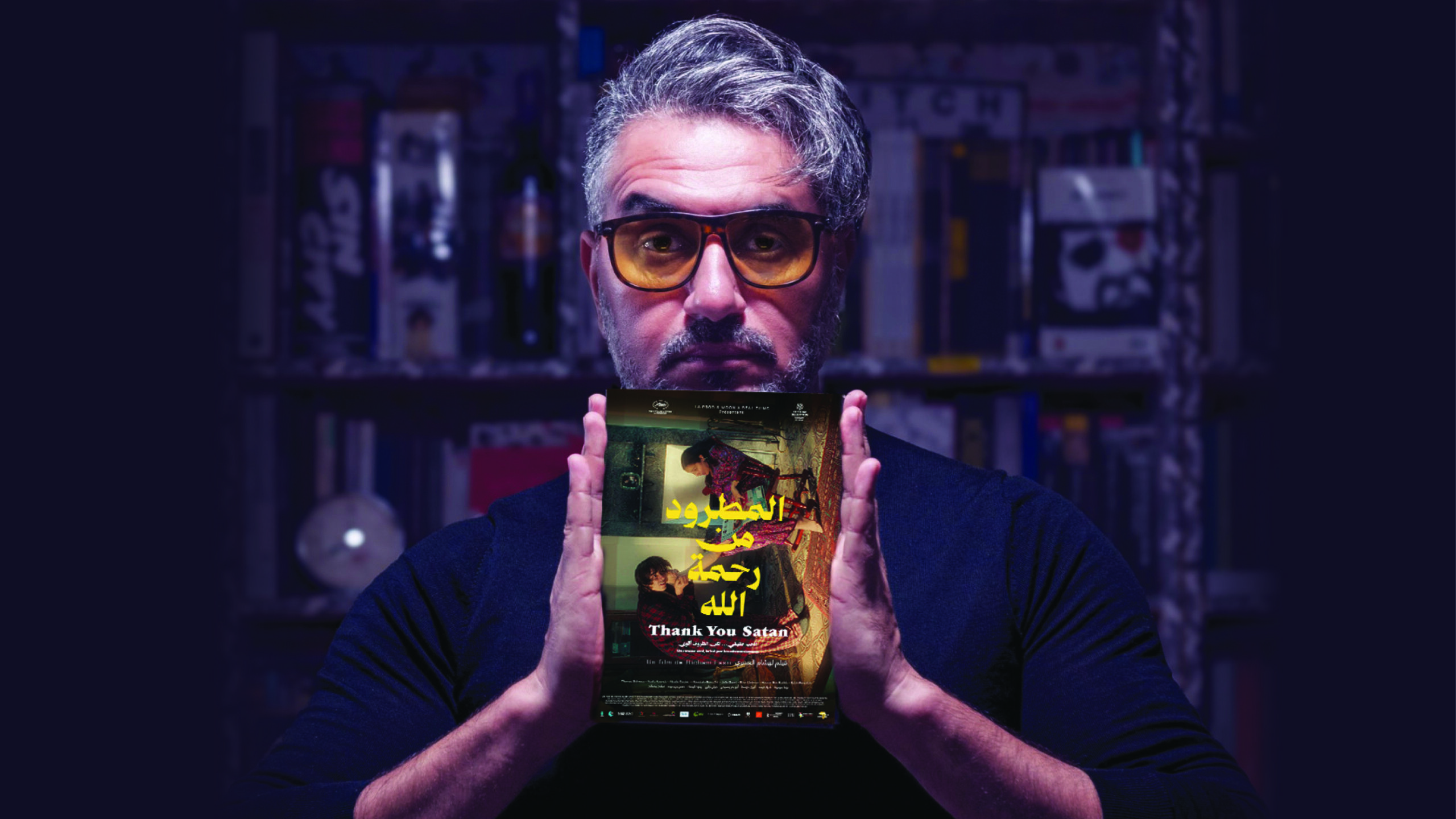
Barely had “The Excluded One from Divine Mercy (Thank You Satan)” begun circulating on social media when the self-appointed guardians of morality sounded the alarm.
On 24 March, the Presidency of the Public Prosecution forwarded the case file to the Prosecutor at the Casablanca Court of Appeal.
The reason? A complaint lodged by the association Printemps du cinéma (Rabii al‑cinema), which clearly did not appreciate the images. The association denounced a promotional clip, broadcast by La Prod, described as being “riddled with shocking scenes.”
The indictment is now well rehearsed. “Satan” in a sacred place, religious symbols – the Quran foremost among them – mixed with sequences deemed obscene, a few insults in English, and the criminal justice mechanism is set in motion.
The complainants invoke the Moroccan Penal Code, as well as a recent ruling by the Court of Cassation criminalising the dissemination of pornographic content online.
The association does not stop there.
It formally urges the Moroccan Cinematographic Centre (CCM) to block the film’s screening permit, the release of which had been announced for 8 April, warning that authorising a work containing such sequences would amount to granting it a free pass while it is under judicial investigation.
It also considers referring the matter to the Supreme Council of Ulema and the supervising ministry in order to verify compliance with the “protection of public morals” on set.
Kafka in Casablanca, teaser version
In another context, one would speak of overreaction. Here, it is almost a genre in itself. The iconoclastic artist facing the sentinels of virtue, fiction summoned before the tribunal of the sacred, and, in the background, a long-standing struggle between moral control and creative freedom.
Hicham Lasri, for his part, neither feigns surprise nor indignation. “We are in a state governed by the rule of law. Everyone is free in their actions, but everyone is also responsible for their actions,” he says.
“One should not forget that this is an election year. There are a lot of absurd things that exist solely to make noise, for show. I look at this with great detachment,” he adds.
Detachment, then. But not disengagement. “If we must follow a legal procedure, we are ready. But this is intimidation that is not justified. The film had not even been shown.
People assume they have understood, but in a very limited way. As a result, we are talking about nothing. It’s Kafkaesque,” he insists.
What is being attacked here, the filmmaker recalls, is not a debated work, but a few images taken out of their narrative logic. “We are talking about a teaser. It is artistic, not explanatory. It gives an atmosphere, a universe,” he explains.
Yet behind these images lies a precise project. “It’s a film noir about the story of a failed writer who is struggling and has to find a solution to make money, and who ends up adopting the principle of a fatwa.
Except that the character is not Muslim at all,” he recounts. A biting dismantling of extremist excesses. And above all, an involuntary mise en abyme. “What is very ironic is that the film talks about what is happening to us right now: blindness, the instrumentalisation of politics and religion, and cynicism,” he notes.
His tone hardens when he evokes the “guardians of the temple.” “I can understand that there are people who want to defend values. But by what right do we set ourselves up as guardians of the temple? Who mandated you?” he asks pointedly. For him, the issue goes beyond shock.
It concerns freedom. “I understand that one may be disturbed by a work. But I belong to the school of freedom. People must be allowed to make their own choices,” he states.
He distinguishes between regulation and censorship
“Classification is interesting. It evolves. Morals change,” he notes. But, he presses on, “are our values so fragile that an image can shake them?”
“Our society is not fragile. Our values are not fragile. Our relationship with religion is not fragile,” he reiterates.
From there, the controversy takes on another dimension. “It is a petty, dishonest political manoeuvre to gain power,” he asserts. “It’s easier to say no than to create something interesting,” he adds.
The filmmaker broadens his critique
“We have a rain of coaches, a whole range of imams, a palette of politicians… everyone thinks they can talk about everything,” he says ironically. “Someone creates something and thousands of people come to say whether it’s good or not.
It’s sterile,” he continues. He claims a different stance: “I wake up, I write, I work. I’m not there waiting to judge what others do,” he explains.
His vision of cinema is clear. “We’re fed up with content. Things that pass and are forgotten,” he laments. “Important creation is necessarily abrasive. It has to sting. Otherwise, it’s not therapeutic,” he asserts.
“We need to activate our intelligence. Art is not addressed solely to the digestive tract,” he insists.
“If you are not free, you are not an artist”
On censorship, he nuances his position. “There is no real structural censorship in Morocco. There is classification,” he explains.
“I was asked to cut scenes; I refused. I was told the film would be prohibited for under‑16s, and I find that coherent,” he specifies. But he points to another danger: “The_tfhe real censorship is self‑censorship.
And informal censorship,” he says. “When you dig a little, you uncover instrumentalisations,” he adds.
Paradoxically, however, the controversy also benefits the film. “People are curious.
They will discover that it is more interesting than what is being said about it,” he believes.
At heart, the affair reenacts a familiar script: a disruptive cinema confronted with a system that prefers comfort. Between the two, a space of friction. “One must not be afraid.
One must not be intimidated,” Lasri insists. “If you are not free, you are not an artist,” he concludes.
A teaser was enough to reignite an old dramaturgy. At its centre, a filmmaker who persists in believing that art must disturb. Otherwise, it is nothing more than just another noise.