Kingdom
Health: Resistance to Change, the Unions’ Ultimate Battle?
Since the launch of the reform, the sector has been the scene of fierce union resistance. From students to doctors, discontent has affected all levels. Healthcare offers an example of the major changes that union action is currently undergoing. Analysis.

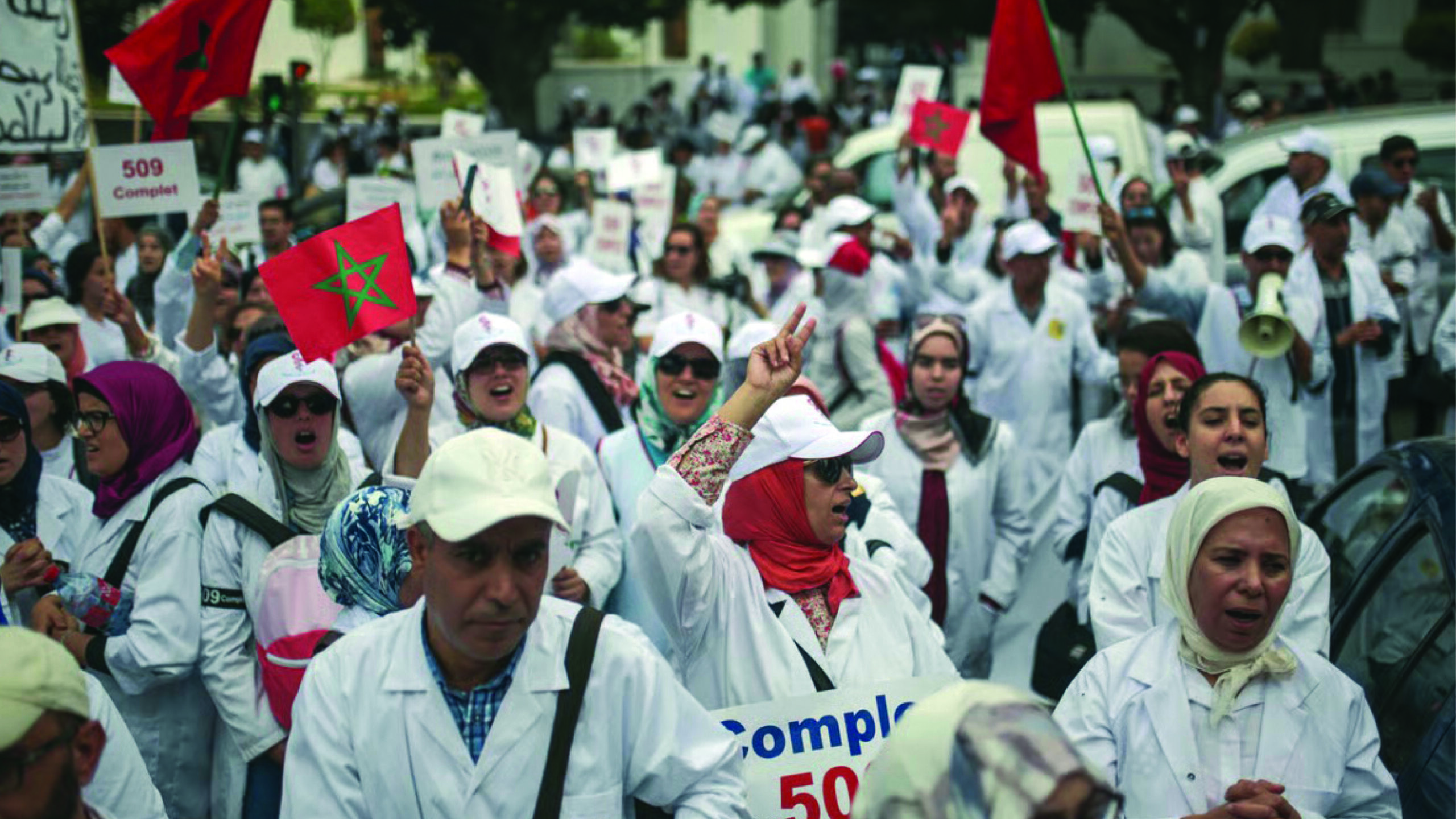
In the health sector, the year 2026 begins as the previous one ended: in tension. Since the adoption of the decrees for deploying the GSTs (Territorial Health Groupings) across the country, unions have remained on the front line of protest. This is, moreover, not new since the beginning of the sector’s reform.
A protest program has already been developed with various forms of demonstrations, sit-ins at regional and national levels, boycotts of ministry meetings and programs, and even a national strike decreed for January 8 in various health establishments, with the customary exception of Emergency services.
Why this raising of shields? Officially, the unions criticize the government for its intention to deploy all eleven GSTs during 2026 in the absence of consultation with them. Above all, according to the Trade Union Coordination created for this purpose, which brings together the CDT, FDT, ODT, UGTM and UNTM, “without having taken the time to objectively evaluate the results of the pilot experience launched in the Tangier-Tetouan-Al Hoceima region,” which started on October 1st.
At its core, as some analysts have pointed out, the issue is far more serious (for the union federations, that is). The latter are on the verge of losing their grip on one of the most important social sectors. And failing to have anticipated the change, the unions are trying to block it or at least delay it.
And for good reason. The creation of GSTs constitutes a profound reform, as it radically changes the way human resources are managed at the regional level. Today, these groups allow for a better distribution of staff, a more efficient use of available resources, and an improvement in the continuity of services, particularly in rural and remote areas.
Certainly, but for the unions, the abandonment of centralized human resources management sounds like the beginning of a decline. In any case, a loss of power.
In the health sector more specifically, much like in education, the government has particularly focused on improving the purchasing power and working conditions of personnel. The salary increases granted range from 1,700 dirhams for technical assistants to 4,405 dirhams for specialist doctors.
In parallel, recruitment has particularly increased in recent years. 6,500 new doctors were hired in 2025 and another 8,000 positions are planned for the year that has just begun. Another indicator, which does not really serve the interests of certain unions, is that the majority of new positions are allocated outside major urban centers.
Therefore, logically, they are more difficult to mobilize. The assignment rate to rural and remote areas increased from 52% in 2024 to 70% by the end of 2025. It will be 72% by the end of this year. An orientation which, according to the ministry, “concerns both general practitioners and nurses, midwives, and family health staff, prioritizing provinces suffering from a chronic deficit.”
Dialogue and negotiation
Even more, the overall situation of human resources in health is improving. In parallel, the classic protest arguments of the unions are dwindling.
Since the launch of the health reform, the government has successively proceeded with salary revaluations, allowances for professional risks, on-call duty, standby duty, and special permanence specifically for nurses, health technicians, and nursing assistants. A new statute has also been promulgated for the nursing corps.
Furthermore, the ministry is currently working on four new draft decrees that will soon be submitted to the Council of Government for adoption. These are the text concerning the allowance for participation in national health programs, the decree on mobility, the one relating to the variable part of the salary, and the text establishing an allowance for working in difficult areas.
Consequently, resisting the deployment of GSTs today already seems like a lost bet. The health reform cannot be stopped in its tracks. The Executive is firm on this point. “The principle of creating Territorial Health Groupings has been legally decided by Law No. 08.22.
It constitutes a strategic choice of the State in reforming health governance and is not subject to prior evaluation.” Thus, as the Minister of Health, Amine Tehraoui, emphasized during a recent oral question session in the First Chamber, the generalization of GSTs “will be done according to a progressive approach, taking into account the degree of preparation of each region.
The ministry ensures, during all stages of creation and implementation, to continue dialogue and consultation with social partners, within an interactive and positive framework.”
Concretely, before launching each new GST, broad consultations will be organized, during which lessons learned from the pilot experience as well as identified difficulties will be presented, in order to take them into consideration and improve implementation mechanisms.
“Evaluation constitutes a lever for adjustment and development and not an obstacle to the implementation of this structural reform which essentially aims to improve service quality, guarantee territorial equity, and bring health decision-making closer to the citizen,” emphasizes the minister.
What should be concluded from this? First, that the union federations – with the changes that the civil service is undergoing thanks to the regionalization of so-called social sectors and the adoption of a regulatory framework for the exercise of the right to strike – are called upon to change their approach.
The UMT, given its long experience in the private sector, easily embraces this change. Everything suggests that the CDT is undergoing a turning point in the same direction, to speak only of the country’s two largest union forces.
The other federations must follow. The planned adoption of new legislation concerning trade union organization will provide the ideal framework for this change. Secondly, and again, the private sector, and to a certain extent the semi-public sector, offers an example of what the core of union action could be, namely negotiation and collective agreements.
Reform is irreversible!
A few months ago, the presentation to Parliament for examination and adoption of a new draft law reforming higher education caused an outcry among unions. They multiplied announcements of strikes, sit-ins, and other forms of protest to force the government to withdraw the text, or at least freeze its adoption process.
Instead, draft law 59-24 was adopted by a majority in the House of Representatives. It is currently before the councilors. More recently, it is the lawyers who are taking up the challenge, announcing a new paralysis in the courts. They have already done so on occasion, when the government introduced the draft reform of the civil and criminal procedure codes.
The first is back in Parliament to amend it taking into account the observations of the Constitutional Court, while the latter entered into force on December 8th last year. Today, the black robes are protesting as a sign of rejection of draft law 66-23 concerning the organization of the profession.