Influences
Hassani Culture: The Voice of the Wind, the Soul of the Sahara
In the Sahara, Hassani dances like a mirage: poetry encoded in verses chiseled by the sirocco, a ‘guembri’ that whispers to the stars, a ‘melhfa’ veiled by nomadic centuries, and sacred tea. From Laâyoune to the lagoons of Dakhla, it weaves the Bedouin heritage into the Moroccan harmony with a golden thread, where the desert sings the eternal.

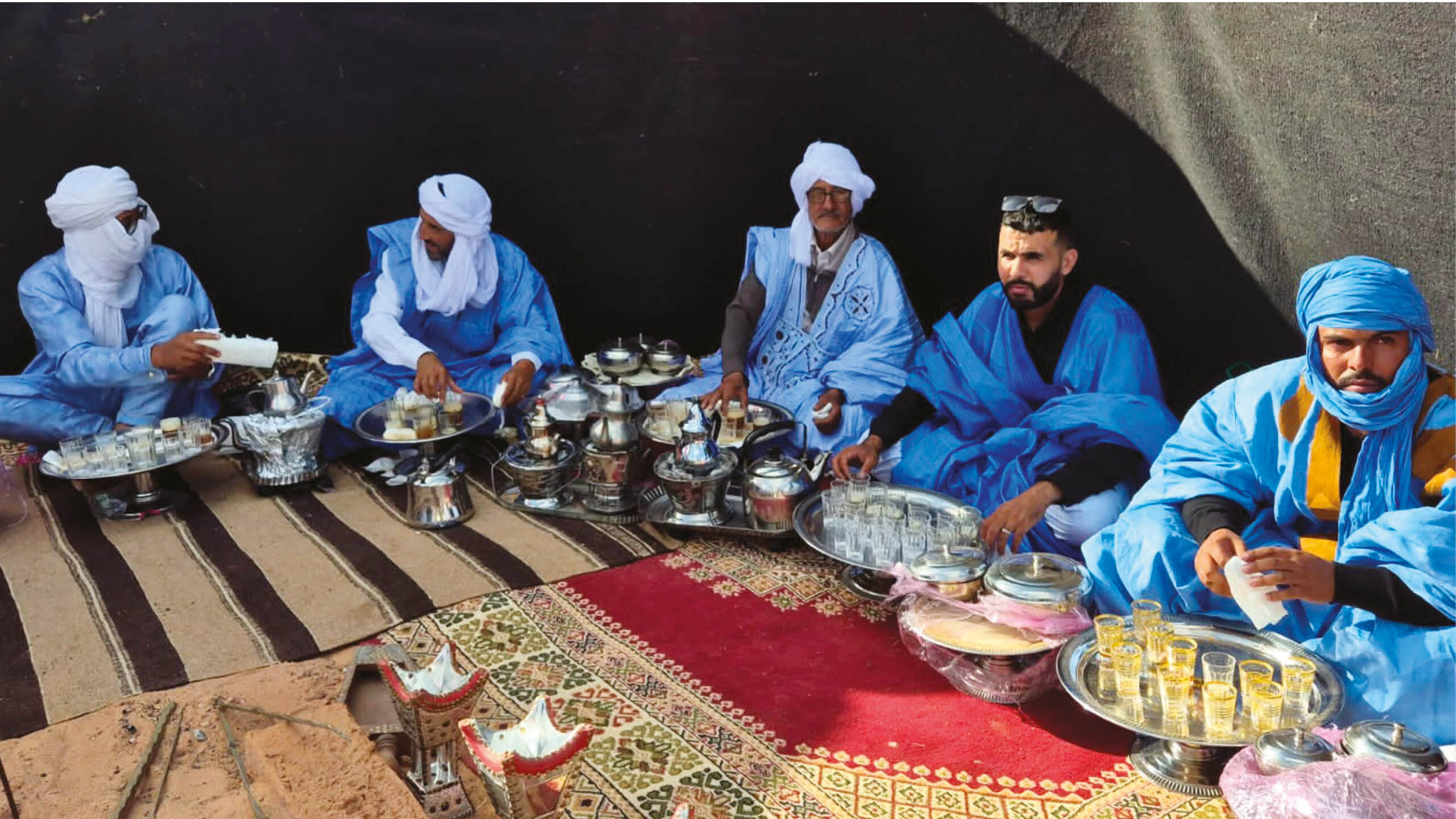
In the heart of the Grand Sahara, where the dunes whisper the secrets of caravans, Hassani culture emerges as a living treasure, forged by centuries of nomadism and resilience. This Sahrawi identity(*), dialectal and oral, unites 85% classical Arabic with Berber and sub-Saharan influences.
“A dialectal expression that carries a dual message: that of highlighting the local tradition, the way of life, the spirit and mentality of a population influenced by the nature of the desert,” reads a presentation fact sheet.
A symbol of a deeply rooted Moroccan identity, it braves colonial trials, affirming a visceral attachment to the Alaouite Throne, as the Sahrawis proclaimed: “lah ihadane loutane ou insar sultane (nothing separates us from our country nor distances us from our Sultan).”
Whisper of the Dunes
Orality is the pillar of this culture, where memory is transmitted by voice rather than writing. Tales, proverbs, and tribal genealogies weave an invisible net connecting the generations. Hassani poetry, vast as the Atlantic Ocean, is its jewel.
Referenced as a “permanent song through time, a slow or rhythmic melody, and a music of trance,” it preserves national history: battles of resistance, the exile of Mohammed V, the joy of the Green March.
Poets like Abderrahmane Chenguiti encoded messages and orders in verses, stimulating patriotism against the occupier. Mohamed Souih, for his part, sings of modern progress: ports, airports, the transition from nomad to sedentary, without erasing traditions.
An excerpt from his work evokes this transformation: “The progress of the Southern provinces: ports, airports, fishing boats, basic infrastructure, the airplane, the car, the new style of dress and cuisine, the transition from nomadism to sedentarism, urban development and the new life transforming Sahrawi society without harming traditions.”
This portrait of progress is accompanied by a reflection on the place of women, the true muse and guardian of the Hassani soul, to such an extent that “a poet compares her to a poem in human flesh,” while fraternal love, *alhob alodri*, welds the tribes together.
Hassani music, inseparable from poetry, resonates to the rhythm of the ‘guembri’, the ‘tidinit’, and the ‘bendir’. “It is music similar to that found in other regions of Africa, but with its own codes,” notes Wahiba Kantaoui, Head of Territorial Marketing at the Agency for the Development of the Southern Provinces.
Difficult to master, it induces trance and contemplation, evoking fauna, flora, and scarce water. The book “La musique hassanie. Voyage au cœur du Sahara marocain” by Ahmed Aydoun explores these rhythms, highlighting their role in nomadic rituals.
In Laâyoune, annual festivals broadcast these sounds via the TV channel Laâyoune, created in 2004 for Hassani programming, fostering local creativity.
Breath of the Desert
Daily traditions reflect this harmony with the desert. The matriarchal society crowns the woman: mother, daughter, or wife, she wears the ‘melhfa’, a “transgenerational dress worn for centuries,” asserts Kantaoui.
Hospitality is sacred: tea, a “great spiritual ceremony,” seals alliances around three symbolic glasses – bitter like life, sweet like love, sugary like death.
Nomadic cuisine: camel tagine, couscous with goat’s milk, where the dromedary is the hero after man. The Moussem of Tan-Tan, inscribed on UNESCO’s World Heritage list in 2008 (and strengthened in 2024 by initiatives), brings tribes together for barter, marriages, and equestrian folklore that strengthens ties.
“Morocco has been able to protect and develop Sahrawi Hassani culture, given that it was recognized by the Constitution, which provides for its preservation,” states an official report. An annual fund of 15 million dirhams supports films and documentaries; a museum in Dakhla and the Center for Sahrawi Studies in Rabat archive the memory.
The INDH (National Human Development Initiative) has financed 116 cultural projects since 2007. As a sociologist writes, Hassani culture embodies “the factual and social unity resulting from the adoption of the same Maliki rite from North to South.” In the winds of the Sahara, its nomadic echoes remind us: the desert unites, it does not divide.
Originating from Bedouin Arab tribes who came from Yemen and Saudi Arabia in the 16th century, Hassani culture permeates the Southern provinces of Morocco, from Laâyoune to Dakhla.