Kingdom
Hassan II: Speeches, Actions, and Visions
November 6th has always been a moment of communion between the King and his people regarding the sacred cause of territorial integrity. An anthology of the words of a Sovereign who left his mark on History.

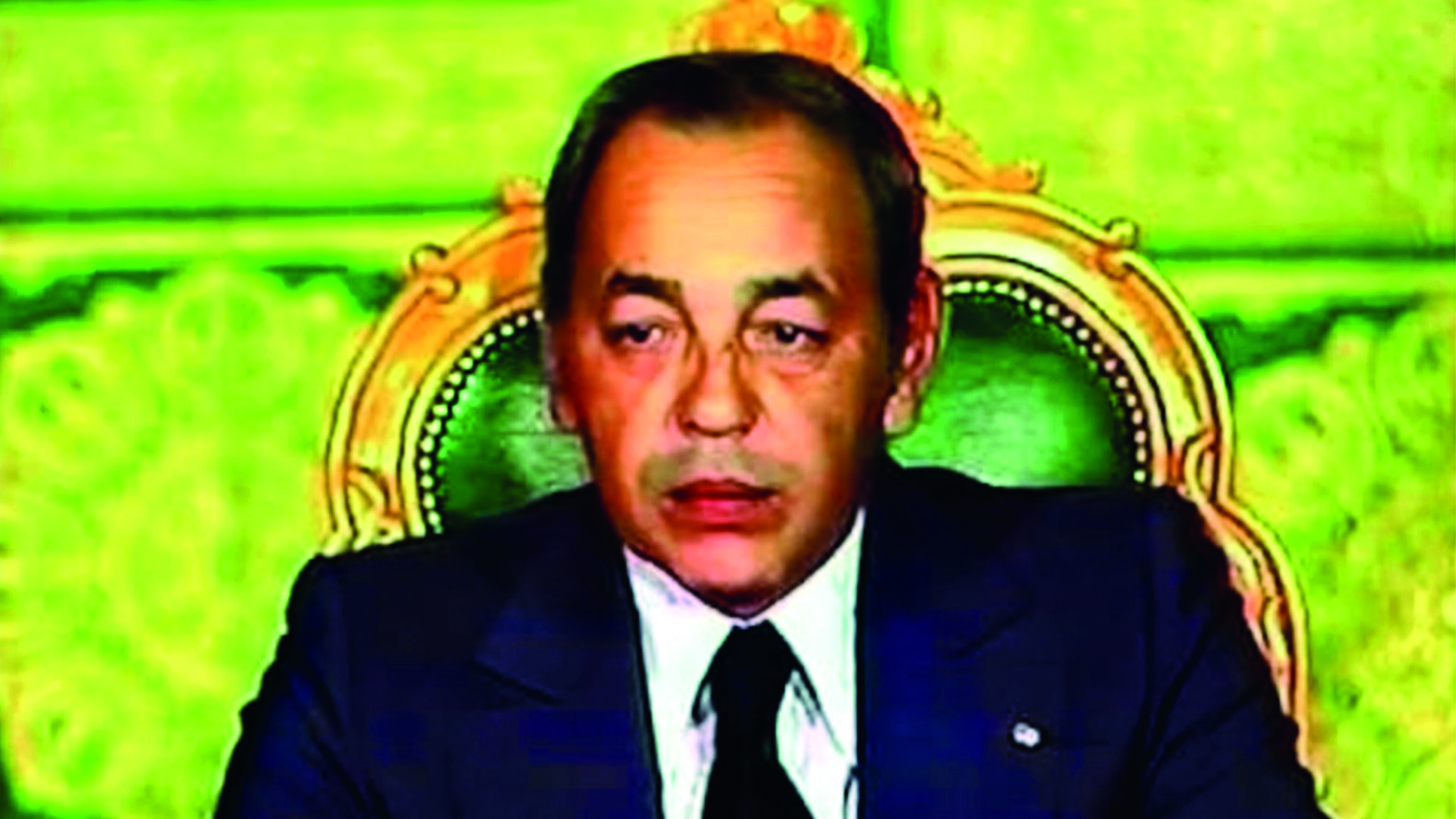
November 5, 1975
“Tomorrow, you will cross the border. Tomorrow, you will begin your March. Tomorrow, you will tread upon a land that is yours. You will touch sands that are yours. Tomorrow, you will embrace a soil that is an integral part of your dear country (…). Go forward, then, by the grace of God. May God steady your steps and ensure that your March is one of victory for the Moroccan people and for our Sahrawi brothers, whom we are so eager to reunite with.”
November 6, 1976
“Last year, on this same day, we gave the order to begin the Green March, convinced that victory was certain and inevitable (…). They were magnificent moments, dear people, when, within a month, at our request, you provided volunteers, began the march, crossed artificial borders, and, at the moment we ordered you to stop, it was done (…). We therefore consider this march as a source of inspiration and we meditate on the profound meaning of the lessons we can draw from it (…). We have decided to make this day of November 6 an official national holiday, for it confers a new identity upon the new Morocco, which we wish to build together.”
November 6, 1977
“For the past three weeks, in our recovered Sahara, we have observed a continual escalation, as the weaponry used by what they call ‘the Polisario’ has constantly evolved and now consists of heavy artillery that few countries know how to handle (…). Who is this ‘Polisario’ that possesses such capabilities, has financial reserves, and maintains relations with international firms, even with states, enabling it to acquire such weaponry? I wish to reiterate here and solemnly that there is no dispute between the Moroccan people and the Algerian people. However, I must emphasize, it falls upon me, as Sovereign of the country and Supreme Commander of the Royal Armed Forces, to fulfill sacred duties. I will therefore be compelled – I say compelled – to exercise the right of pursuit even if it leads us to cross borders and infringe upon the sovereignty of neighbors.”
November 6, 1978
“Before beginning this speech, I ask every family, listening to this message, to take hold of the sacred book, so that all of us, once this address is over, may take the oath of the Massira. I myself composed this oath and transcribed it by my own hand. I will send it to the competent services to produce a laminated print that will be given to every Moroccan woman and man, even to those who did not physically participate in the Green March, for it constitutes an oath of fidelity to the achievements of the Massira.”
November 6, 1979
“Truly, two peoples must celebrate the anniversary of the Green March: the Moroccan people, because, through their genius, they conceived, created, organized, and executed this March to its completion; and the Spanish people because they resolved a dilemma. One posed for the first time to mankind: to choose between an embrace or recourse to violence. The Spanish people knew how to choose and preferred the embrace to the bayonet. There is nothing surprising in this choice: it is an eloquent demonstration that Moroccans and Spaniards have always known how to coexist and live together in an interpenetration of civilization and influences. Therefore, it is natural for brothers to embrace.”
November 6, 1980
“We were informed of a significant infiltration of enemy elements attempting to destroy the locality of Boucraâ. The Royal Armed Forces repelled this violent attack (…). If this victory, dear people, serves to strengthen our determination, it should also bring you joy and reassurance, for we have now assimilated the war of the Sahara, and we have learned to master the military situation day by day (…). That is why we once again address the rebels, the misguided, and those who led them astray, to tell them that the path of return is always open, that they can always repent, and that a new opportunity to reintegrate their homeland and rejoin their fellow citizens is offered to them (…). In any case, you must know that Morocco will never renounce its Sahara. This situation will last until the end of time. You will never, whether during Hassan II’s lifetime or after Hassan II, set foot on this land, occupy it, or even be spoken of there.”
November 6, 1981
“When we accept the referendum, it is not at all for us to ask Moroccans if they intend to remain Moroccans. We tell them, and we take this council meeting to say that the question at hand is the following: ‘Do you confirm the acts of allegiance (the bei’a) that bind you to His Majesty the King of Morocco, Amir Al Mouminine, and which imply your belonging to the Kingdom of Morocco?’. This is the question we ask you and we want you to ask it in turn to all voters. Our acceptance of the principle of the referendum does not imply that we have decided to abandon you. Moreover, we cannot consider abandoning our Sahrawi subjects after they have long and hard struggled and endured, under the pretext that some have raised the question of whether you wish to be considered Moroccans.”
November 6, 1982
“The Sahara is indeed Moroccan and can only be Moroccan. No one can consider that this country will live in peace and security and that its people will know tranquility if its Saharan provinces were to be amputated to serve as a base for agitation (…). Our adversaries must know that for us the issue is one of glory, history, rights, and destiny (…). We are therefore willing to meet, discuss, debate, and overcome obstacles to achieve our goal, to surpass present difficulties to turn towards the future and work for the benefit of future generations and the peoples of the region. In doing so, we reiterate our goodwill, our pure intentions, while reaffirming that we will continue if necessary to wage war, and for centuries, for the issue is first and foremost a matter of rights, then a matter of history, and thirdly a vital matter for our country and our people as well as for the balance of our region.”
November 6, 1984
“In fifteen years, a new century will begin. It is therefore imminent. In the year 2000, there will be one hundred million Arab and Muslim Maghrebis. This speaks to the immensity of the tasks that await them. In evaluating them, we can only conduct an examination of conscience that allows us to lucidly look at the work to come. What will be the responsibilities of the Great Arab Maghreb in the next century? Above all, they will be responsibilities towards the peoples that compose it and towards common values. It will essentially be about the Maghreb mastering its wealth, which, scientifically considered, must be put at the service of our peoples’ needs and for the exploitation of which all potentialities must be mobilized (…). We also have a particular responsibility towards our African brothers, without distinction of color, ethnicity, or religion. We are and will remain Africans. Towards the continent, we assume a human, cultural, and civilizational responsibility.”
November 6, 1985
“During this decade, dear people, we used all means to avoid military action and to prevail through reason, patience, dialogue, and good neighborliness. Despite our goodwill, we found ourselves obliged to take action, thereby expressing, and to the face of the world, that for us dialogue cannot be synonymous with weakness or hesitation (…). Thus, civilians and military personnel, at all levels, in every arena and home, gave their best so that it may be forever established that the Moroccan people can accept all sorts of compromises except when it comes to its unity and territorial integrity.”
November 6, 1987
“Over the years, we have strived to explain the matter and define our case, at times when numerous problems and difficulties assailed all continents. This situation did not allow the UN to devote the necessary attention to the case so that everyone could have the opportunity to know our point of view. Through our patience, perseverance, and labor, we succeeded in making the issue known ourselves and we achieved an important result: the case is now handled by the UN, which has officially placed it in the hands of its Secretary-General. We consider this step a great victory; it will allow everyone, particularly the international community, to distinguish truth from falsehood.”
HM King Hassan, November 6, 1988
“On this occasion, I say to all, to all those animated by good intentions, to all who have a drop of Moroccan blood in their veins, I tell them: the homeland is clement and merciful (…). I know there are families suffering from撕裂, some of their members on one side, others on the other. To those who have gone astray, who have strayed from the right path, I say: think of your country, think of your families (…). I pray to God – may He be exalted – to guide the misguided towards the right path, to unite our ranks, to inspire us to persevere on the good path, that of right and legitimacy.”
November 6, 1990
“We Moroccans are all a little mad. Why? Because it occurred to us, sixty years ago, that we could free ourselves from the French when we had neither an army, nor security, nor weapons, nor money – one must indeed be a little mad (…). It also required a certain dose of madness to succeed, with three hundred and fifty thousand volunteers whose only weapons were the Quran in their right hand and the national flag in their left, in recovering our Sahara. Our madness, we Moroccans, is, it seems, a political madness: the madness of the inspired. If such is madness, we pray to God to give us more of it. In any case, thanks to this madness, we were able to throw out the French and recover our Sahara. Should the occasion arise, this same madness will inspire us the day someone dares to disrespect us: that day, with a bit of intuitive perception, we would surely make them see reason.”
November 6, 1991
“We are going to witness new changes in the world. New forces will emerge and develop. Perhaps we do not think enough about the countries of the Far East: China, Japan, Malaysia, Indonesia, Korea, Taiwan, and the other powers with foundations, potential, and states that have a future because they have a past.”
November 6, 1992
“A month ago, another march was launched. I would not call it the ‘march of democracy’, because democracy is, above all, sensibility, conviction, and faith. Democracy has a definition and until last year it had several – according to systems, continents, countries, and peoples. I therefore do not assert that we have embarked on the path of democracy and in the democratic march, but rather in that of political ethics, the distribution of political powers, the respect for political and human rights, and the decision taken unanimously by the community. (…). Know, dear people, that what awaits us is not a matter of six or ten years, but a constant virtuous conduct, ceaselessly reaffirmed, striving for the best and not at all for the worst.”
November 6, 1995
“If some attempt to thwart the process underway, as for us, we must remain attached to two principles: firstly, the peace plan and nothing but the peace plan, and secondly, and this is important: if the peace plan is not strictly respected, we will no longer want a referendum, it being understood that we are indeed established, under divine protection, in our Sahara where our own quench their thirst, some by drinking water, others by enjoying tea or fruit juice – all relying on the law, living in tranquility, well-being, and in respect of democratic rights and individual and collective freedoms, and above all, in hope and faith. We accept nothing other than the peace plan as it was conceived.”
November 6, 1996
“I would like to inform you very clearly, and without detour, of the talks that took place between the Moroccan side, on the one hand, and a group of our misguided sons, on the other. At their request, we accepted that they come to Morocco and that there be a direct meeting. Why did we accept? We did so first out of respect for age-old traditions, the first of which dictates that the palace doors in Morocco are open to all Moroccans, whether they have been misguided or are on the right path. Secondly, we accepted to make contact with them, not to renounce our rights but rather to convince them to find the right path. It was agreed as an essential condition, when they came to Morocco, that the thesis of independence or secession must under no circumstances be raised. We reiterate, once again, that the homeland is clement and merciful.”
November 6, 1997
“We must analyze our actions and activities in our Southern provinces somewhat and ask ourselves this question: did we think carefully when we decided to open construction sites, build roads, construct ports and airports, build schools, hospitals, and clinics, proceed with connecting the telephone network of the South with that of the North, extend the radio and television network, and when we attempted to apply to these regions the way of life we live? (…) Have the education programs, social programs, training programs, the integration of women into the new society, and the integration of herders and nomads into the city been carried out without problems, apparent or not? Have they not given rise to contradictions so hidden that even those concerned may not realize them? Did they generate total happiness, knowing that they may not have taken into account the social factor that is the family unit and the tribal unit?”
November 6, 1998
“Since 1975, therefore, we have not ceased to build, to build roads, to construct ports and airports, hospitals, clinics, kindergartens, schools, boarding schools, and to improve every day the standard of living of our sons and daughters in the Sahara, men and women (…). They are, God be praised, reasonable people who know very well how to conduct their affairs. Anyone who believes they would trade beneficial gains for what is uncertain is only wasting their time. Our sons and daughters in the Sahara are perfectly aware that they live within a serene, peaceful, and organized society.”