Influences
Gnaoua and World Music: A Trance‑mission Without Borders
From 25 to 27 June, Essaouira is preparing to reunite with its major annual gathering where guembris engage in dialogue with world music. Behind the Gnaoua and World Music Festival, its producer Neila Tazi champions a vision of a city shaped by openness, a culture born of movement, and a project that has, over time, become an “intangible cultural infrastructure” through which music circulates, connects, transforms, and travels.

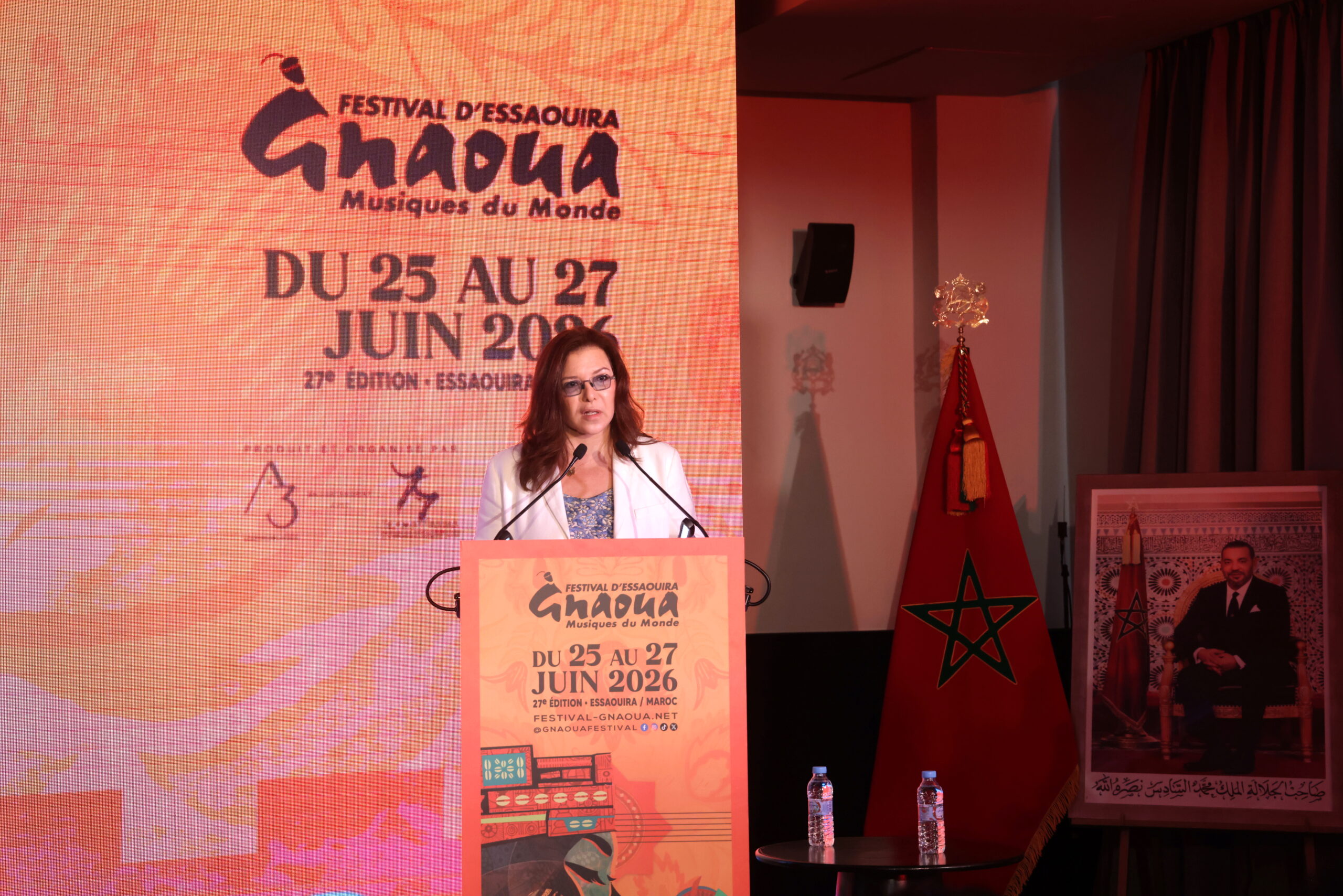
Before journalists, Neila Tazi refuses shortcuts. She does not present a simple festival, but a patiently constructed endeavour that has ultimately outgrown its original framework. The Gnaoua and World Music Festival of Essaouira, expected to take place from 25 to 27 June, thus comes forward with an intact promise and an ambition that continues to expand.
She begins by opening onto what she considers to be the matrix of the project, far beyond music itself. “Essaouira is a city conceived for openness. From its founding in the 18th century, it established itself as a port city oriented towards the world, organised to welcome exchanges and allow the circulation of people, goods, and ideas,” she explains. She goes on to recall that this port city was built at the crossroads of commercial, spiritual, and human routes, with a constant historical trait: welcoming, connecting, and transforming.
She then immediately situates Gnaoua within this genealogy. “Gnaoua culture carries this memory. Born of histories of displacement and resistance, it turned cultural mixing into a creative force. It reminds us that living cultures are born of dialogue,” she says. The festival would thus be only the contemporary form of a much older movement.
It is within this continuity that she turns to the festival’s architecture. “This festival rests on two essential pillars. The first is that it is deeply Moroccan — a made‑in‑Morocco festival, created by Moroccans for Moroccans — which has nonetheless won hearts across the international stage,” she explains. A way of embracing a constitutive tension between rootedness and circulation.
Essaouira connects the world
Neila Tazi then insists on what prevents any reduction of the festival to a simple musical event. “This festival is highly original. It is deeply Moroccan while at the same time open to the world. Free access is maintained, the welcome is warm, and it remains open to all audiences — the original spirit is intact,” she explains. Continuity here becomes a guiding line, almost a discipline.
The second pillar further broadens the scope. “The Essaouira Festival represents a constant commitment of nearly three decades to a genuine cultural project — a vision, a structuring endeavour,” she continues. Music shifts here towards something else: a space where transmission, training, and reflection come together.
From this, Neila Tazi draws a formula she fully embraces. “We are an intangible cultural infrastructure,” she affirms. The expression speaks as much to duration as to transformation — a way of inscribing the festival within a logic that far exceeds the event calendar.
This logic is embodied in a programme conceived as a space for encounters and frictions. This year, the festival brings together artists from territories shaped by maritime circulations and port dynamics. From Lebanon to Cameroon, from the United States to India, from Palestine to Ethiopia, these spaces share a memory of crossings. Their music bears the traces of these journeys, marked by hybridisation, improvisation, and constant reinvention.
Conceived as a field of dialogue, the programme makes fusion an active principle rather than a stylistic effect. Traditions confront contemporary forms through artistic trajectories that seek less to merge than to be transformed through contact with others. Essaouira thus becomes a point of convergence where musical languages move without disappearing.
“We want to offer the public unique moments, exceptional moments,” explains Neila Tazi. She specifies that these moments also concern the artists themselves, confronted with the power of the maâlems and the grammar of the guembri, which often reshapes their own relationship to creation. The festival then acts as a space of transition.
This dynamic is concretely reflected in a programme that brings together more than 400 artists and around forty Gnaoua maâlems. Original creations, unexpected crossovers, and tributes structure an ensemble where the stage becomes both a place of experimentation and of memory.
One of the highlights of this edition will be dedicated to Mustapha Baqbou, who passed away last year. A major figure of the group Jil Jilala, he left a lasting mark on several generations of musicians. His legacy will be carried on stage by several maâlems brought together to extend his memory through a collective act of transmission.
But the festival is not limited to the stage. It also unfolds within spaces of reflection and training. The Human Rights Forum, created in 2012, will bring together researchers, artists, and thinkers around the theme “Youth of the World: Freedom, Identity, Future.” The objective is to open a space for debate anchored in contemporary realities and informed by multiple perspectives.
In addition, the Berklee at the Gnaoua Festival programme offers an intensive learning framework bringing together musicians from Morocco, Africa, and beyond. Supervised by Berklee professors and established artists, it combines artistic rigour with collective practice, within a space where traditions meet contemporary forms of writing.
This dynamic is further extended through the Chair of Transitions, developed in partnership with Mohammed VI Polytechnic University (UM6P). It accompanies the festival in a structured reflection on cultural circulations and artistic hybridisations that underpin its logic.
From all these initiatives emerges a central idea that Neila Tazi summarises directly: “We defend a simple conviction — culture is structuring. It connects, it educates, it projects forward.” In her view, music is not merely presented; it acts.
Neila Tazi extends this idea by restoring the festival to its broadest dimension. “In Essaouira, music is not merely celebrated. It is transmitted, thought through, and inscribed into the future,” she explains, adding an image that runs through the entire project: “Because a port is never an end point. It is always a point of departure.”
Indeed, Essaouira is no longer merely a backdrop or a setting. It becomes a space of circulation, where histories, memories, and artistic trajectories intersect — a city that extends its own founding logic: that of a place open to, traversed by, and transformed through movement.
Finally, she situates the festival within what it has become over time: an extended community, built as much on human continuity as on artistic continuity. Neila Tazi concludes by addressing a message of gratitude to the maâlems, the artists, public and private partners, local authorities — but above all to the inhabitants of Essaouira. “The Souiris keep this flame alive and sustain it,” she says.
A flame which, year after year, continues to transform music into a space of passage, and passage into a form of permanence.