Kingdom
Food Sovereignty: How Morocco Aims to Secure 80% of Its Cereal Needs by 2030
One million hectares will be dedicated to cereals and leguminous crops to ensure an annual production of over 80 million quintals (8 million metric tons). Additionally, 150,000 hectares of land will be irrigated, rain or shine. This is the plan.

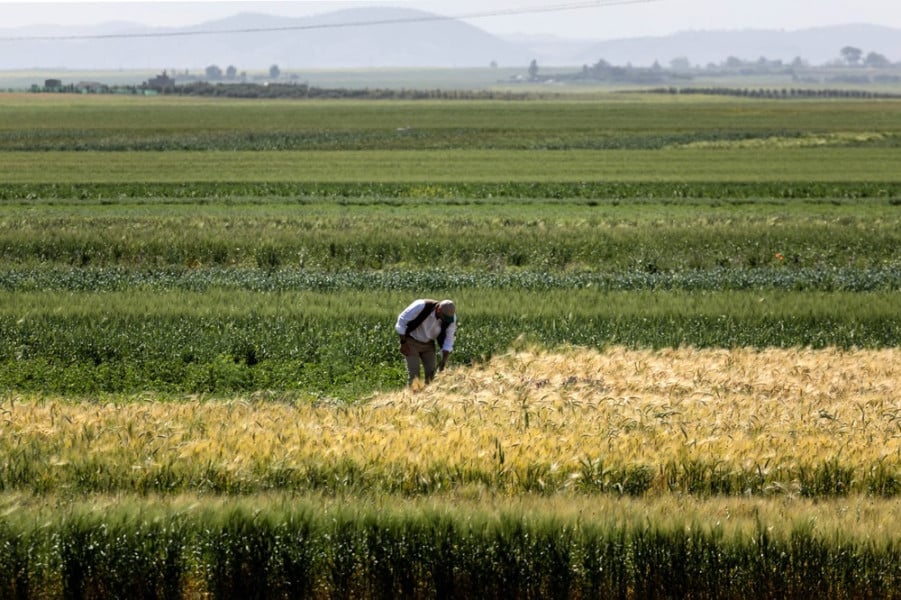
The Ministry of Agriculture is currently deploying a national strategy to secure a large portion of the country’s cereal and legume needs. According to Minister Ahmed El Bouari, the plan is ready and implementation is underway. The goal is to mobilize one million hectares of land, irrigated either fully or partially, exclusively reserved for cereals and legumes.
This will enable an annual production of approximately 80 million quintals (8 million metric tons). Recent statistics show Morocco consumes about 82 million quintals of soft wheat and nearly 5.5 million quintals of legumes annually. The ministry’s measures are straightforward and fall under a program contract signed with the agricultural sector, backed by a budget of 7.3 billion dirhams.
“We have a clear vision,” explained the minister during a radio program on Friday. “We aim to cultivate one million hectares of drought-resistant cereals to enable our country to produce 80 million quintals per year, rain or shine.” The plan, he stressed, seeks to decouple food sovereignty needs from the unpredictability of rainfall. “We will achieve this through supplemental irrigation,” the minister affirmed.
This involves providing additional water in rain-fed (‘bour’) zones when rainfall is delayed to salvage production. “It doesn’t require much—just 1,000 to 1,500 cubic meters per hectare—and we can do it. We’re already working on it.” The former Director of Irrigation and Agricultural Spatial Planning clarified: “Our work ensures agricultural water remains for agriculture, while drinking water is reserved for households, industry, and services.”
“Today, dam water is allocated to consumption,” a consequence of seven consecutive drought years. But the minister posed a question: “Is it reasonable for Casablanca, for instance, to consume water earmarked for agriculture in the Doukkala region?” He acknowledged, “Of course, drinking water takes priority—this is natural and legally mandated—but this deficit must be balanced. Even cities must reduce consumption to allocate a share to agriculture.” This, he admitted, is “another kettle of fish.”
In short, Morocco remains an agricultural nation, and water must be mobilized through all possible means. “We need an annual strategic water reserve. We have the means to secure it, and these means are obvious solutions,” he stated.
“We have a clear vision: every irrigated perimeter will have its own resources, and we will add desalination plants. We plan to allocate approximately one billion cubic meters of water to agriculture, irrigating 150,000 hectares, rain or shine,” the minister declared.
Desalination for Drinking Water
The government is now unanimously convinced that all coastal cities in Morocco must be supplied with drinking water via seawater desalination. This strategy is already in motion, with large-scale projects launched—some in the study phase, others nearing completion.
For example, Oujda, Berkane, Saïdia, Nador, and Driouch will be supplied by the new Nador plant, currently in development. Al Hoceima already has its own plant. Tangier will also have a desalination facility, and Rabat’s plant, whose construction contract was finalized during the French president’s visit to Morocco last October, is underway.
Casablanca’s desalination plant is slated to become operational by late next year or early 2027 at the latest. Meanwhile, the Safi and Jorf Lasfar plants, developed by OCP, already supply drinking water to cities in the Casablanca-Settat region and inland areas like Khouribga. Marrakech will receive 80 million cubic meters annually.
Agadir’s plant is operational and undergoing expansion. A new facility in Tiznit—set to be the nation’s largest, with 350 million cubic meters per year—is planned. Smaller plants in Tan-Tan, Guelmim, and Laâyoune cover local needs. A plant in Boujdour is in the works, and Dakhla’s facility will be finalized and inaugurated in the coming weeks.
Henceforth, dam water will be reserved for agriculture to balance needs with conventional and non-conventional water resources. Concurrently, the hydraulic basin interconnection project is advancing, with its first two phases already operational.