Business
Finance Bill 2026: The Government’s Four Key Priorities Unveiled
2026 Finance Bill (PLF): Centered on Four Core Pillars from the Royal Strategic Directives — Economic Advancement, Social & Regional Equity, Strengthening the Welfare State, and Structural Reforms.


The Finance Bill (PLF) for the 2026 fiscal year, in line with the Royal High Guidelines, establishes four major priorities that outline a new phase of development, according to the policy note accompanying the bill, addressed by the Head of Government to ministerial departments.
These priorities include consolidating the Kingdom’s emergence as a rising power, balancing economic development with social and spatial justice, reinforcing the foundations of the social state, accelerating major structural reforms, and safeguarding the equilibrium of public finances, the note elaborates.
The guidelines emphasize consolidating Morocco’s emergence by mobilizing all drivers of growth, investment, and reforms to enhance economic resilience and national competitiveness.
They also underscore His Majesty King Mohammed VI’s prioritization of spatial justice, aiming to reduce social and geographic disparities through balanced and inclusive development nationwide.
The policy note highlights that Morocco is embarking on a new transformational phase focused on promoting employment, strengthening essential social services, preserving water resources, and advancing integrated territorial development.
The 2026 Finance Bill (PLF) thus aims to consolidate Morocco’s economic emergence, in alignment with the Royal High Guidelines outlined in His Majesty King Mohammed VI’s speech marking the 26th anniversary of the Throne Day. This will be achieved through sustained investment momentum, strengthening the Kingdom’s global economic sectors, and advancing industrial capabilities to solidify Morocco’s position within global value chains.
Furthermore, the PLF 2026 reinforces the Royal vision centered on balancing economic development with social and spatial justice. It prioritizes the creation of a new generation of territorial development programs, grounded in leveraging local specificities, advancing regionalization policies, and fostering complementarity and solidarity among territorial entities.
In this context, the PLF 2026 places reducing social and geographic disparities at the core of its agenda. Key measures include promoting employment, enhancing access to essential social services, adopting proactive and sustainable water resource management models, and launching integrated territorial development projects.
Additionally, the government remains committed to strengthening the social role of the state through more targeted and effective action. This includes expanding direct aid programs, broadening social coverage, improving housing access, and boosting household purchasing power as central priorities.
The 2026 Finance Bill (PLF) therefore marks a clear shift toward targeted and effective impact in the implementation of public policies.
Furthermore, the PLF 2026 seeks to consolidate and accelerate structural reforms to bolster the socioeconomic momentum that strengthens Morocco’s standing among emerging nations.
The bill also reaffirms its alignment with the Kingdom’s ongoing reform agenda to modernize institutions and enhance governance efficiency. In 2026, public administration will continue its transformation, prioritizing streamlined procedures, digitalized services, and closer citizen engagement. A core goal is to make regions more attractive by improving access to public services.
The government further commits to maintaining macroeconomic stability to support sustainable growth, manage public debt, and safeguard household purchasing power.
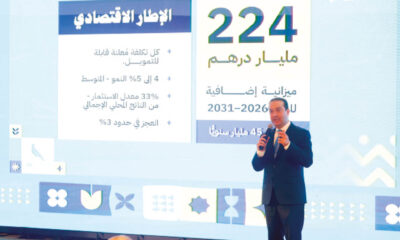
Under these priorities, Morocco aims to achieve a growth rate of approximately 4.5% in 2026, reduce the budget deficit to 3% of GDP, and cap public debt at 65.8% of GDP by the same year.