Kingdom
Desalination: Morocco’s Next Industrial Battle
Membranes, piping, high‑pressure pumps, energy recovery devices, sensors… Behind every desalination plant lies a complex industrial chain still dominated by a handful of international giants. As the Kingdom accelerates its investments, the stakes now go beyond water security alone—they are becoming decisively industrial.

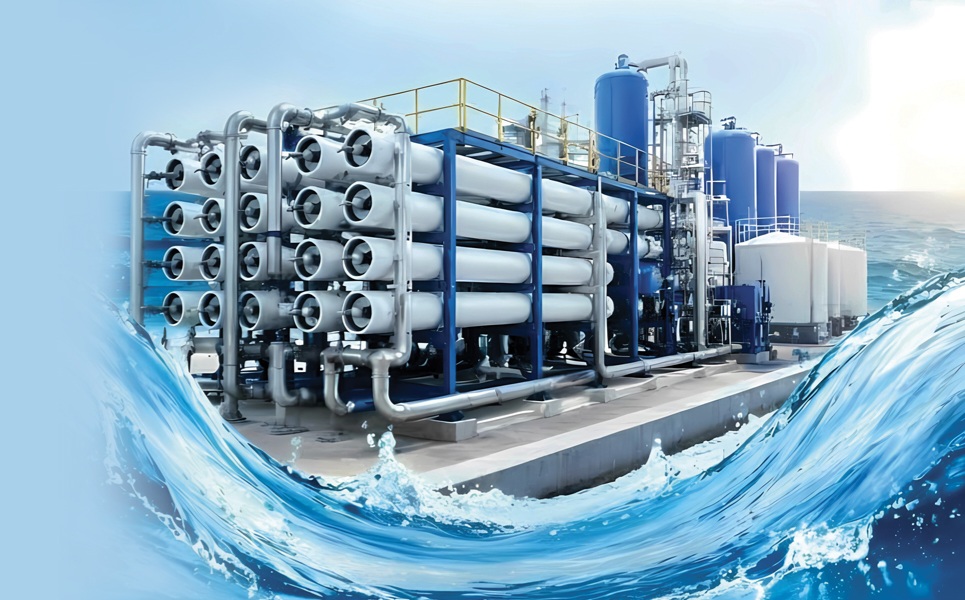
Just a few cables’ lengths from the coastline, vast infrastructures are taking shape. Amid giant pipelines, treatment basins, and industrial installations, desalination is now establishing itself as a cornerstone of Morocco’s water strategy. In these next-generation plants, seawater will be transformed into a vital resource.
But behind this technological feat lies a less visible reality: most of the equipment that makes this “miracle” possible is imported.
Membranes, pumps, filtration systems… the majority of components come from abroad. Driven by climate pressure and urbanisation in arid regions, the global desalination market is experiencing exponential growth.
Today, global capacity exceeds 100 million m³ of water per day. Valued between $18.2 and $41.5 billion in 2024, the industry could reach $73.6 billion by 2030, rising to $109.4 billion by 2034.
Reverse osmosis, which is less energy-intensive, dominates the sector. This process filters seawater through semi-permeable membranes with pores measuring just a few nanometres, retaining salt and impurities before remineralising the water. With average consumption of 2.5 to 3 kWh per m³, it is used in more than 70% of the world’s 22,000 plants.
These membranes, which form the technological core of desalination plants, remain concentrated among a few industrial giants such as DuPont, Toray Industries, and LG Chem.
A dependency to turn into opportunity
As Morocco embarks on a major desalination programme to secure its supply, could it replicate the industrial success seen in automotive and aerospace, and turn this dependency into an industrial opportunity? In any case, the Kingdom has concrete assets to make this shift.
Even without producing membranes, more than half of the value of a plant can be captured locally through civil engineering, metal structures, industrial modules, and pre-treatment systems. It is precisely in these segments that the real window of opportunity lies today.
Several local players have already begun this transition. OCP Green Water (OGW), a subsidiary of the OCP Group, is developing desalination units for its mining sites and for urban supply in Safi, El Jadida, and Casablanca, with a local integration rate of 60–70%.
The objective is to produce 630 million m³ of desalinated water per year by 2030, relying on R&D conducted with InnovX and UM6P to manufacture certain key components.
Other major players include Green of Africa and Afriquia Gaz, in consortium with the Spanish group Acciona for the construction of the Casablanca desalination plant, as well as Nareva which, together with Engie, is developing the Dakhla desalination plant.
This nearly 2 billion dirham project, with an annual capacity of 37 million m³, will be entirely powered by a 60 MW wind farm, illustrating the rise of low-carbon desalination plants in the Kingdom. These two megaprojects will encourage technology transfer and enable Moroccan groups to master the desalination value chain.
Watec, founded in 1987, also operates across the full desalination cycle. Over the past three years, it has deployed more than 100 stations (small, medium, and large), with a total annual capacity of 40 million m³ across the Kingdom, focusing on speed, energy efficiency, and sustainability. Its integration rate ranges between 40% and 60%, the remainder consisting of high-tech equipment not produced locally.
Civil engineering as a strategic lever
Atlas Énergie (Atner), specialising in hydraulic engineering, is also part of this landscape.
In partnership with Capep, it won in November 2023 a 374 million dirham contract to connect the future Casablanca mega-desalination plant to the urban network.
Among its references is also the Sidi Ifni desalination plant, with a capacity of 8,640 m³ per day extendable to 17,280 m³ per day, for around 320 million dirhams.
Moroccan construction leaders have also become major players in recent years in building civil engineering works and marine infrastructure linked to desalination projects, which represent 30–40% of total construction costs (Capex).
For example, Société Générale des Travaux du Maroc (SGTM) builds subsea tunnels and pipelines to transport desalinated water to consumption centres. It was also among the candidates for the Casablanca megaproject, in consortium with Somagec, IDE Technologies, and Mitsui.
Previously, the group led by Hamza Kabbaj, in partnership with Somagec, secured the construction of the Dakhla Atlantic port, which is directly linked to desalination, as the desalinated water from the Nareva/Engie plant will pass through this megaport’s infrastructure to supply the city.
SGTM also actively contributed to the complex civil engineering works required for reverse osmosis and seawater intake during the construction of the Chtouka-Aït Baha plant in Agadir. With a capacity of 275,000 m³/day, extendable to 400,000 m³/day, the plant has been operational since February 2022.
Similarly, Somagec stands out. The company, led by Roger Sahyoun, is a key player in building essential infrastructure for desalination projects, including marine works (intakes, discharge), plant civil engineering, and complex coastal works.
The ripple effect of large projects
While these national champions excel in civil engineering, others such as Jacobs Engineering (JESA) operate upstream in engineering and design (10–15% of Capex).
As the main contractor for OCP’s desalination projects, JESA handles the sizing and engineering of desalination units and their integration into industrial ecosystems, notably in Jorf Lasfar and Safi.
This crucial positioning could foster the development of local expertise in complex engineering within this sector. More broadly, it could position Morocco as a regional hub for desalination engineering in Africa.
TGCC, Jet Contractors, Maghreb Steel, and Sonasid complete this industrial network, covering construction, metallurgy, and assembly of industrial modules.
Together, these companies could form the backbone of a Moroccan desalination ecosystem capable of capturing 40–60% of the value of a plant. As for membrane production—the industrial core of desalination, controlled by a global oligopoly—the most realistic strategy is to attract manufacturers through industrial partnerships or assembly units.
Morocco has already commissioned 17 plants with a total capacity of 350 million m³ per year and is currently developing four new units in El Jadida and Safi, which will produce 567 million m³ at full capacity. Eleven additional projects are planned in Tangier, Rabat, Essaouira, Guelmim, Souss-Massa, and the Oriental region. The goal: 1.7 billion m³ by 2030, covering 60% of national needs.
This scale effect attracts suppliers and subcontractors, enabling the structuring of an industrial ecosystem of specialised subcontractors in metallurgy, engineering, assembly, training, and R&D—similar to the automotive sector fifteen years ago.
After automotive and aerospace, desalination could well become the next field of expression for Morocco’s industrial strategy, at the intersection of water, energy, and technological challenges. In the pipelines of desalination plants, a new industry may already be beginning to flow.
Global membrane giants
The reverse osmosis membrane market remains dominated by a very small group of industrial players with strong R&D capabilities. The American company DuPont is among the global leaders, alongside Japan’s Toray Industries, a pioneer in the sector.
South Korea’s LG Chem has also emerged in recent years as a major player. The market also includes specialists such as Hydranautics, a subsidiary of Japan’s Nitto Denko, and Suez Water Technologies & Solutions, originally a French entity now integrated into the Veolia group.
This high concentration reflects the technological complexity of these membranes, whose production requires advanced chemical processes and heavy R&D investments, creating particularly high barriers to entry.
Low-carbon desalination: Morocco’s competitive advantage
In the global desalination industry, competition now hinges on four key levers: reducing energy consumption, lowering the cost per cubic metre, integrating renewable energy, and technological innovation—particularly in membranes.
In this area, Morocco has significant advantages. Future plants in Casablanca, Dakhla, and Rabat already incorporate solar and wind power, reducing production costs while limiting carbon footprint.
Beyond this, coupling with future green hydrogen sectors—highly dependent on purified water for electrolysis—strengthens Morocco’s position in the global value chain of green industries. This dynamic paves the way for exportable low-carbon models, particularly towards Africa and Europe.